By DERBAL Hospitality Sourcing Team | Guestroom Equipment, Hospitality Procurement & Quality Control | November 26, 2026
A luggage rack is rarely the most expensive item on a hotel opening procurement list. Yet it is one of the first pieces of equipment many guests use after checking in. A guest arrives after a long international flight, opens a large suitcase and places it on the rack. The straps stretch, the frame moves slightly, and the suitcase leans toward the wall. The guest will simply decide whether it feels reliable.
A luggage rack needs to support luggage, protect surrounding furniture, fit within the guestroom and remain practical for housekeeping. A commercial hotel luggage rack should be specified as a complete load-bearing assembly, including its frame, straps, joints, folding mechanism, floor contact points and operating dimensions.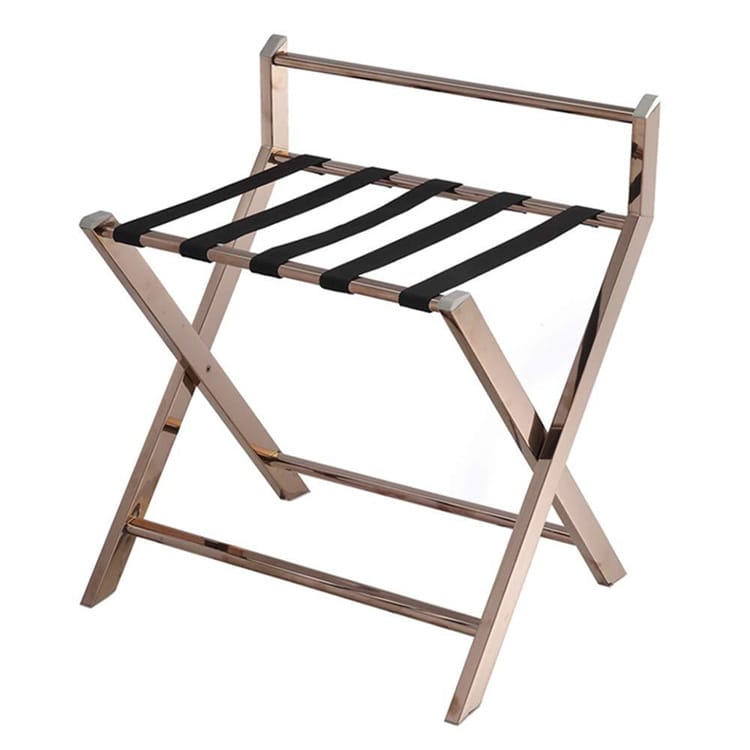
DERBAL TECHNOLOGY CO., LTD supports hotels and resorts with China-based OS&E and FF&E sourcing, customization, supplier evaluation, sample coordination, quality inspection and international logistics. Explore our hotel luggage rack range and use this guide to develop your procurement specification.
Key Takeaways
- Advertised load capacity should be supported by a defined test method.
- Strap material, attachment and spacing influence luggage support.
- Static testing alone does not establish long-term durability.
- Check open and folded dimensions against actual guestroom layouts.
- Coastal resorts should examine hidden hardware as well as frames.
- Approved replacement parts can simplify maintenance.
- Use the approved production sample as the reference for bulk inspection.
Table of Contents
- Purchasing specifications
- Load capacity
- Strap construction
- Frame inspection
- Folding mechanisms
- Guestroom space planning
- Regional requirements
- Replacement and lifecycle cost
- Factory quality control
- Packaging
- RFQ checklist
- FAQ
1. The Problem With Purchasing Luggage Racks by Appearance Alone
When a hotel purchases 200 or 300 luggage racks, the quotation typically includes dimensions, material, color, quantity and unit price. Some suppliers also provide a maximum load figure. What is often missing is an explanation of how that figure was established.
Was the load distributed evenly across the straps? Was the rack tested on a level surface? Was the load applied gradually? Was the product inspected afterward for deformation or damage? Without this information, comparing two load ratings can be misleading. A rack described as supporting 80 kg is not automatically better than one described as supporting 60 kg if the figures were established under different conditions.
Establish the intended use first
A luxury island resort receiving international leisure travelers may regularly accommodate large suitcases and equipment bags. An urban business hotel may see more compact cabin luggage, although larger suitcases must still be considered. Family resorts may require additional luggage support in selected room categories. Purchasing managers should understand the guest profile, room layout and expected luggage characteristics.
DERBAL’s existing Hotel Luggage Rack Buyer’s Guide 2026 provides complementary background on material selection. The next step is to turn those choices into measurable acceptance requirements.
2. Understanding Hotel Luggage Rack Load Capacity
Load capacity is an engineering characteristic of the complete product. The strength of an individual strap or metal tube does not establish the capacity of the assembled rack.
Static load capacity
A static load test evaluates the product under a defined stationary load. The manufacturer and purchasing team should agree on load distribution, application method, duration and acceptance criteria. After testing, examine relevant damage, permanent deformation, loosened connections and changes in function.
Uneven and repeated loading
Suitcases do not always distribute their weight evenly. A large suitcase may extend beyond the center of the rack, or a smaller bag may concentrate weight over only part of the supporting surface. Consider representative luggage placement within approved operating conditions. A successful one-time static load test does not demonstrate resistance to repeated loading, unloading, folding and unfolding. Agree on an appropriate repeated-use test with the manufacturer or qualified laboratory.
| Evaluation | Purpose |
|---|---|
| Static load | Structural performance under a defined stationary load |
| Uneven load | Stability under representative luggage placement |
| Repeated loading | Performance after repeated use |
| Folding cycles | Wear and function of moving joints |
| Post-test inspection | Deformation, looseness and visible damage |
These are proposed evaluation categories, not claims of completed DERBAL product tests. A supplier should identify the tested model, construction, conditions and result. A generic report for another rack is not sufficient evidence for a customized model.
3. Luggage Rack Straps: The Component That Deserves More Attention
Straps are the direct interface between the suitcase and the frame. They influence how luggage sits, how its weight is distributed and how much movement occurs during use.
Polyester, nylon and blended webbing
Polyester is worth evaluating where dimensional consistency, abrasion resistance and moisture-related characteristics matter. Nylon can offer useful strength and abrasion-related properties, but buyers should consider elongation and moisture exposure. Cotton or blended straps may suit particular interior designs. Actual performance depends on yarn, weave, width, thickness and attachment design.
| Material | Procurement consideration |
|---|---|
| Polyester | Elongation, abrasion and attachment strength |
| Nylon | Strength, stretch and moisture behavior |
| Cotton blends | Dimensional stability, cleaning and durability |
| Custom webbing | Repeat-order consistency and performance |
Width, spacing and attachment
A wider strap may provide a larger contact surface, but width alone does not establish strength. A small suitcase should not sit awkwardly between widely spaced straps. Test representative luggage sizes on the sample. Straps may be sewn, mechanically fastened or attached through another manufacturer-specific construction. Inspect stitching, fasteners, edge protection and contact points that could contribute to wear. Strong webbing is of limited value if its attachment is poorly designed.
4. Wooden and Metal Frames Require Different Inspection Priorities
Wooden luggage racks
Wooden frames are frequently selected for villas, boutique hotels and guestrooms with natural interior finishes. Examine timber specification, joint construction, surface finish and dimensional consistency. For humid environments, request intended moisture conditions and maintenance requirements. Inspect splitting, poorly finished edges, loose joints and unacceptable finish variation. A mahogany-colored finish does not necessarily mean mahogany timber.
Metal luggage racks
A polished finish can conceal important differences in underlying material or hardware. Ask for frame material, tube dimensions, wall thickness where relevant, surface treatment and connection method. Pay particular attention to folding pivots and areas where coatings experience repeated contact.
| Inspection area | Wood | Metal |
|---|---|---|
| Material | Species and construction | Metal type and tube specification |
| Connections | Joinery and fasteners | Welds, pivots and fasteners |
| Finish | Stain and coating | Plating or powder coating |
| Moisture | Dimensional stability | Corrosion protection |
| Moving parts | Joint wear | Pivot and hardware wear |
5. Folding Mechanisms and Stability
A folding luggage rack is convenient because it can be stored when not required. That convenience introduces moving joints into a product that must remain stable when opened. The sample should open consistently into its intended operating position. Where the design incorporates stops, restraints or locking components, inspect their operation.
A folded rack should fit its designated storage location without damaging surrounding furniture. Protruding hardware, sharp edges or uncontrolled movement can create handling problems. Housekeeping staff should be able to move and store the rack according to manufacturer instructions. Inspect protective feet and evaluate compatibility with polished stone, timber, tile or carpet. Missing or damaged protectors should be addressed before returning the rack to guest service.
6. Guestroom Space Planning: Measure the Suitcase, Not Just the Rack
A luggage rack can fit neatly into an architectural drawing and still become inconvenient when a guest places an open suitcase on it. The usable area must account for the luggage itself. Establish open width, open depth, luggage support height and overall height including any rear guard. Record folded dimensions separately.
A raised rear guard can help separate luggage from the wall or surrounding furniture. Its usefulness depends on suitcase geometry, guard height and rack placement. It may also increase overall folded or open dimensions. Evaluate the feature using the actual guestroom layout. For new hotels, coordinate rack positioning with the wider hotel opening procurement and room setup process.
7. Procurement for Maldives, Fiji and GCC Hotels
Maldives: hidden hardware
In humid coastal environments, wooden or aluminum frames may still contain metal screws, pivots and brackets with different corrosion characteristics. Identify relevant hardware and protective finishes. Support corrosion-resistant descriptions with material information and appropriate testing where required.
Fiji: practical replacement
For remote resorts, replacing a small damaged component can become inconvenient if unavailable locally. Confirm whether straps, protective feet and serviceable hardware can be purchased separately. Retain approved specifications.
UAE and Saudi Arabia: interior design coordination
Large hospitality developments may specify different furniture finishes across room categories. Match the approved design without unnecessary structural variations. Where practical, evaluate whether decorative finishes can share an approved underlying construction.
8. Replacement Straps and the True Cost of a Luggage Rack
A worn strap should not automatically mean discarding an otherwise usable frame. Repairability depends on the original design and manufacturer-approved maintenance procedure. Retain strap material, width, length, attachment method, pivot references, protective feet, fasteners and finish details. A visually similar strap does not establish equivalent structural performance.
Illustrative lifecycle comparison
| Cost item | Option A | Option B |
|---|---|---|
| Price per rack | $24 | $29 |
| Quantity | 200 | 200 |
| Initial purchase | $4,800 | $5,800 |
| Assumed units requiring attention | 60 | 60 |
| Remedy | Complete replacement | Approved strap repair |
| Cost per remedy | $24 | $6 |
| Modeled maintenance | $1,440 | $360 |
| Combined cost | $6,240 | $6,160 |
Prices and failure assumptions are illustrative, not DERBAL quotations or measured failure rates. The model excludes freight, taxes and downtime. It demonstrates why serviceability should be considered before selecting a product.
9. Factory Quality Control Before Bulk Shipment
The approved sample should define construction, dimensions, materials and functional requirements. Any proposed production changes should be submitted for approval. A different strap supplier, thinner tube section or altered folding joint could affect performance.
| Inspection item | Verification |
|---|---|
| Open and folded dimensions | Approved drawings and storage envelope |
| Frame material and finish | Approved specification and physical sample |
| Straps | Material, width and attachment |
| Folding function | Consistent operation |
| Stability and load | Agreed evaluation and test evidence |
| Floor protectors | Correct fit and attachment |
| Rear guard | Geometry and workmanship |
| Packaging | Protection and correct SKU labels |
Separate destructive testing from routine inspection. Structural tests that damage samples should be conducted on designated units under an agreed procedure. Routine production inspection is not equivalent to independent structural certification. For further research into applicable furniture and material testing methods, consult the ISO standards database and ASTM International. Select the applicable methods with a qualified laboratory; these references do not establish product certification.
10. Packaging: Protect the Finish Before the Rack Reaches the Hotel
Luggage racks are relatively compact when folded, making consolidated shipping attractive. However, repeated contact between folded frames during transportation can damage decorative surfaces. Wooden racks may require protection against abrasion and moisture exposure. Metal racks may need separation between plated or coated components. Specify protective materials, carton dimensions, orientation and handling requirements. Carton labels should clearly identify the model and room category.
11. Hotel Luggage Rack RFQ Checklist
| RFQ parameter | Information required |
|---|---|
| Property and destination | Hotel type and final delivery location |
| Quantity | Initial order and reserve |
| Frame and finish | Approved material and physical color reference |
| Dimensions | Open and folded envelope |
| Load requirement | Defined performance and test conditions |
| Straps | Material, construction and attachment |
| Rear guard | Required or not required |
| Flooring | Stone, tile, timber or carpet |
| Folding mechanism | Functional requirements |
| Spare parts | Approved replacement components |
| Sample and QC | Functional evaluation and acceptance criteria |
| Packaging | Export protection and labels |
| Commercial terms | MOQ, lead time, warranty and Incoterm |
For replacement projects, photographs of existing racks and damaged components can help suppliers identify which aspects of the original design need improvement.
Frequently Asked Questions
What load capacity should a commercial hotel luggage rack have?
Establish the expected luggage load and request a manufacturer-supported rating for the complete rack, including frame, straps and joints.
How many straps should a hotel luggage rack have?
The appropriate number depends on width, spacing, geometry and load requirements. Strap count alone does not establish structural capacity.
Can hotel luggage rack straps be replaced?
Yes, if the rack is designed for approved strap replacement. Confirm the component and repair procedure with the manufacturer.
Is a wooden luggage rack suitable for a Maldives resort?
It can be suitable when timber, finish, joints and hardware are appropriate for the intended indoor environment.
Does a hotel luggage rack need a backrest?
Not every rack requires one. A raised rear guard can help protect nearby walls, subject to room layout and suitcase dimensions.
Can one model be used across all room categories?
Yes, provided its dimensions, appearance and operating characteristics suit each category.
What is the difference between load and durability testing?
A load test evaluates defined loading conditions. A durability test evaluates repeated use or other specified exposure. One does not establish the other.
Can DERBAL customize hotel luggage racks?
DERBAL coordinates customized hospitality equipment sourcing, materials, dimensions, finishes, samples and inspection. Options depend on the selected design.
Related Reading and Procurement Resources
Explore DERBAL’s wooden versus metal luggage rack buying guide for general material selection and our hotel and resort product portfolio for wider guestroom procurement.
Conclusion: Specify the Luggage Rack for Years of Use, Not Just Opening Day
The frame must support the intended load. The straps must work with the luggage being placed on them. The folding mechanism must remain practical, the finish must suit the room, and the product must fit both operating and storage locations. These requirements are easier to evaluate before bulk production than after hundreds of units have arrived. Select a product whose construction, performance and maintenance requirements are understood.
Request a Customized Hotel Guestroom Equipment Proposal
Share your room quantities, interior finishes, preferred frame material, dimensions, load requirements and delivery destination with DERBAL. Our China-based sourcing team can coordinate supplier comparisons, OEM/ODM customization, sample development, quality inspection, warehousing and consolidated international shipping.
DERBAL TECHNOLOGY CO., LTD
One-Stop Hotel & Resort Supply Partner
Based in China, Serving the Globe
Help Hotels Purchase Better.