Resort wooden ceiling fans are not decorative afterthoughts — they are the difference between a guest who sleeps deeply and one who leaves a one-star review about a clicking noise at 3 AM. For procurement managers and resort operators, specifying the right ceiling fan means understanding the engineering beneath the blades: motor technology, blade material, corrosion resistance, and energy efficiency. Here is how to evaluate each factor with confidence.
Upgrading ceiling fans across your resort portfolio?
DERBAL supplies resort wooden ceiling fans to luxury properties across the Maldives, Seychelles, and the Middle East — with ultra-silent DC motors, solid paulownia wood blades, and marine-grade anti-corrosion protection.
→ Request a Quote for Your Property
Why Silent Resort Wooden Ceiling Fans Define Luxury Stays

When a guest pays $800 to $2,000 per night for an overwater villa or beachfront suite, they expect one thing above all: uninterrupted sleep. Noise is consistently the top driver of negative room experience reviews in tropical resort destinations — ahead of Wi-Fi reliability, water pressure, and air conditioning performance — according to hospitality industry guest satisfaction data.
Standard retail ceiling fans introduce two problems in high-end settings. First, alternating current (AC) motors emit a low-frequency hum that becomes intrusive in the silence of a luxury suite. Second, pressed-wood MDF blades absorb moisture in coastal environments and warp over time, throwing the fan off balance and creating an audible ticking rhythm. The guest’s response is not to call maintenance — it is to open their phone and post a review.
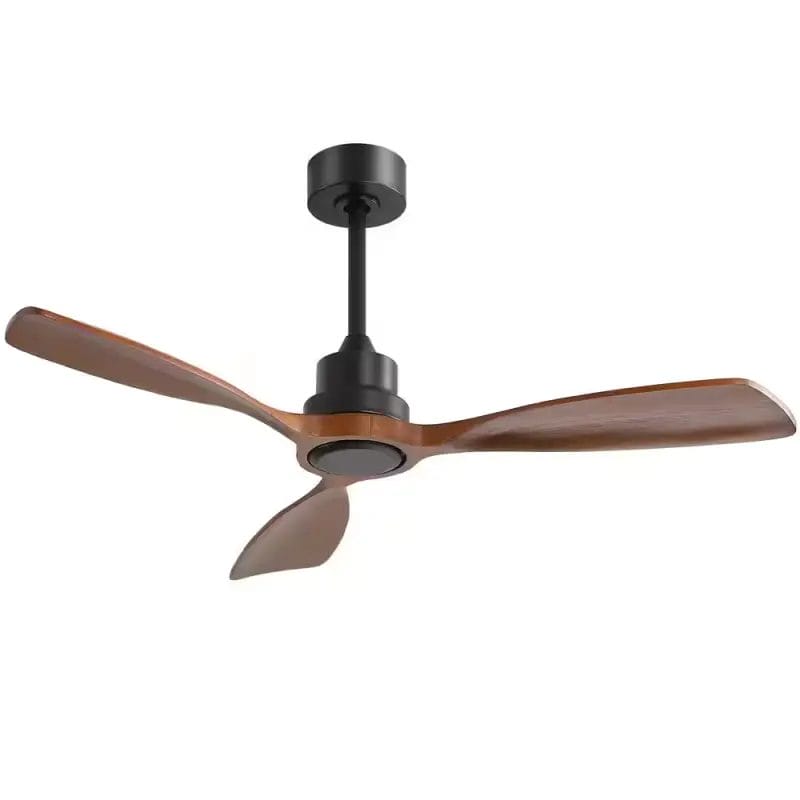
A properly specified resort wooden ceiling fan eliminates both issues — it should be felt as a breeze, never heard as a machine. This distinction separates commercial-grade units from residential products dressed up to look the part.
The Engineering Behind a Silent Resort Wooden Ceiling Fan
What makes a ceiling fan truly silent for luxury hospitality comes down to three engineering decisions.
Brushless DC Motor: The Core of Silent Operation
The motor is the single most important component in any resort wooden ceiling fan. Brushless DC motors operate without physical friction from carbon brushes — meaning no sparking, no brush wear, and critically, no humming transmitted through the mounting bracket into the ceiling structure.
DERBAL’s commercial wooden ceiling fans use pure copper winding DC motors that run below 28 decibels at maximum speed — for context, a whisper is approximately 30 dB. At lower speed settings, the fan is effectively inaudible. Pure copper windings also run cooler and last longer than aluminum alternatives, a critical advantage in tropical properties where fans run 18 to 24 hours daily.
Solid Paulownia Wood vs. MDF: Why Blade Material Matters
Many ceiling fans marketed as “wooden” use medium-density fiberboard (MDF) wrapped in a wood-grain laminate. In resort environments — open-air pavilions or beachfront restaurants with 80%+ humidity — MDF blades absorb moisture within months, swell, lose their aerodynamic profile, and cause the fan assembly to shake and click.
Solid paulownia wood, by contrast, has a naturally low density that resists moisture absorption. Each blade is hand-carved from a single piece of timber, maintaining identical weight distribution across the full span — keeping the fan perfectly balanced through seasonal humidity swings from the dry Middle East to monsoon-season Southeast Asia.
DERBAL Commercial Ceiling Fans for Resort Properties
Engineered for coastal environments, silent operation, and continuous duty cycles. Available in 48-inch and 52-inch blade spans with custom finishes.
→ Request Pricing & Lead Times
Marine-Grade Protection for Coastal Resort Environments

Salt spray is the silent killer of resort fixtures. Properties within 500 meters of the ocean experience airborne salt that accelerates metal corrosion three to five times faster than inland installations — standard powder-coated steel fan housings can show visible rust within a single season.
A commercial-grade resort wooden ceiling fan must include multi-layer anti-corrosion protection on all metal components. DERBAL’s models undergo electroplating followed by an anti-oxidation powder coat — a two-stage process that seals metal surfaces against salt-spray penetration across the downrod, canopy, motor casing, and internal hardware.
For resorts in the Maldives, Seychelles, and Caribbean markets — where open-air architecture is standard — this protection level determines whether ceiling fans are replaced every two years or last the full renovation cycle.
Energy Savings and Procurement Checklist

For off-grid island resorts, resort wooden ceiling fans with DC motors cut electricity consumption by up to 70% versus AC equivalents — a meaningful operational saving across a 200-villa portfolio running fans 18 hours daily.
Six Specifications to Verify Before Ordering
Motor type: Brushless DC with pure copper windings — not AC or aluminum-core.
Blade material: Solid paulownia wood, not MDF or laminate-wrapped composite.
Noise rating: Below 30 dB at max speed, with documented test results.
Blade span: 48 inches for standard guest rooms, 52 inches for suites and villa interiors.
Voltage range: 110V–240V smart-adaptive for regions with unstable grid power.
Corrosion treatment: Electroplating plus powder coat on all metal surfaces — verify salt-spray test certification.
“A commercial wooden ceiling fan should be felt, not heard — this is the single most important specification for any resort wooden ceiling fan procurement decision.”
— DERBAL Engineering Team
Frequently Asked Questions
Q: What makes a ceiling fan suitable for resort use versus home use?
A: Three factors differentiate commercial resort wooden ceiling fans from residential models: brushless DC motors for silent 24/7 operation, solid wood blades that resist humidity warping, and marine-grade corrosion protection on all metal components.
Q: How quiet should a luxury resort ceiling fan be?
A: A properly specified resort wooden ceiling fan should operate below 30 decibels at maximum speed — quieter than a whisper. At lower speeds, it should be effectively silent. Any audible hum or click signals a mechanical issue.
Q: Why choose solid wood blades over metal or plastic alternatives?
A: Solid wood — specifically paulownia — combines lightweight construction, natural moisture resistance, and aesthetic warmth. Metal blades feel clinical in luxury interiors; plastic blades lack the durability required for commercial hospitality.
Q: Can these ceiling fans operate continuously in tropical humidity?
A: Yes. DERBAL’s resort wooden ceiling fans are built with solid paulownia wood blades and multi-layer electroplated metal housings engineered for 24/7 operation in beachfront pavilions, overwater villas, and semi-outdoor restaurants.
Q: What blade size do I need for standard hotel guest rooms?
A: A 48-inch blade span fits standard luxury guest rooms of 30 to 45 square meters. For larger suites, open-plan villas, or semi-outdoor dining areas, a 52-inch span provides better air distribution without added motor noise.
Q: Do DERBAL wooden ceiling fans support custom finishes for brand consistency?
A: Yes. DERBAL’s wooden ceiling fans offer custom wood stains, matte or gloss housing finishes, and tailored packaging to match major flag specifications — including Marriott, Anantara, and Hilton. Contact our team for a custom quotation.
Ready to Specify Silent Ceiling Fans for Your Resort? DERBAL works with procurement managers, purchasing directors, and resort operators
across the Maldives, Seychelles, Middle East, and Southeast Asia.
Send us your spec — we’ll respond with pricing, MOQ, and lead times within 24 hours. → Get a Custom Quote Browse All Products