Hotel Wine Cooler Fridge Buying Guide for Bars, Lounges & Resorts
A hotel wine cooler fridge is no longer a back-of-house afterthought — it is a front-line revenue tool. Guests remember a perfectly chilled glass of Chardonnay at a rooftop bar, and they notice when the Cabernet arrives warm. For procurement teams, the right unit protects both the wine and the margin: stable temperature, blocked UV, controlled humidity, and near-silent operation that never disturbs a sleeping suite. This guide breaks down the two cooling technologies DERBAL supplies, the specs that actually matter for hospitality, and where each model belongs in your property.

Why a Dedicated Hotel Wine Cooler Fridge Beats a Kitchen Refrigerator
A standard kitchen fridge swings 10–15°F every time the door opens, runs loud, and baths bottles in light. A purpose-built hotel wine cooler fridge holds a tight band — often within ±0.5°C — and shields labels from UV that quietly cooks the tannins. Humidity control stops corks from drying and letting oxygen in. For a property selling $80 glasses, those details are the difference between a repeat order and a bad review.
Two Cooling Technologies for Hospitality
Thermoelectric Models (8-Bottle Class)
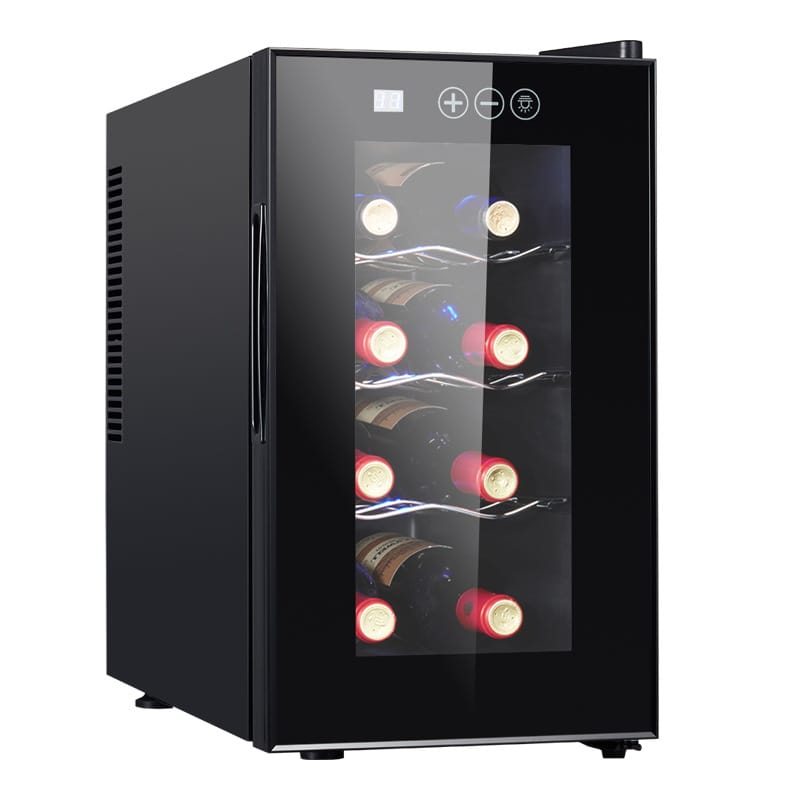
The 8-bottle thermoelectric unit is the entry point for boutique bars and in-suite minibars. It uses a solid-state cooling chip instead of a compressor, which means zero vibration (no sediment disturbance) and very low noise. Specs: 46–66°F range, 23 L capacity, single temperature zone, three adjustable metal shelves, LED interior light, and a double mirrored glass door that blocks UV. It is freestanding and sits on any countertop. Because it has no compressor, it is the quietest option — ideal for guest rooms where a hum is unacceptable.
Compressor Models (JC-48AW, 48 L)

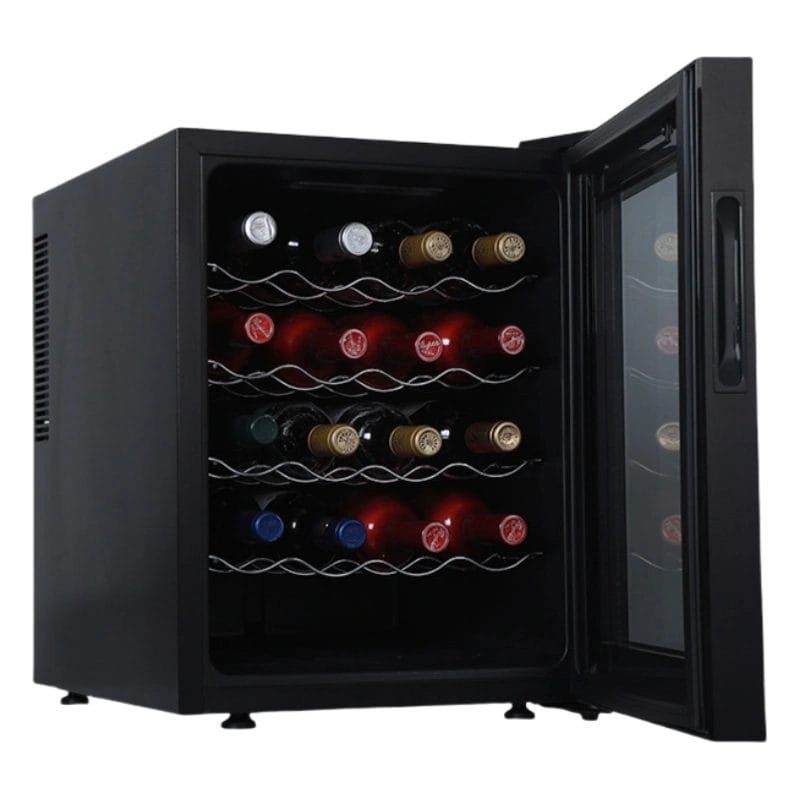
For high-volume lounges and wine lists, the JC-48AW compressor model delivers cellar-grade stability. It holds 20 standard bottles (or 14 magnums) in 48 L, with a digital range of 53.6–64.4°F and automatic humidity control at 60–70% RH — the band that keeps corks alive in tropical resorts. Noise is rated at just 39 dB, quieter than a ticking clock. Power draw is 55 W, roughly 40% below traditional units. It carries CE, RoHS, and ISO 9001 certification, with dual-layer tempered glass that blocks 99% of UV. Footprint is a compact 15.7″ × 19.7″ × 20.8″.

Specs That Protect Your Wine (and Your Margin)
When you shortlist a hotel wine cooler fridge, judge it on five numbers, not the showroom finish. Temperature accuracy: digital control within ±0.5°C beats a dial. Humidity: 60–70% RH prevents cork shrinkage. Noise: under 40 dB keeps it suite-safe. UV protection: double or tempered glass with a stated block percentage. Certification: electrical safety marks such as UL (North America) or CE (Europe) are non-negotiable for any appliance placed where guests sleep. Energy-conscious buyers can also benchmark efficiency against ENERGY STAR ratings where the model is listed, since a cooler runs 24/7 and the wattage adds up across a portfolio.
Where a Hotel Wine Cooler Fridge Belongs

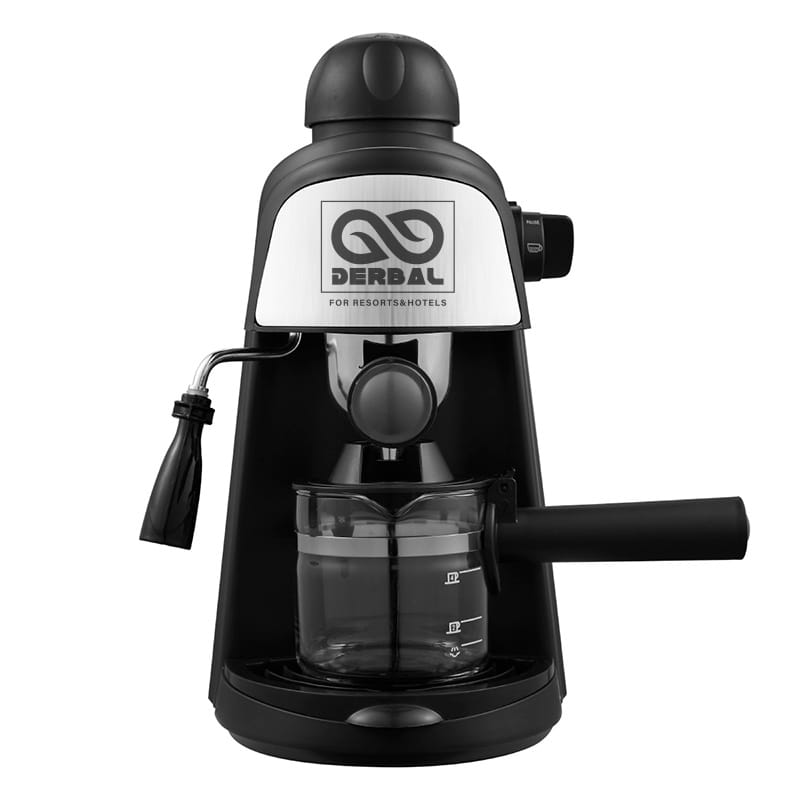
Placement drives the payback. A hotel wine cooler fridge earns its keep in five spots: the lobby wine lounge, the rooftop champagne bar, the overwater-villa minibar, the fine-dining restaurant pass, and the VIP airport lounge. In tropical markets, humidity control is the feature that stops a $200 bottle from spoiling before it is poured. Pair the back-of-house unit with a commercial food heat lamp for your buffet, an hotel espresso coffee machine for in-room service, a commercial juice dispenser at breakfast, and a hotel towel warmer cabinet at the spa to complete the F&B equipment set.

Sizing by Venue
Match capacity to the pour. A boutique bar or in-suite minibar is served by the 8-bottle thermoelectric class. A wine lounge, rooftop bar, or VIP lounge needs the 20–48 bottle compressor class with humidity control. When in doubt, size for your top周末 service, not your average Tuesday — a chiller that runs full on Saturday night is the one guests remember. Refrigerant choices should follow EPA guidelines for low-GWP alternatives, which also future-proofs your spec against tightening regulations in the EU and Middle East.
Maintenance for 24/7 Operation
A hotel wine cooler fridge is a set-and-forget asset only if you respect two rules. First, leave 2–3 inches of clearance behind and above for airflow; a sealed-in compressor cooks itself. Second, wipe spills immediately with a damp cloth — the interior resists staining, but sugar syrups attract pests if left. Glass gaskets should be checked quarterly in coastal properties where salt air accelerates wear. Done right, compressor units deliver 7–10 years of continuous service.

Frequently Asked Questions
What size hotel wine cooler fridge do I need for a rooftop bar?
For a rooftop or lounge pouring 30–60 glasses a night, choose a compressor model in the 20–48 bottle (48 L) class with humidity control. The 8-bottle thermoelectric unit is better suited to in-suite minibars and boutique bars with short lists.
Thermoelectric or compressor — which is quieter?
Thermoelectric is the quietest because it has no compressor; the 8-bottle model is essentially silent and ideal for guest rooms. The JC-48AW compressor unit is rated at 39 dB, still below a library whisper, and safe for sleep suites when placed away from the bed.
Do these wine coolers control humidity?
The JC-48AW compressor model auto-maintains 60–70% RH, which prevents cork drying in tropical and desert resorts. The 8-bottle thermoelectric class is single-zone and does not actively control humidity, so it suits shorter holding periods rather than long aging.
Are DERBAL wine coolers certified for guestroom use?
The JC-48AW carries CE, RoHS, and ISO 9001 certification. Always confirm the specific model’s marks for your market; electrical safety certification is required wherever guests sleep or where the unit is guest-accessible.
Can the shelves hold magnum or odd-shape bottles?
Yes. Both models use adjustable metal shelves. The JC-48AW holds 14 magnums or mixes Burgundy, Prosecco, and even craft cans on its four wire shelves, so your list is not limited to standard 750 ml bordeaux shapes.
How long do hotel wine cooler fridges last in 24/7 service?
Compressor units are tested for 100,000 cycles and typically run 7–10 years of continuous operation. Thermoelectric models last longest when not asked to fight ambient heat above ~80°F, so keep them in climate-controlled interiors.