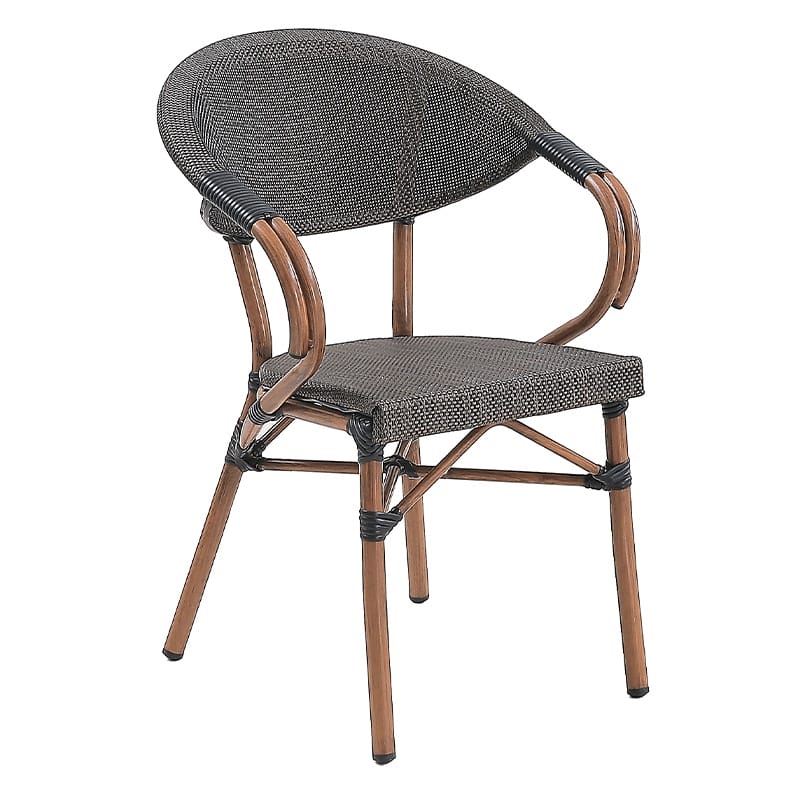
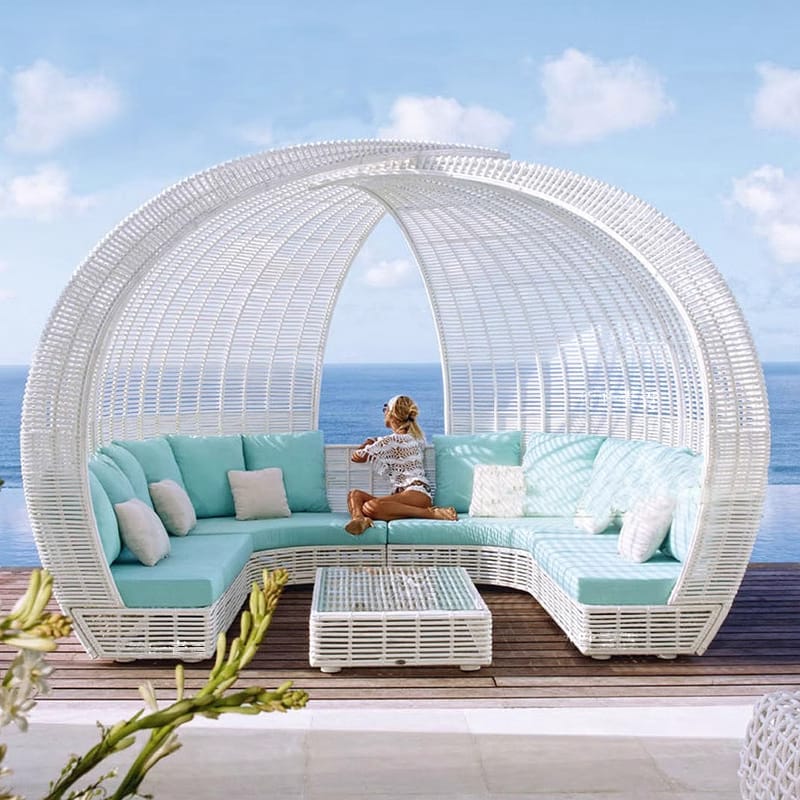
1. Why Coastal Resorts Need Different Outdoor Furniture Specifications
A restaurant chair installed inside an air-conditioned hotel lobby experiences a very different environment from the same chair placed beside an oceanfront restaurant.
Coastal Outdoor furniture may be exposed to airborne chlorides carried by sea spray. When moisture and salts accumulate on susceptible surfaces, corrosion can develop.
Exposure is not uniform across a property.
A chair positioned beside an open beachfront restaurant may experience more salt deposition than furniture installed in a sheltered courtyard. A rooftop terrace may have greater wind exposure, while furniture beside a swimming pool can encounter additional chemical and cleaning-related conditions.
This means the phrase suitable for outdoor use is not a sufficiently detailed specification for many resort projects.
The five environmental factors buyers should evaluate
| Environmental Factor | Potential Furniture Impact | Procurement Response |
|---|---|---|
| Salt-laden air | Corrosion of susceptible metals and connections | Specify alloy, coating system and hardware |
| High humidity | Prolonged surface moisture and slower drying | Evaluate drainage, joints and ventilation |
| Strong UV exposure | Fading, polymer degradation and coating changes | Request appropriate material and weathering evidence |
| Sand abrasion | Scratches and accelerated finish wear | Review coating durability and maintenance procedures |
| Frequent cleaning | Chemical attack or surface damage | Confirm compatible cleaning products and instructions |
The interaction between these factors is important.
For example, a scratch in a protective coating may be relatively minor in one environment but become a more serious maintenance concern when combined with salt deposition and persistent moisture.
A hotel purchasing manager should therefore ask not only what a chair is made from, but also how the complete chair has been designed for its intended location.
Start by mapping the furniture’s exposure
Before issuing an RFQ, divide the property into practical exposure zones.
An open beachfront dining area, a partially covered villa terrace and an enclosed outdoor courtyard may not need identical specifications.
For each zone, document the proximity to the sea, degree of shelter, likely moisture exposure, cleaning frequency, expected daily use and any unusual operational conditions.
This simple exercise helps avoid two expensive mistakes: under-specifying furniture for exposed areas and unnecessarily paying for features that provide little benefit in protected locations.
2. Aluminum vs Steel vs Stainless Steel: Which Frame Material Is Best?

Frame material is one of the first decisions in an outdoor furniture procurement project.
However, there is no universal winner.
Aluminum, coated carbon steel and stainless steel can all be appropriate in selected applications when correctly specified and maintained.
Aluminum outdoor furniture
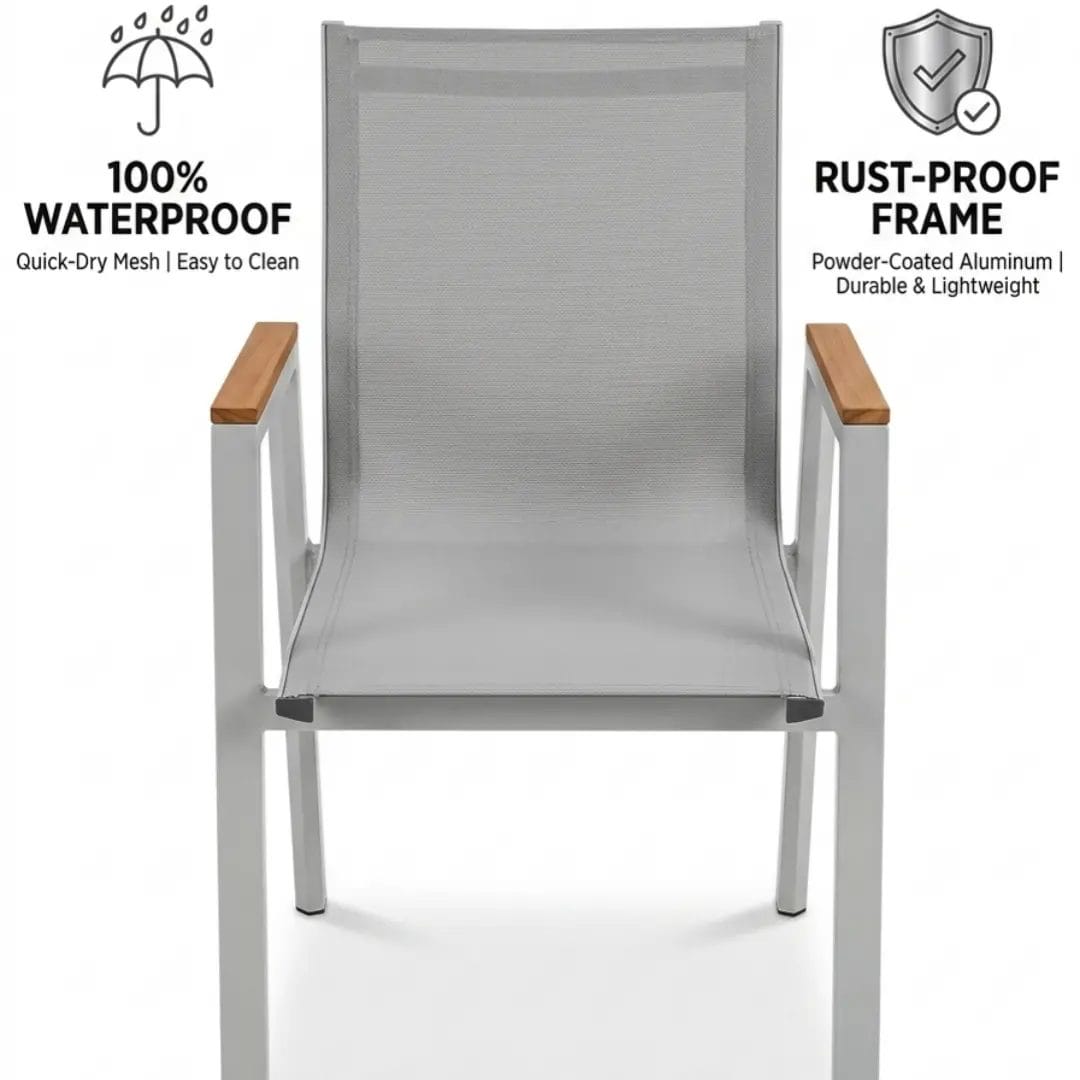
Aluminum is widely used for outdoor furniture because it combines relatively low weight with useful corrosion resistance.
Unlike carbon steel, aluminum does not produce conventional red iron rust. It naturally develops a thin oxide layer that helps protect the underlying metal.
That does not make aluminum immune to corrosion.
In chloride-containing environments, aluminum can experience localized corrosion, particularly where salts and moisture remain trapped or where the material is exposed to unfavorable combinations of metals and surface conditions.
The exact alloy, manufacturing method, coating and design details matter.
For resort procurement, useful questions include:
-
Which aluminum alloy is used for the frame?
-
What are the tube dimensions and wall thicknesses?
-
Are welds finished and protected consistently?
-
How are internal cavities drained or sealed?
-
What surface preparation is performed before coating?
-
What is the proposed maintenance procedure?
A supplier who can answer these questions is providing more useful information than one who simply describes a product as “100% rust-proof.”
Powder-coated carbon steel
Carbon steel can offer structural strength and design flexibility, but it generally requires effective protection against corrosion.
Coatings, galvanizing and careful design can improve performance. However, damage to protective systems may expose steel to corrosion.
Steel may remain suitable for selected sheltered or controlled applications. Its suitability should be assessed against the exposure conditions and the complete protection system rather than dismissed solely because it contains iron.
Stainless steel
Stainless steel is often selected for hardware, fasteners and structural components because appropriate grades can offer useful corrosion resistance.
Yet the term stainless steel is not enough.
Different grades have different resistance to chloride-containing environments. Grade 316 stainless steel generally offers better resistance to chloride-related pitting than grade 304, although neither is immune to corrosion under all conditions.
For particularly aggressive exposures, additional engineering review may be necessary.
Material comparison for resort buyers
| Material | Advantages | Main Risks | Typical Procurement Consideration |
|---|---|---|---|
| Aluminum alloy | Lightweight, formable, corrosion-resistant in many outdoor conditions | Pitting, coating defects, galvanic interactions | Alloy, pretreatment, finish and joints |
| Coated carbon steel | Strong, versatile, potentially economical | Corrosion if protection is damaged or inadequate | Complete protective coating system |
| 304 stainless steel | Useful general corrosion resistance | Possible staining or pitting in chloride exposure | Grade verification and location |
| 316 stainless steel | Improved chloride resistance compared with 304 | Higher cost; still needs appropriate design and care | Exposed fasteners and selected components |
| Teak or suitable hardwood | Natural aesthetic, no metallic frame corrosion | Weathering, movement, maintenance requirements | Species, sourcing, finish and upkeep |
DERBAL procurement insight: For a coastal outdoor dining chair, evaluate the frame, fasteners, seat material and finish as one assembly. Choosing an aluminum frame does not automatically solve problems caused by unsuitable screws, poor weld finishing or trapped moisture.
3. Powder Coating: Why Surface Preparation Matters More Than Color

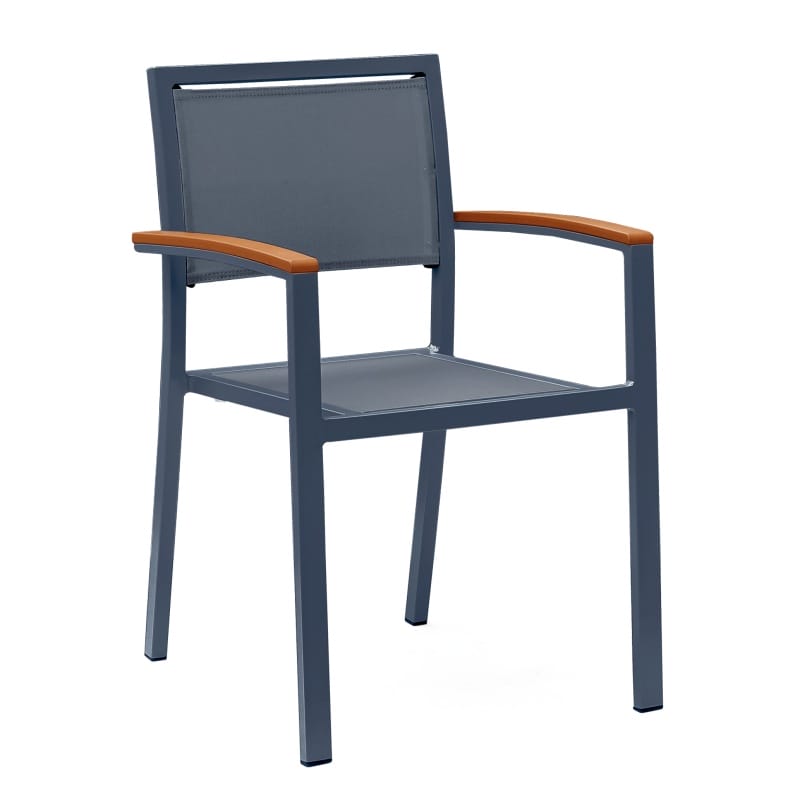
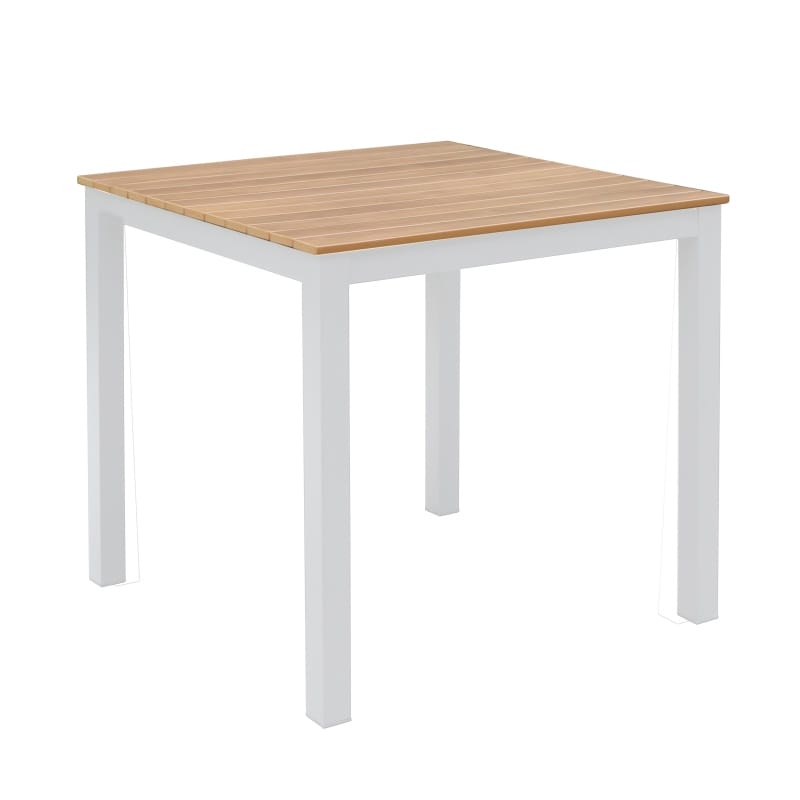
Powder-coated aluminum is frequently used for hospitality outdoor furniture because it allows a broad range of colors and decorative finishes, including wood-grain effects.
For luxury resorts, this offers an appealing design opportunity.
A property may want the appearance of natural timber while preferring the handling and maintenance characteristics of a coated metal frame.
However, a visually attractive finish does not establish its long-term performance.
What happens before powder coating?
A robust finishing process normally involves cleaning and suitable surface pretreatment before coating application.
Depending on the specified system, this may include degreasing, removal of surface contamination, appropriate conversion treatment, drying, powder application and curing.
Each stage can influence coating adhesion and corrosion performance.
If contamination remains on the substrate, a coating may appear acceptable immediately after production yet develop adhesion problems later.
Likewise, insufficient coverage at edges, welds or recessed areas may leave vulnerable points.
Polyester and other coating formulations
Exterior-grade polyester powder coatings are commonly used in outdoor architectural and furniture applications.
Nevertheless, the formulation must be selected for the intended service environment.
A buyer should request the coating manufacturer’s technical information and clarify the intended UV, weathering and corrosion performance.
Do not assume that every powder coating provides identical outdoor durability.
What to include in the coating specification
A professional furniture RFQ should define:
| Specification Item | Required Information |
|---|---|
| Coating type | Manufacturer, product reference and intended outdoor grade |
| Pretreatment | Process appropriate to the substrate and exposure |
| Finish | Color reference, texture and gloss |
| Coating thickness | Agreed measurement method and acceptance range |
| Adhesion | Test method and acceptance criteria |
| Corrosion evaluation | Relevant test method, duration and performance criteria |
| UV/weathering | Relevant evidence where required |
| Repair procedure | Approved touch-up and maintenance instructions |
A supplier may provide a test report showing good results for a particular coating system. The purchasing team should verify whether that report applies to the actual substrate, pretreatment, coating and production process proposed for the order.
A certificate for a coating powder is not automatically evidence that every finished chair will perform identically.
4. Fasteners, Welds and Joints: The Hidden Failure Points
A resort chair is not a single material.
It is an assembly of tubes, welds, brackets, screws, connectors, feet, mesh or cushions.
These smaller components can determine how well the product performs over time.
Galvanic corrosion and mixed metals
When dissimilar metals are electrically connected in the presence of a conductive electrolyte, such as salty moisture, galvanic corrosion may occur.
The risk depends on the metal combination, exposed surface areas, moisture conditions and design.
This does not mean stainless steel fasteners can never be used with aluminum. It means the connection should be designed appropriately.
Depending on the application, isolation washers, suitable coatings, sealants or other protective measures may be considered.
Why weld finishing matters
Welded joints can contain geometries that collect dirt or moisture.
Poor finishing can also create visible defects, sharp edges or inconsistencies in coating coverage.
During sample approval, buyers should examine weld continuity, appearance, finishing and any structural requirements established for the chair.
A polished photograph of the complete product is not enough.
Request close-up images of the underside, frame joints and connection details.
Chair feet and drainage
Furniture feet are frequently overlooked.
They may be exposed to standing water, abrasive surfaces, repeated movement and cleaning chemicals.
Buyers should check that feet are secure, replaceable where practical and suitable for the intended flooring.
Hollow frames should also be evaluated for potential water accumulation.
The best solution depends on the frame design; uncontrolled openings and fully sealed cavities can each create different problems if poorly executed.
5. Outdoor Seat Materials: Comfort, Drying and Maintenance

The frame may determine much of the furniture’s structural performance, but the seat and backrest directly influence the guest experience.
For tropical resort dining areas, woven synthetic mesh materials such as Teslin-type fabrics are often considered because they can provide an open, breathable seating surface.
However, the word Teslin alone does not establish fabric quality.
What to evaluate in outdoor mesh
A useful material review should consider yarn construction, weave density, dimensional stability, attachment method, UV performance, cleaning compatibility and resistance to tearing or deformation.
A very open weave may feel different from a tighter construction. A comfortable sample may also behave differently after extended loading or exposure.
Request a physical sample and, where appropriate, evidence of relevant performance testing.
Cushioned versus non-cushioned seating
Cushions can increase comfort and contribute to a premium dining atmosphere.
They also introduce additional requirements: fabric durability, water management, foam construction, drying, storage and replacement covers.
For exposed beachfront restaurants, removable cushions may offer operational flexibility, but they require housekeeping and storage procedures.
For busy dining outlets where staff must reset furniture quickly after rainfall, mesh seating without cushions may be easier to manage.
The correct choice depends on the guest experience the hotel wants to provide and the resources available to maintain it.
Guest comfort is part of procurement quality
A chair should not be evaluated only by its materials.
Consider seat height, seat depth, backrest angle, armrest clearance, table compatibility and stability.
A chair that looks excellent in a catalog may be uncomfortable during a long dinner or difficult for staff to move.
Before ordering hundreds of units, arrange a sample evaluation with representatives from procurement, F&B operations, engineering and housekeeping.
This cross-department review can identify practical issues before they become expensive purchasing mistakes.
6. Salt Spray Testing: What Hotel Buyers Should Actually Ask For
Salt spray testing is often mentioned in outdoor furniture quotations.
Unfortunately, the result is sometimes reduced to a single statement such as “passed 500 hours” or “tested for 1,000 hours.”
Without additional information, that statement has limited value.
What does a salt spray test measure?
A commonly referenced method is ISO 9227, which describes artificial-atmosphere salt spray tests for assessing corrosion resistance under specified laboratory conditions.
Such tests can help compare materials or protective systems and identify weaknesses.
However, laboratory exposure does not reproduce every aspect of real coastal service.
Salt deposition, drying cycles, UV exposure, temperature, abrasion, maintenance and mechanical loading can differ significantly from test conditions.
Therefore, 500 hours of salt spray exposure does not mean 500 hours, five years or any other fixed period of actual service life.
How to interpret a test report
A useful report should identify the tested specimen, applicable test method, exposure duration, inspection criteria and observed results.
For coated furniture, buyers may also need to understand whether samples were intentionally scribed, how corrosion creep was measured, and whether blistering or coating adhesion was evaluated.
Ask whether the test covered a flat coated panel, a frame section or a complete assembled product.
These are not interchangeable.
Standards and evidence
Relevant technical references can include:
-
ISO — for standards such as ISO 9227 covering salt spray test methods.
-
QUALICOAT — for quality requirements associated with coated aluminum systems.
-
ASTM International — for applicable material, coating and corrosion test standards.
The exact standard, current edition, test method and acceptance criteria should be selected according to the project. Compliance should only be claimed when supporting documentation is available.
For hotel procurement teams, the key question is not “How many hours did it pass?” but:
“What was tested, against which acceptance criteria, and how closely does that specimen represent the furniture we are buying?”
7. The Coastal Outdoor Furniture Quality Inspection Checklist
A structured inspection is especially valuable for resorts purchasing furniture internationally.
Once a shipment reaches a remote island, correcting manufacturing defects can become complicated.
Replacement parts may require additional freight, customs procedures and inter-island transportation.
The most practical approach is to identify defects before dispatch.
Pre-production sample approval
Before mass production, approve a representative sample covering dimensions, materials, finish, color, comfort, branding and assembly details.
Photographs are useful, but physical samples remain important for seating comfort, stability and workmanship.
In-process quality checks
During manufacturing, the agreed inspection scope may include material identification, tube dimensions, weld quality, surface preparation records, coating application and hardware consistency.
The depth of inspection should reflect the order value and risk.
Pre-shipment inspection
| Inspection Area | What to Verify | Common Risk |
|---|---|---|
| Dimensions | Width, depth, height and tolerances | Furniture does not fit planned layout |
| Frame | Alloy specification, tube thickness, visible defects | Structural or durability concerns |
| Welds | Workmanship and agreed acceptance criteria | Weak or poorly finished joints |
| Coating | Color, thickness, adhesion and visible finish | Peeling, scratches, inconsistent appearance |
| Fasteners | Material grade, quantity and installation | Corrosion, loosening, missing hardware |
| Seat material | Weave, tension, attachment and finish | Sagging, tearing or discomfort |
| Stability | Approved functional or standard-based test | Unsafe or uncomfortable seating |
| Packaging | Protection, labeling and carton strength | Transit damage |
| Quantity | Units, colors and configurations | Delivery shortages |
Where contractually required, appropriate furniture safety and durability testing should be selected for the product’s intended use and market.
Inspection criteria should be agreed before production, not invented after a disagreement arises.
Why packaging is part of product quality
A chair can leave the factory in perfect condition and arrive with damaged coating.
For international resort projects, packaging should account for stacking pressure, abrasion, moisture exposure, handling and multiple transport stages.
Protective separators, suitable wrapping, secure cartons or other approved methods may be necessary.
A stackable chair can offer logistics advantages, but stacking must be designed and tested appropriately to avoid damaging the finish.
Procurement recommendation: Request photographs of the final packing method and a packing list showing the quantity, dimensions and weight of each package before shipment.
8. Total Cost of Ownership: Why the Cheapest Chair May Not Be the Best Value
A hotel’s furniture budget should account for more than the initial invoice.
For a remote resort, replacement furniture can create additional shipping costs and operational inconvenience.
A useful cost model is:
This is a simplified model. More detailed analyses may also include financing, storage, downtime, disposal and the time value of money.
Illustrative procurement comparison
Consider a hypothetical beachfront restaurant purchasing 100 chairs.
| Cost Component | Option A | Option B |
|---|---|---|
| Initial unit price | $48 | $72 |
| Initial furniture cost | $4,800 | $7,200 |
| Initial freight and handling | $1,000 | $1,000 |
| Maintenance over 4 years | $800 | $500 |
| Replacement purchases | $2,400 | $720 |
| Replacement freight | $600 | $200 |
| Four-year total | $9,600 | $9,620 |
Illustrative planning scenario only. These are not DERBAL prices, actual project results or predicted product lifespans.
In this scenario, the more expensive chair costs only $20 more over four years.
That does not prove Option B is always better.
It demonstrates why initial purchase price alone can be misleading.
If the premium chair provides better guest comfort, appearance retention or easier maintenance, the hotel may consider the additional initial investment worthwhile.
If the assumed replacement rate is inaccurate, the outcome could change.
A responsible procurement team should use its own maintenance history, supplier evidence and operating conditions to build the comparison.
The overlooked cost of inconsistent replacement furniture
There is another issue that is difficult to capture in a simple spreadsheet: visual consistency.
If an outdoor dining area uses a distinctive chair design, replacing damaged units with mismatched alternatives can undermine the intended atmosphere.
This is particularly relevant for luxury resorts where furniture, architecture and landscape design are carefully coordinated.
Hotels should therefore ask whether the supplier can support future replacement orders with consistent finishes and specifications.
For properties planning renovation or phased upgrades, DERBAL’s hotel renovation supply solutions provide a related starting point.
9. Maldives, Seychelles and GCC: Different Locations, Different Priorities
Coastal resort procurement is not identical across international markets.
The materials may be similar, but operational priorities can differ.

Maldives: Salt exposure and island logistics
For Maldivian island resorts, furniture selection should account for coastal exposure, moisture, frequent outdoor use and the practical challenges of replacing damaged products.
The final delivery journey may involve a combination of international freight, local handling and inter-island transportation.
This makes product consistency, packaging and spare-parts planning particularly important.
A lightweight aluminum dining chair can be attractive from a handling perspective, but the design must still provide appropriate stability and structural performance.
DERBAL’s Maldives resort supply solutions address broader island procurement requirements.
Seychelles and Fiji: Tropical moisture and material care
In humid tropical destinations, hotels should pay particular attention to moisture retention, fabric drying, cleaning practices and outdoor storage.
The appearance of natural materials may be desirable, but their maintenance requirements should be considered during design approval.
UAE and GCC: UV exposure and surface temperature
In hot, sunny environments, material temperature and UV-related appearance changes can be important guest-comfort considerations.
Dark metal furniture exposed to direct sunlight may become uncomfortable to touch or sit against.
A buyer should assess finish color, shading, surface temperature and seat material alongside corrosion protection.
Coastal GCC properties may also require attention to chloride exposure, while inland locations present different environmental conditions.
Design for the actual site
The best outdoor furniture specification is not simply labeled “Maldives-grade” or “marine-grade.”
It is a documented specification that reflects the furniture’s location, intended use, materials, protective systems and maintenance program.
10. How DERBAL Supports Coastal Resort Furniture Procurement
DERBAL TECHNOLOGY CO., LTD supports international hospitality buyers with sourcing, customization, quality coordination and consolidated delivery from China.
Our role is to help purchasing teams translate hotel requirements into practical product specifications and coordinated procurement arrangements.
Product specification and supplier comparison
Hotels can share drawings, reference images, dimensions, target finishes, quantities and operating conditions.
DERBAL can then help evaluate suitable manufacturing options and identify details requiring clarification before quotation approval.
OEM and ODM customization
For outdoor furniture projects, customization may include frame colors, wood-grain finishes, dimensions, fabric options and selected branding features, subject to manufacturing feasibility.
Physical samples and approved finish references help reduce misunderstandings.
Quality control coordination
Quality requirements should be established in the purchase specification.
Depending on the project, DERBAL can coordinate sample reviews, production follow-up and pre-shipment inspections against agreed criteria.
Consolidated FF&E and OS&E procurement
Outdoor furniture is often one part of a larger resort project.
A hotel may also need umbrellas, sun loungers, guestroom furniture, housekeeping equipment, restaurant supplies and other operating items.
Coordinating these categories through a one-stop sourcing partner can simplify communication and shipping arrangements.
For broader procurement planning, see DERBAL’s hotel FF&E and OS&E procurement guide.
What to send when requesting a quotation
To receive a more accurate proposal, provide the property location, furniture type, estimated quantity, reference photos or drawings, required dimensions, preferred materials, finish colors, expected usage and delivery schedule.
If corrosion testing or specific certifications are required by the project, include those requirements in the initial RFQ.
This allows suppliers to quote against a consistent specification rather than make assumptions that may affect price or performance.
11. Frequently Asked Questions
Is aluminum outdoor furniture suitable for beachfront hotels?
Yes, aluminum is commonly used for outdoor furniture and can be appropriate for beachfront applications. Performance depends on the alloy, coating, fasteners, assembly design and maintenance conditions.
Does aluminum furniture rust in salt air?
Aluminum does not develop conventional red iron rust like carbon steel, but it can experience corrosion, including localized pitting, in aggressive environments.
Is powder-coated aluminum better than painted steel for resorts?
It may be preferable for some coastal applications, but the comparison depends on the aluminum alloy, coating systems, manufacturing quality and operating conditions. Neither material should be selected solely by its marketing description.
What is the best stainless steel grade for outdoor furniture screws?
Grade 316 is often considered where chloride exposure is a concern because it generally offers better pitting resistance than grade 304. Final selection should account for the environment, connection design and relevant engineering requirements.
How many hours of salt spray testing should hotel furniture pass?
There is no universal number suitable for every project. Buyers should specify the relevant test method, specimen type, duration and acceptance criteria based on the intended application.
Does a 1,000-hour salt spray test guarantee long furniture life?
No. Salt spray test duration cannot be directly converted into a guaranteed number of years in service.
What is the best fabric for outdoor resort dining chairs?
Open-weave synthetic mesh and suitable outdoor upholstery fabrics are common options. The best choice depends on comfort, UV exposure, drying requirements, cleaning and the hotel’s intended use.
Are wood-grain aluminum chairs suitable for luxury resorts?
They can be a useful design option when a hotel wants a timber-inspired appearance with a metal frame. Buyers should assess the finish system, color consistency and durability evidence.
What should hotels inspect before accepting an outdoor furniture shipment?
Important items include dimensions, frame workmanship, welds, finish quality, fasteners, seating materials, stability, quantities and packaging. Additional testing may be needed for the specific product and destination market.
Can outdoor resort furniture be customized with hotel branding?
Depending on the model and manufacturing process, customization may include colors, finishes, dimensions and selected branding features. Samples should be approved before mass production.
How can resorts reduce outdoor furniture replacement costs?
Specify products for the actual environment, approve representative samples, establish inspection criteria, train staff on suitable cleaning and maintenance, and track replacement reasons.
Can DERBAL consolidate outdoor furniture with other hotel supplies?
DERBAL offers coordinated sourcing and shipment consolidation services for hotel OS&E and FF&E projects. The appropriate shipping arrangement depends on order size, product mix, destination and delivery requirements.
12. Final Thoughts: Specify for the Coast, Not Just the Catalog
A successful coastal resort furniture purchase starts long before the chairs arrive.
It begins with understanding the environment, selecting suitable materials, defining coating and hardware requirements, reviewing representative samples and agreeing on inspection standards.
For procurement managers, the most important shift is from buying a product described as weatherproof to purchasing an assembly with documented requirements and an appropriate maintenance plan.
For hotel owners and operators, that approach can support more consistent outdoor spaces, fewer avoidable defects and better-informed long-term investment decisions.
The goal is not to purchase the most expensive furniture.
It is to select furniture that delivers the right combination of guest comfort, appearance, operational practicality and cost for the property.
Ready to Upgrade Your Resort’s Outdoor Furniture?
Whether you are developing a new island resort, renovating an outdoor restaurant or replacing aging beachfront furniture, DERBAL can help you evaluate sourcing options and develop a project-specific procurement plan.
Share your furniture requirements with our team, including location, quantity, preferred materials, finish and delivery schedule.
DERBAL TECHNOLOGY CO., LTD
One-Stop Hotel & Resort Supply Partner
Help Hotels Purchase Better.