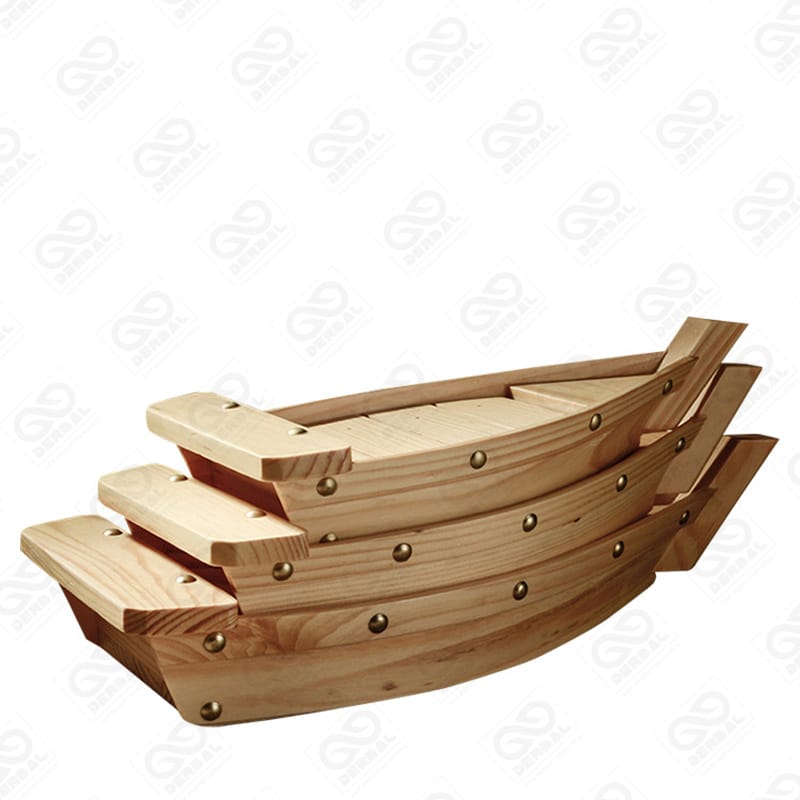
A wooden sushi boat for hotels is one of the smallest investments in a fine-dining venue that delivers the largest visual payoff. In a resort where guests photograph every plate, the vessel itself becomes part of the story. A well-made pine boat turns a few pieces of sashimi into a signature moment worth sharing—and sharing online is free marketing for the property.
Most F&B teams focus procurement on the food and forget the stage. The properties that get tagged on social media treat presentation as a spec, not an afterthought. Below are five ways hotels and resorts use a wooden sushi boat to raise perceived value, plus the sourcing and care details that keep it safe and beautiful through hundreds of services a week.
1. Why Presentation Drives Perceived Value
In Japanese dining, natural materials and visible craft signal quality long before the first bite. A pine boat with honest grain tells guests this is not mass cafeteria fare. Plating research consistently shows that natural wood surfaces raise a dish’s perceived authenticity and price-worthiness. For a resort, that perception translates directly into higher F&B revenue per cover and more guest photos that name-drop the property. The boat is a low-cost prop with outsized branding power—exactly the kind of detail a five-star F&B director specs on purpose.

2. Pine Wood: The Right Material Choice
Not all wood is equal for food contact. DERBAL’s boat is crafted from solid pine—light, stable, and easy to maintain with food-safe oil. Pine takes finishes well and resists warping when cared for correctly. For buyers with sustainability commitments, ask whether the wood is responsibly sourced; certification schemes such as the Forest Stewardship Council (fsc.org) verify chain-of-custody from forest to finished product. Avoid unknown softwoods that may leach resin or splinter under repeated washing in a busy kitchen.
3. Three Size Tiers for Every Service Style
The same boat ships in three footprints: S (33×15×6 cm), M (37×15.3×7 cm), and L (42×17×7.5 cm). Use the S for in-room dining or a two-piece amuse-bouche, the M for a standard sashimi platter at the teppanyaki counter, and the L as a shared centerpiece for a banquet table. Standardizing on one shape across sizes keeps storage simple and lets the kitchen scale a presentation from solo diners to large parties without redesigning the plate. That consistency is what makes the wooden sushi boat for hotels a practical buy, not just a pretty one.

4. Food-Safe Care and Compliance
Wood is porous, so cleaning discipline matters. Rinse with mild soap and warm water, never soak, and air-dry completely before stacking. Periodic wiping with a food-grade mineral oil keeps the grain from cracking. On the compliance side, any reusable servingware that touches ready-to-eat food should meet the local authority’s food-code expectations—in the U.S. that means following the FDA Food Code (fda.gov) on clean and sanitized food-contact surfaces, and ideally sourced from suppliers whose materials align with NSF food-equipment standards (nsf.org). Train staff to the same routine you’d use for ceramic and stainless lines, and the boat will stay safe and presentable for years.

5. Beyond Sushi: A Versatile Centerpiece
The boat is not a one-trick prop. The same pine vessel presents cheese and charcuterie at a villa happy hour, holds canapés at a welcome reception, or carries a dessert assortment in a Japanese-style kaiseki finish. That versatility is why procurement teams like it: one SKU covers multiple outlets—fine dining, in-room dining, banquets—and reduces the number of single-use serveware lines to manage. Coordinate the look with commercial glass racks and other F&B pieces for a unified back-of-house program.

Frequently Asked Questions
What wood is best for a hotel sushi boat?
Solid pine is the standard choice—light, stable, and easy to maintain with food-safe oil. Avoid unknown softwoods that may splinter or leach resin under repeated washing.
What sizes does DERBAL’s wooden sushi boat come in?
Three tiers: S 33×15×6 cm, M 37×15.3×7 cm, and L 42×17×7.5 cm, covering in-room dining through banquet centerpieces.
Is a wooden sushi boat food-safe?
Yes when cleaned correctly—mild soap, no soaking, full air-dry, and periodic food-grade oil. Follow your local food code (for example the FDA Food Code in the U.S.) for reusable food-contact surfaces.
Can the boat be used for foods other than sushi?
Absolutely. It works for sashimi, appetizers, cheese boards, canapés, and desserts—one SKU serves multiple F&B outlets.
How do I stop a pine sushi boat from cracking?
Never soak it, dry it completely after washing, and rub a food-grade mineral oil into the grain every few weeks of heavy service.
Should I choose a branded or plain sushi boat?
Plain pine reads authentic and photographs well; branded engraving suits welcome gifts or retail. Decide by whether the boat is serviceware or a guest-takeaway item.