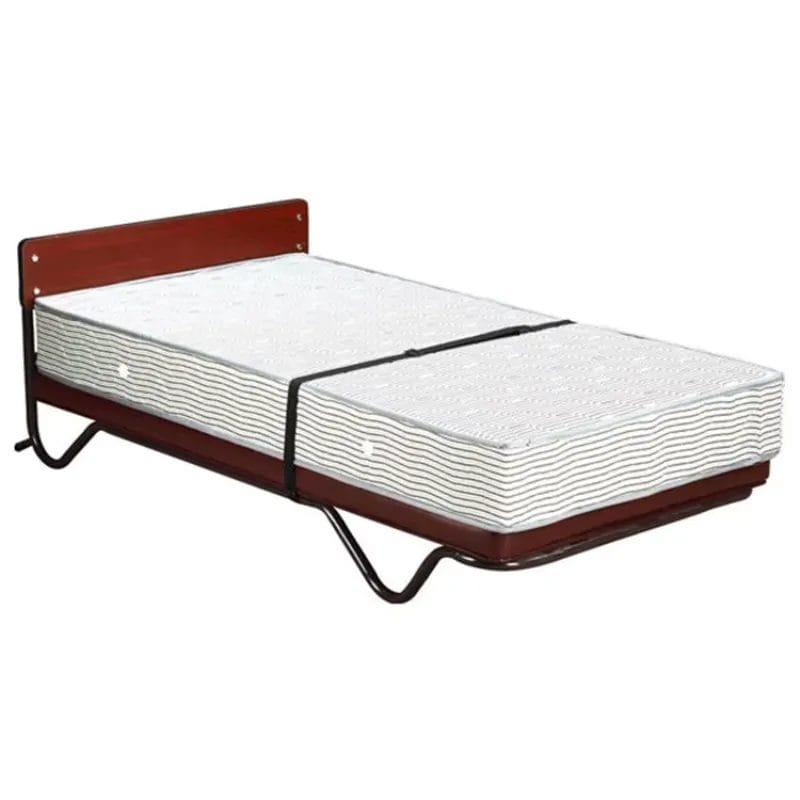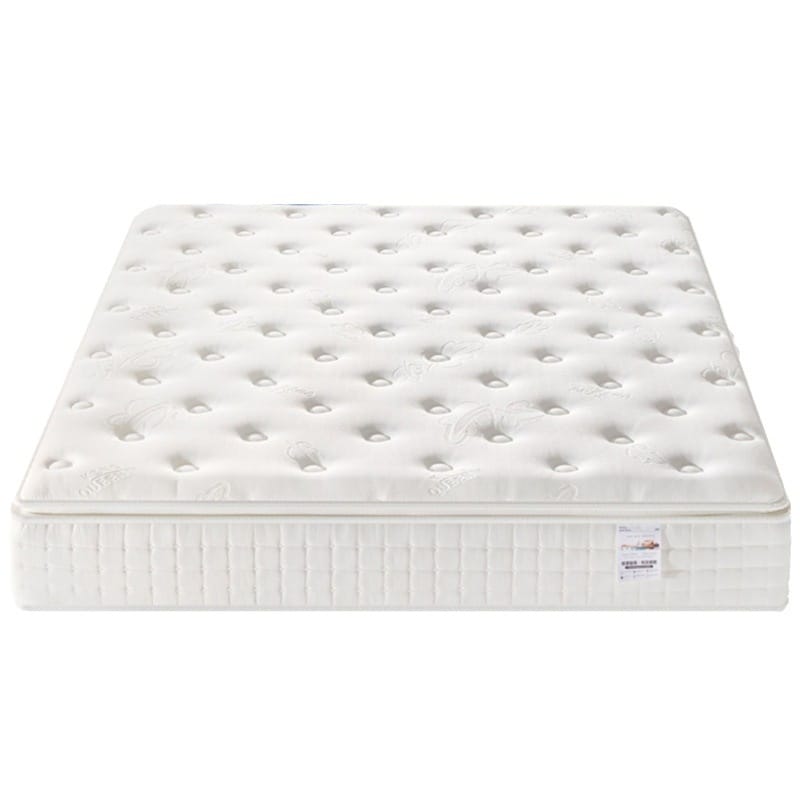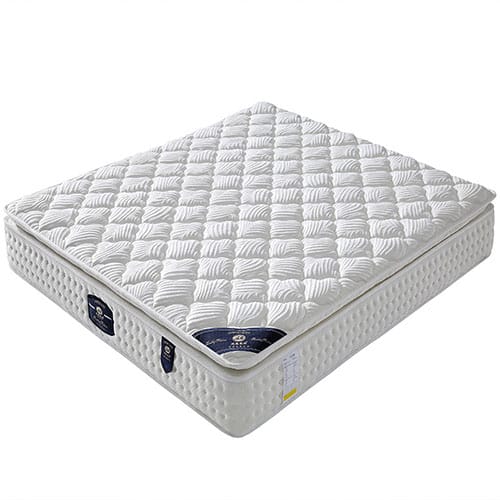
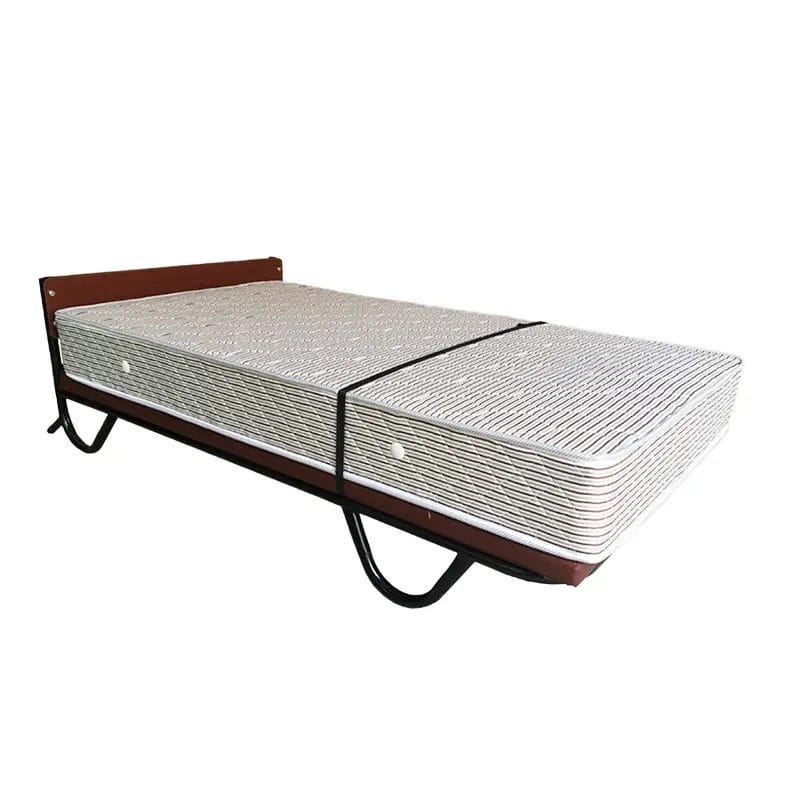
If a rollaway bed tips, glides during the night, or fails a flammability audit, the problem doesn’t end with a guest complaint—it can become a safety incident, an insurance exposure, and a brand-standard violation. That’s why the smartest hotel teams treat rollaway (extra) beds as safety equipment first, guest comfort second, and only then as overflow inventory. In this guide, we translate regional safety standards into plain-English purchasing specs and housekeeping SOPs so you can confidently specify, buy, deploy, and maintain rollaway beds that pass audits and protect guests and staff.
Key Takeaways
- Treat the rollaway bed as a safety-critical asset. Specify mattresses and frames that meet the standards in your jurisdiction and document compliance up front.
- For U.S. hotels, require mattress compliance to 16 CFR Part 1633 (open-flame) and 16 CFR Part 1632 (smoldering); for upholstered elements, confirm TB 117-2013 smolder resistance and the 16 CFR Part 1640 label where applicable.
- For UK/EU properties, specify BS 7177 (typically Medium Hazard for hotels), plus EN 597-1/2 for ignitability; for frames, require EN 1725 for safety, stability, and durability.
- Prioritize operational specs: load rating, locking casters, stable folding legs, noise control, folded footprint, and replaceable components.
- Build a documentation pack with third-party test reports and labels. Request it at RFQ stage and keep it ready for audits.

What a Rollaway (Extra) Bed Is—And Where It Fits in Hotel Operations
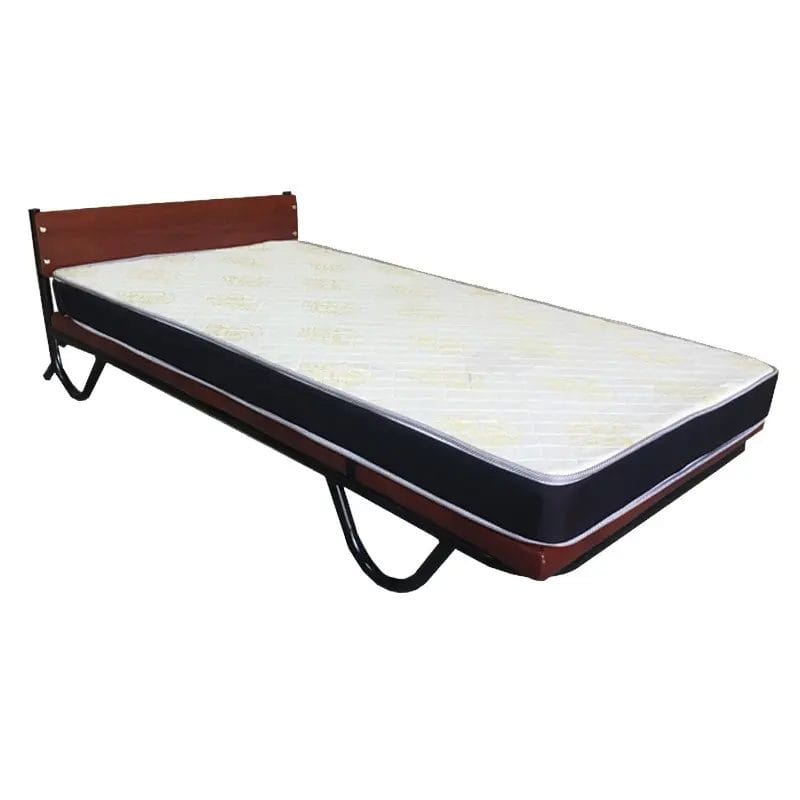
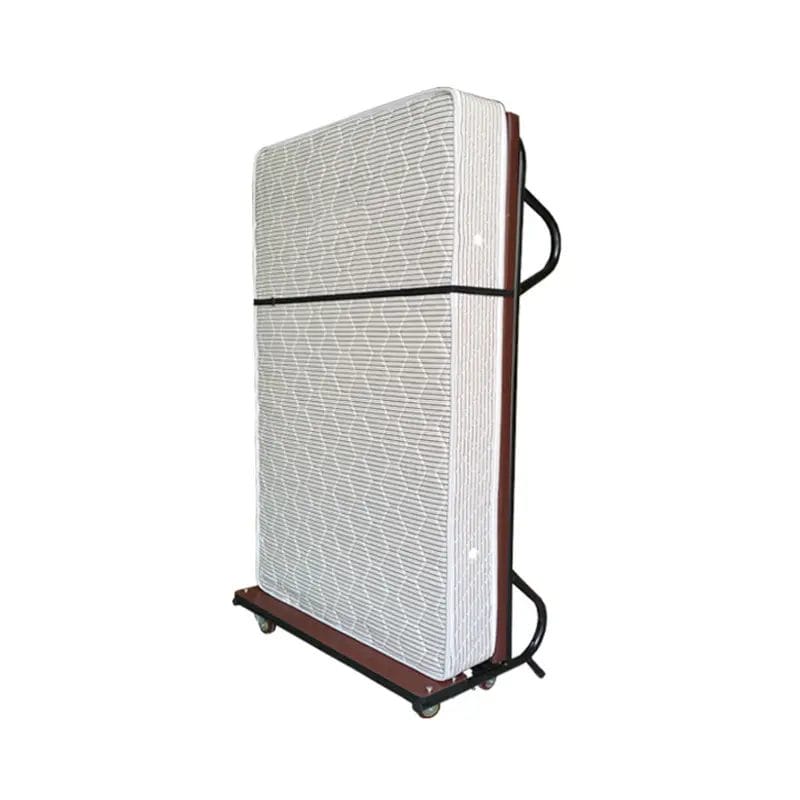
A rollaway bed—also called an extra bed, folding bed, or mobile sleeper—is a compact, movable bed designed to be deployed on demand in eligible guest rooms. Operators use them to accommodate families, last-minute inventory balancing, and upgrade scenarios. Because they move, fold, and often store in back-of-house corridors or closets, they create unique safety and housekeeping challenges: stability, caster locking, egress clearance, hygiene, and fire-load management.
Most properties adopt a policy that limits rollaway placement to certain room categories with adequate clearance and occupancy headroom. Many hotels explicitly restrict rollaways in rooms that would block egress or exceed safe occupancy. For example, policies at large-brand and independent properties often state that rollaways are permitted only in specific king or suite layouts to maintain clear paths and comply with local fire codes; this kind of restriction keeps operations aligned with safety mandates and audit expectations as highlighted by well-known properties’ public policy pages.
Here’s the deal: an extra bed that passes lab tests but fails in day-to-day use—wobbling frames, sliding casters, or noisy decks—will draw complaints, strain housekeeping workflows, and ultimately cost more in replacements. Your spec should balance compliance, durability, and operational fit.
Types of Rollaway Beds and Where Each One Works Best
Below are common rollaway/extra-bed subtypes you’ll encounter. Choose based on duty cycle (how often you’ll deploy), guest profile (adult vs. child), storage space, and noise/comfort expectations.
- Heavy-duty steel-frame rollaway (often higher load ratings)
- Best for: Business hotels and resorts with frequent extra-bed requests and mostly adult users.
- Why hotels choose it: Rigid frames, better long-term stability under heavier loads, and lower complaint rates when paired with a supportive mattress.
- Watch for: Maneuvering weight; specify quality twin-wheel casters and brakes.
- Standard commercial rollaway (mid-range load ratings)
- Best for: Select-service properties and independents with occasional deployments.
- Why hotels choose it: Lower unit cost and lighter handling.
- Watch for: Shorter service life if overused; confirm durable locks and spares availability.
- Folding slat-base rollaway (wood or composite slats)
- Best for: Properties prioritizing airflow and reduced mattress moisture buildup.
- Why hotels choose it: Ventilation, typically lighter weight, quieter than some spring decks.
- Watch for: Slat wear/breakage over heavy use; maintain a spares kit.
- Mesh-deck rollaway (steel mesh platform)
- Best for: High-duty environments needing even support and robust frames.
- Why hotels choose it: Good durability and support distribution; resists sagging.
- Watch for: Edge comfort if the mesh frame meets the mattress without a perimeter buffer.
- Trundle-style extra bed (under-bed pullout)
- Best for: Suites and long-stay rooms with designed-under-bed storage.
- Why hotels choose it: Zero back-of-house storage footprint; easy guest acceptance in family suites.
- Watch for: Room design dependency; ensure floor clearances and safe deployment paths.
- Ottoman-fold bed (concealed in an ottoman or bench)
- Best for: Lifestyle properties valuing integrated aesthetics and multifunction furniture.
- Why hotels choose it: Doubles as seating; quick to deploy.
- Watch for: Thinner mattresses; confirm realistic adult comfort expectations.
- Inflatable/air extra bed (with electric pump)
- Best for: Emergency overflow scenarios and rare deployments.
- Why hotels choose it: Tiny storage footprint and lowest upfront cost.
- Watch for: Puncture risk, noise from pumps, and inconsistent comfort—usually not ideal for frequent adult use.
- Mattress variants for rollaways (choose to fit your jurisdiction and guest profile)
- Memory-foam rollaway mattress: Pressure relief; pair with breathable, waterproof protectors.
- Innerspring rollaway mattress: Familiar bounce, edge support; can be noisier on spring decks.
- Fire-retardant foam options: Specify the precise test regime (e.g., EN 597-1/2 or jurisdictional equivalents) and hazard class labeling where required.
- Waterproof mattress protector sized for rollaways: Reduces contamination, simplifies turnover, and prolongs mattress life.
Two frames can look alike and behave very differently. To make trade-offs visible, use a short comparison snapshot:
| Rollaway subtype | Typical duty cycle | Comfort profile | Operational watch-outs |
|---|---|---|---|
| Heavy-duty steel-frame | Frequent/adult | High with supportive mattress | Heavier to move; spec larger twin-wheel locking casters |
| Standard commercial | Occasional/mixed | Moderate | Shorter service life under frequent use |
| Slat-base | Occasional–moderate | Quiet, breathable | Slat wear; keep spares |
| Mesh-deck | Frequent/adult | Even support | Edge comfort; choose proper mattress thickness |
| Trundle under-bed | Suite-specific | Good if designed-in | Requires room design fit; egress planning |
| Ottoman-fold | Occasional/child | Compact, discreet | Thinner mattress; weight limits |
| Inflatable | Rare/emergency | Variable | Puncture risk; pump noise |
Standards and Compliance—What Buyers Must Request by Region
Standards are the backbone of a safety-first program. Below, we summarize how the major regimes apply and how they translate to your procurement language. Where full standards are paywalled, we reference authoritative summaries and official regulations.
- United States: Mattress flammability is governed by federal rules—16 CFR Part 1633 (open-flame) and 16 CFR Part 1632 (smoldering cigarette)—administered under the Flammable Fabrics Act. These rules define testing and labeling for mattresses and require production conformity and prototype testing. The controlling regulatory text is publicly available via the Electronic Code of Federal Regulations. See the official texts for scope and definitions in the federal register entries for 16 CFR Part 1633 and 16 CFR Part 1632.
- U.S. upholstered furniture components and labeling: Many rollaway frames integrate upholstered elements (head/foot panels, upholstered ottoman-fold housings). Those components should comply with TB 117-2013 smolder resistance and carry the permanent label required by 16 CFR Part 1640 on upholstered furniture. The California Bureau’s TB 117-2013 text explains the component-level smolder test and barrier options; see the official PDF from the Bureau of Household Goods and Services in California: TB 117-2013 technical bulletin. The U.S. Consumer Product Safety Commission’s pages clarify scope and labeling expectations for upholstered furniture.
- United Kingdom: Hotel-use mattresses typically fall under BS 7177 with a Medium Hazard classification, which generally implies passing EN 597-1 (cigarette) and EN 597-2 (match-flame equivalent) tests and crib 5 (Ignition Source 5) performance, accompanied by labeling to show the hazard category. Reputable technical overviews from testing bodies summarize classification and labeling; for an industry-facing explanation, see SATRA’s article on BS 7177 guidance for mattresses.
- Europe (EN regime): EN 597-1/2 define ignitability tests for mattresses and upholstered bed bases; testing services and standards catalogs outline the test methods and acceptance criteria. For background, see RISE’s page on EN 597 fire tests for mattresses and upholstered beds. For structural stability and durability of frames (including folding legs common to rollaways), specify EN 1725:2023. Testing labs and standards bodies explain the relevant load, fatigue, and stability checks—for example, SATRA’s overview of EN 1725:2023 safety, strength, and durability.
- Middle East/APAC: Many authorities accept BS/EN or U.S. equivalents. Align your specification to the dominant standard in your project (e.g., EN 597 + EN 1725 or 16 CFR 1632/1633) and confirm with the local civil defense/fire authority that your documentation pack is acceptable in English and, if needed, in a bilingual format.
Plain-language translation for procurement:
- Mattresses: In the U.S., require 16 CFR 1633/1632. In the UK, require BS 7177 Medium Hazard with labeling and the underlying EN 597-1/2 evidence. In the EU, require EN 597-1/2 at minimum. Keep copies of lab reports.
- Frames: Require EN 1725:2023 testing (safety, strength, durability), with explicit mention of stability and folding-leg assessments relevant to rollaways.
- Upholstered components: Where present, require TB 117-2013 component smolder resistance and the 16 CFR 1640 permanent label in U.S.-bound projects.
The Rollaway Bed Buying and RFQ Checklist
Use the points below as exact RFQ language or a line-by-line checklist when you evaluate samples and quotations.
Documentation to request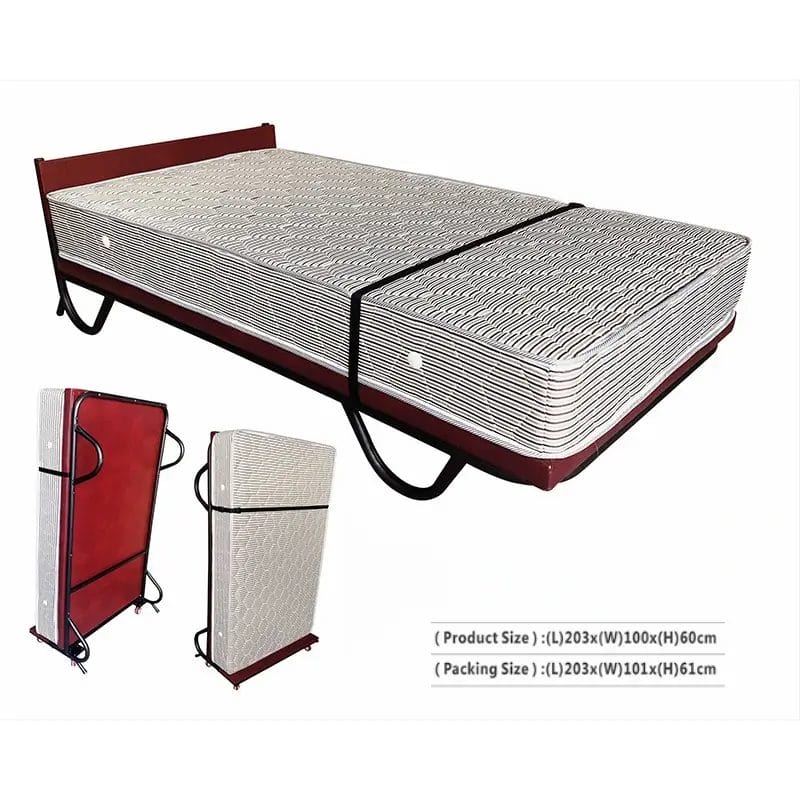
- Mattress: Third-party lab reports for 16 CFR 1633/1632 (U.S.) or BS 7177 Medium Hazard with EN 597-1/2 (UK/EU). Ensure reports show lab name, dates, prototype IDs, and production conformity notes.
- Frame: EN 1725:2023 test report indicating safety, strength, durability, and stability results for folding-leg designs.
- Upholstered components (if any): TB 117-2013 component test evidence and the 16 CFR 1640 permanent label specimen (U.S. scope).
- Labels: Photos/specimens of required mattress and furniture labels showing hazard class (where applicable) and compliance.
- Quality program: Statement of production QC, change-control for materials, and batch traceability; warranty terms and spare-parts policy.
Specifications to compare
- Load rating: Request both static test load and recommended user weight guidance in line with EN 1725 contexts.
- Frame & deck: Tube gauge or profile, weld method, and deck type (spring, slat, mesh). Ask about anti-squeak treatments and hinge design.
- Casters: Diameter, material, twin/single wheel, and lock type; specify locking casters on at least two wheels, ideally all four on heavier frames.
- Dimensions & deployment: Folded footprint (L×W×H), door/elevator clearance, and whether one person can deploy safely. Require clear stop-locks on legs.
- Mattress: Construction (foam/innerspring/hybrid), thickness, fire-compliance class per region, and cover fabric spec. Pair with a waterproof, breathable protector sized for the rollaway.
- Replaceability & spares: Availability of replacement mattresses, decks, casters, hinges, and fasteners; typical lead times.
Red flags
- “Complies with CAL 117” offered as the only mattress evidence for a U.S. project. U.S. mattresses must meet 16 CFR 1632/1633; TB 117-2013/16 CFR 1640 concerns upholstered furniture, not mattresses.
- No stability testing for folding legs or vague load ratings.
- Casters without positive locks or too small for carpeted corridors (hard to steer, more likely to drift).
- No documentation pack ready at quotation time.
Helpful internal references
- If you maintain a central OS&E hub for your brand’s categories, link the RFQ to your internal products and OS&E policies. For an example of how suppliers present OS&E ranges, see the type of product aggregation shown on a typical products hub such as the one at Products. Align your RFQ to the specific SKUs and variants you expect to order by room type and project phase.
Housekeeping and Engineering SOPs for Extra Beds
An audit-ready program doesn’t stop at purchase. Fold these steps into your property or cluster SOPs.
Setup and in-room checks (before guest arrival)
- Verify the frame opens smoothly; confirm secondary locks engage and legs fully seat.
- Lock all casters and confirm no drift on the room’s floor finish; position to maintain egress and heater clearance.
- Inspect the mattress surface, seams, and protector for rips, stains, or odors; ensure the protector is intact and clean.
- Make the bed with the correct sheet size; tuck so linens won’t catch the casters or hinges.
Turnover and routine inspection cadence
- After guest checkout, vacuum the mattress surface and seams; check for bedbug indicators and report any findings immediately per property protocol.
- Rotate the rollaway mattress on a schedule to even wear; spot clean and fully dry before folding.
- Lubricate hinges on a preventive-maintenance schedule; check fasteners and frame welds for movement or cracks.
Cleaning, disinfection, and storage hygiene
- Prefer dry steam passes for disinfection where equipment is available; avoid over-wetting foams or quilting.
- Only fold and store mattresses when completely dry; use breathable, washable covers for storage and transport.
- Store in clean, dry rooms with adequate airflow; avoid stacking that could deform the mattress core.
- For general mattress storage principles, industry health and sleep-hygiene resources recommend drying fully, covering, and keeping off the floor; see guidance like the Sleep Foundation’s mattress storage practices for foundational hygiene principles, and apply your brand’s infection-control policy.
Worker safety and ergonomics
- Train on team lifts and hinge pinch-point awareness; use wheeled carts or dollies for longer transports.
- Encourage micro-breaks and rotation for high-turnover days; require non-slip footwear.
- National occupational safety bodies provide context on hotel housekeeping ergonomics and risk controls; for example, see the Canadian Centre for Occupational Health and Safety’s overview of hotel housekeeping safety guidance to benchmark training topics.
Why these SOPs matter
- They reduce tip-over risk, drift during the night, hygiene complaints, and staff injuries. They also preserve the condition of mattresses and frames, lowering total cost of ownership (TCO).
TCO and Procurement Strategy for Rollaway Beds
A lowest-price rollaway that fails early will cost more than a sturdy model with documented compliance and replaceable parts. Model your lifecycle costs before you commit.
What to include in a simple TCO model
- Acquisition: Unit cost of frame + mattress + initial protectors/linens.
- Deployment accessories: Extra locking-caster kits, spare hinges/fasteners, breathable storage covers.
- Duty cycle: Estimated deployments per month × expected service life (years) before major repair or replacement.
- Maintenance: PM labor (hinge lube, fastener checks), replacement protectors and linens, occasional mattress replacement based on wear/soil.
- Damage and loss: Write-offs from frame bends, broken slats, or mattress contamination.
- Storage and handling: Space use, racks or furniture integration, and staff time to move units.
- Residual value: Salvage or donation at end of life.
Procurement tips
- Pilot with a live-room trial across floor types (carpet, LVT, tile) to test caster performance and noise at night.
- Standardize on a locking-caster spec and keep a small spares inventory on-property.
- Contract for replacement mattresses and parts with guaranteed lead times; require batch labeling to track components by room or building.
- Align linen and protector SKUs with your brand’s bedroom-facilities standards and vendor catalog to keep ordering simple; as an example of how categories are often organized, see a typical supplier’s bedding and mattress category page similar to Hotel Bedroom Facilities.
- For storage and integration into room design, coordinate with construction/furniture vendors early; review corridor widths, housekeeping closets, and any built-ins for rollaway parking. Coordinating with a constructions & furnishings partner can streamline this; see a category overview akin to Constructions & Furnitures to align stakeholders around fixtures and space planning.
Practical Example: Mapping a Spec to Real-World Options
Here’s a neutral, real-world-style example of how a specification maps to a commercial product page. Suppose your RFQ requires EN 1725 stability and durability for the frame, plus a mattress that can be supplied to BS 7177 (Medium Hazard) for the UK or with U.S. 16 CFR 1632/1633 compliance for American properties. A supplier like DERBAL lists a heavy-duty hotel rollaway and notes optional fire-compliance pathways for different markets. In practice, you would request the third-party lab reports for the selected mattress option and the EN 1725 report for the frame, along with label specimens, to assemble your documentation pack.
Note: This is not a performance claim. It’s an example of how to translate a safety-first spec into a vendor conversation and documentation request.
Case Study Template and Outreach Plan (Use When You Have Permissioned Data)
Don’t fabricate case studies. Instead, use this template to capture verifiable outcomes once a partner hotel agrees to share details.
Case study data points to collect
- Hotel name, city/country, property type (e.g., 5-star resort; select-service urban)
- Quantity and specific model(s) deployed; room types eligible for rollaways
- Pre-project problem (e.g., failing audits, drift complaints, slow setup times)
- Compliance framework (e.g., BS 7177 Medium Hazard; EN 1725 stability; 16 CFR 1633/1632)
- Measurable outcomes (e.g., reduction in setup time, complaint rate, or replacement frequency) with dates and measurement methods
- Timeframe (order date, delivery, pilot, full deployment, and follow-up)
- Photos of labels, storage solution, and an in-room setup (with permission)
Outreach plan
- Identify 2–3 properties per region with strong safety/compliance programs.
- Offer to draft a 1-page case with anonymized data first; seek approval for naming later.
- Provide a simple data-capture form to the Rooms Division or Engineering lead.
- Validate evidence (invoices, lab reports, PM logs) and remove any unverifiable claims.
- Publish the case study only after written approval and brand review.
FAQ—Quick Answers for Busy Buyers
Q: Is CAL TB 117 enough for hotel mattresses in the U.S.?
A: No. U.S. mattresses must comply with 16 CFR Part 1633 and 16 CFR Part 1632. TB 117-2013 pertains to upholstered furniture components and labeling under 16 CFR Part 1640, not mattresses.
Q: What hazard level of BS 7177 should I request for UK hotels?
A: Hotels and guest accommodations typically specify Medium Hazard with appropriate labeling, which generally includes EN 597-1/2 testing; always verify with your fire authority or brand standard.
Q: Do rollaway frames need a standard too, or just the mattress?
A: Yes—frames should be assessed to EN 1725:2023 for safety, strength, durability, and stability (especially folding legs and tip resistance).
Q: How can I reduce guest complaints about noise?
A: Specify quiet deck types (slat or mesh with anti-squeak design), quality hinges, and a mattress that suits your guest profile. Add larger twin-wheel casters and lock them to prevent micro-movements that amplify noise.
Q: What’s the most common operational failure?
A: Unlocked or undersized casters leading to drift, plus frames that don’t fully lock open. Build a pre-arrival check into housekeeping SOPs and standardize on locking casters.
Q: How should I store rollaways to extend life?
A: Only when fully dry, in breathable covers, off the floor, in a clean, dry room with airflow. Fold hinges gently and avoid stacking that can deform the mattress core.