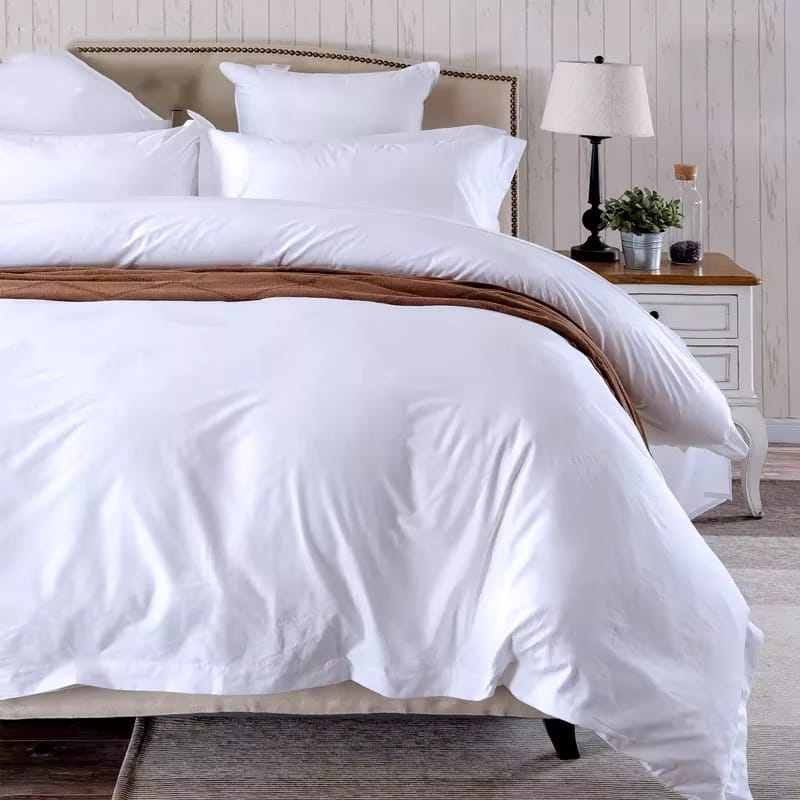
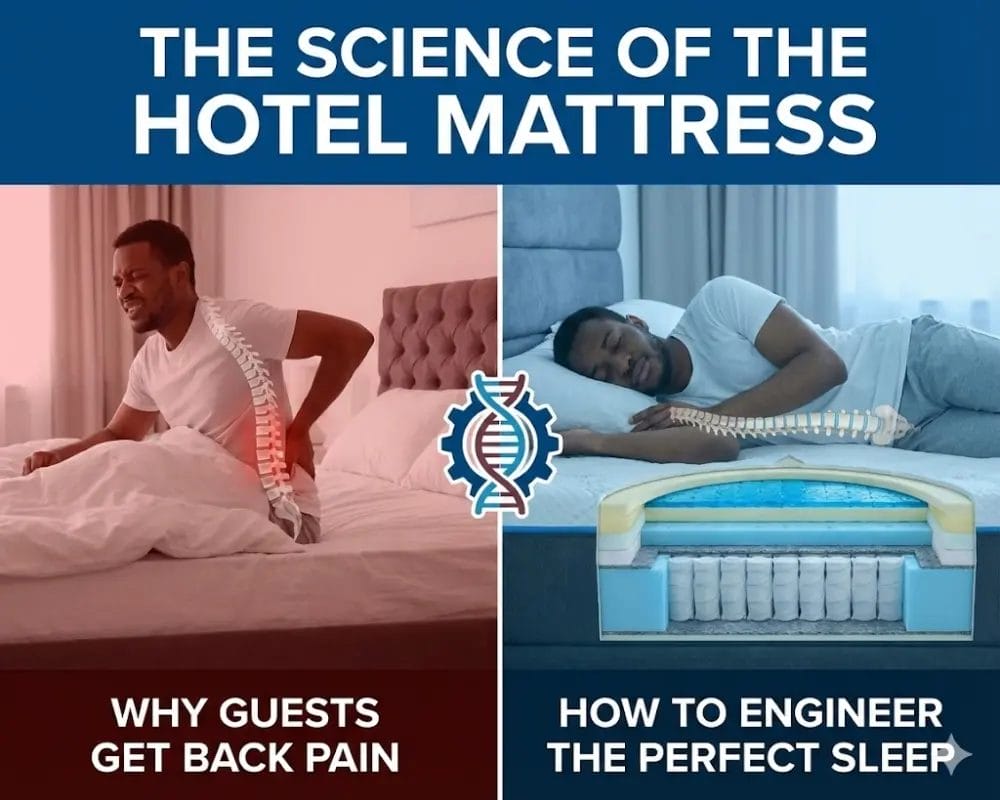
It is the most critical asset in your hotel. It occupies 80% of the guest’s time in the room. It is the primary driver of reviews. Yet, the Hotel Mattress is often the most misunderstood item in hospitality procurement.
I have a personal story that I share with many of our clients—a “Back Pain Paradox” that plagued me for a decade.
About ten years ago, I noticed a pattern. No matter how luxurious the hotel, if I stayed in China for more than three nights, I would wake up with lower back pain. I blamed my age. I blamed my office job and my degenerating lumbar spine. I assumed I just couldn’t handle “soft” beds anymore, so I started asking housekeeping for hardboards to stiffen the mattress.
But then, my work with DERBAL took me frequently to the United States. I stayed in hotels and corporate housing. The mattresses there were undeniably softer—much softer than what I experienced in China. I braced myself for the inevitable back pain.
But it never came.
I slept like a baby. I woke up refreshed.
How could this be? I asked my American colleagues, and they told me, “We buy our mattresses from China.”
So, if the mattresses are made in the same country, why was the experience so radically different? Why did one “soft” bed cripple me, while another “soft” bed cured me?
I sat down with our engineering team at DERBAL and our partner factory directors to deconstruct this. What we found was a fundamental difference in Engineering, Culture, and Support Architecture.
This guide is not just a story; it is a blueprint for General Managers and Procurement Directors. We will explain why “Soft” does not equal “No Support,” and how to choose a Hotel Mattress that ensures your guests—whether from Beijing or Boston—wake up ready to give you a 5-star review.
Part 1: The Core Conflict – The “Hard vs. Soft” Myth
To understand how to buy the right mattress, we must unlearn a common myth: Hard is good for your back; Soft is bad.
This is a simplification that leads to bad purchasing decisions. The difference lies in the distinction between Surface Feel (Comfort) and Deep Support.
The Chinese Approach: “Rigid Support”
Historically, Chinese culture favors a firm sleeping surface (stemming from Kang beds or hard wooden boards). The belief is that a hard bed keeps the spine straight.
-
Typical Structure: A rigid Bonnell spring system or very stiff pocket springs + a thin layer of Coconut Coir (Jute) + a very thin layer of foam.
-
The Result: A mattress that feels “Solid.”
-
The Problem: For side sleepers or those with spinal issues, the bed doesn’t contour. It forces the shoulder and hip to bear all the weight, leaving the lumbar (lower back) floating in the air. This lack of support causes muscles to tense up all night, leading to pain.
The American Approach: “Dynamic Contouring”
The US market prefers a “Cloud-like” feel but demands deep suspension.
-
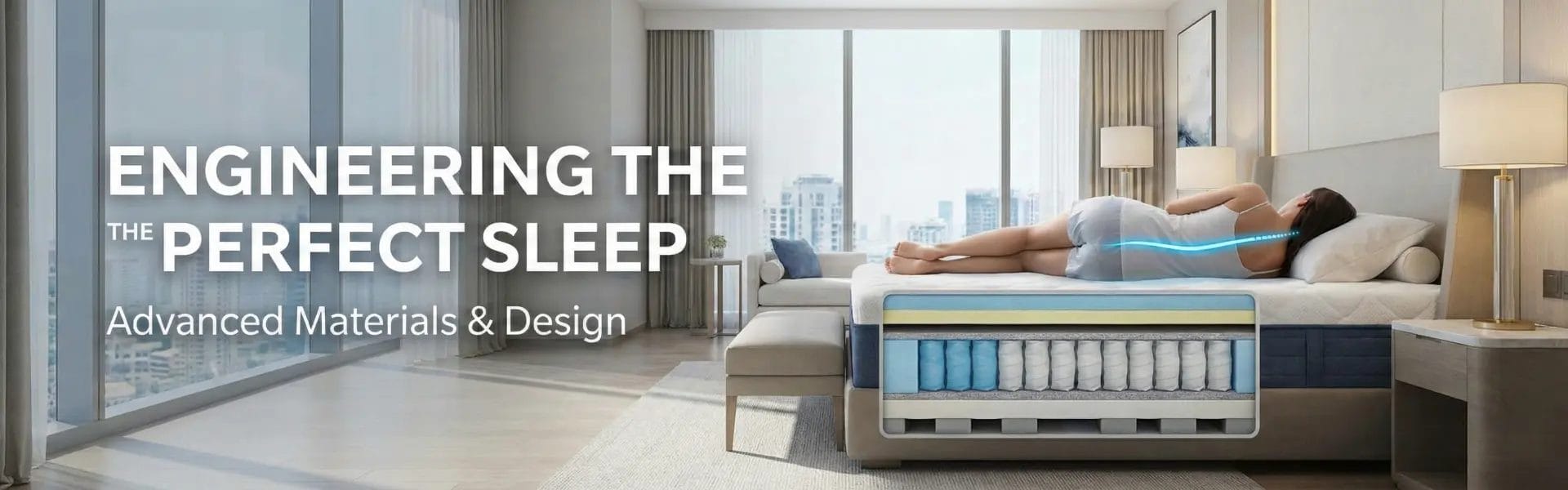
Typical Structure: High-gauge Independent Pocket Springs (Zoned) + A thick Comfort Layer (Memory Foam, Latex, or Gel).
-
The Result: You sink in, but you stop sinking.
-
The Solution: The thick comfort layer allows the heavy parts of the body (hips/shoulders) to sink, while the zoning springs push up against the lighter parts (waist/legs). The spine remains neutral.
The Epiphany: My back pain wasn’t caused by softness. It was caused by Support Failure. In many generic mattresses, “Soft” just means cheap, low-density foam that collapses. In a high-end Hotel Mattress, “Soft” means precision engineering.
Part 2: The 6 Key Categories of Hotel Mattresses
At DERBAL, we provide a one-stop solution. We don’t just sell “mattresses”; we engineer sleep systems. Here are the six technical categories you need to understand to build your RFQ (Request for Quote).
1. Independent Pocket Spring Mattress
This is the gold standard for modern hospitality. Unlike old “Bonnell” coils that are wired together (where one person moves, and the other bounces), pocket springs function independently.
-
DERBAL Standard: We use high-carbon steel springs, pre-compressed into individual fabric pockets.
-
Benefit: Zero Motion Transfer. If a guest tosses and turns, their partner doesn’t feel it. This is non-negotiable for 4-star and 5-star hotels.
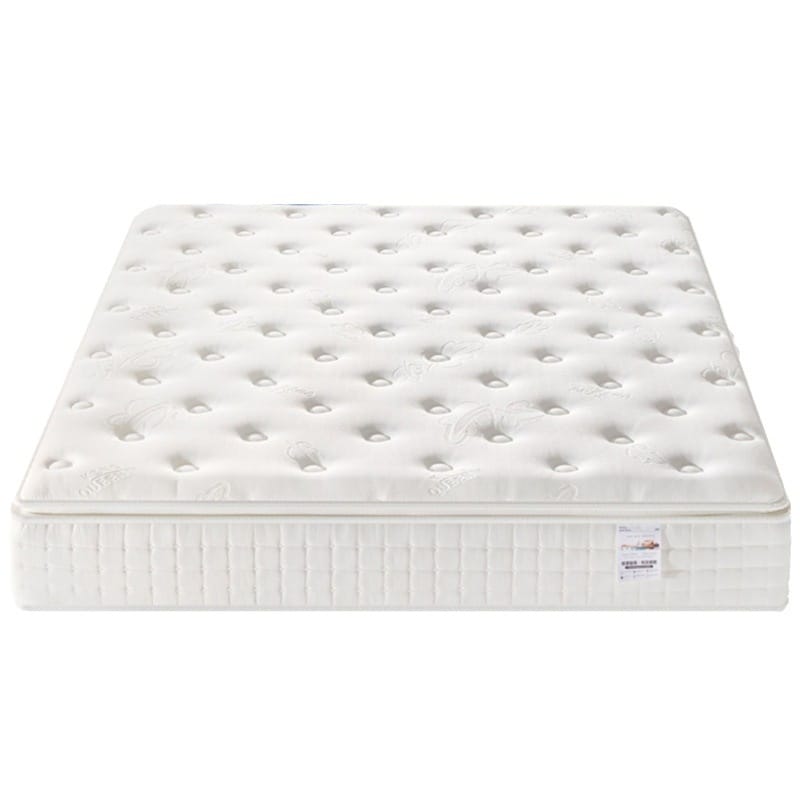
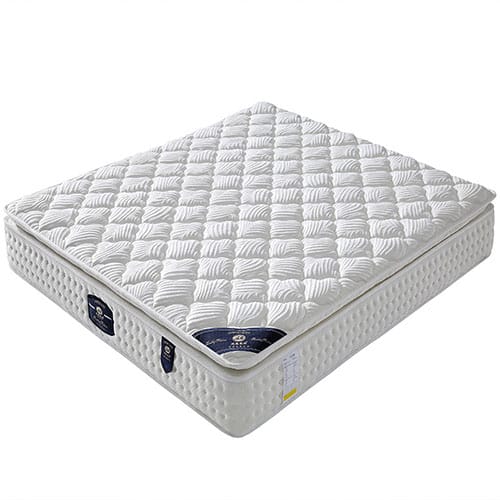
2. Hotel Pillow Top Mattress
The “Pillow Top” or “Euro Top” is that extra layer of padding sewn onto the top of the mattress.
-
The Construction: Usually contains 3-5cm of soft foam or fiberfill.
-
Why Buy It: It provides that immediate “Ahhh” feeling when a guest sits on the bed. It creates a visual perception of luxury and height.
3. Memory Foam Hospitality Mattress
Memory foam (Viscoelastic foam) was developed by NASA. It reacts to body heat and mold to the shape of the sleeper.
-
The Trend: While full memory foam mattresses are popular in residential markets (like Tempur-Pedic), hotels usually prefer Hybrid Models (Springs + Memory Foam Top).
-
Why: Full foam can sleep “hot” and is difficult for guests to move around on. A hybrid offers the cool airflow of springs with the pressure relief of memory foam.

4. Natural Latex Hotel Bed
For eco-conscious resorts or premium suites, Latex is the material of choice.
-
The Material: Derived from the sap of rubber trees.
-
Benefit: It is naturally hypoallergenic, anti-dust mite, and antimicrobial. It has a “bouncy” feel compared to the “sinking” feel of memory foam. It is incredibly durable and resists sagging better than polyurethane foam.
5. Fire Retardant Hotel Mattress (CFR1633 / BS7177)
This is the most critical B2B spec. You cannot put a residential mattress in a hotel.
-
US Standard (CFR 1633): The mattress must withstand a significant open flame test without fueling the fire.
-
UK Standard (BS 7177 Crib 5): A stricter standard required for many international chains and cruise ships.
-
DERBAL’s Role: We ensure all layers—from the knitting fabric to the inner barrier cloth—are chemically treated or inherently fire-resistant to meet local codes.

6. Orthopedic Hotel Mattress
These are engineered specifically for spinal support, often utilizing the “Zoning” technique.
-
The Tech: The springs in the center third of the mattress (where the heavy hips rest) are made of thicker wire (e.g., 2.2mm gauge), while the head and foot zones use lighter wire (e.g., 2.0mm).
-
Benefit: This balances the body horizontally, preventing the “hammock effect” that causes back pain.
Part 3: Why “Zoning” is the Secret to No Back Pain
Let’s go back to my conversation with the factory director. He revealed that the reason American mattresses felt better was Zoning and Material Resilience.
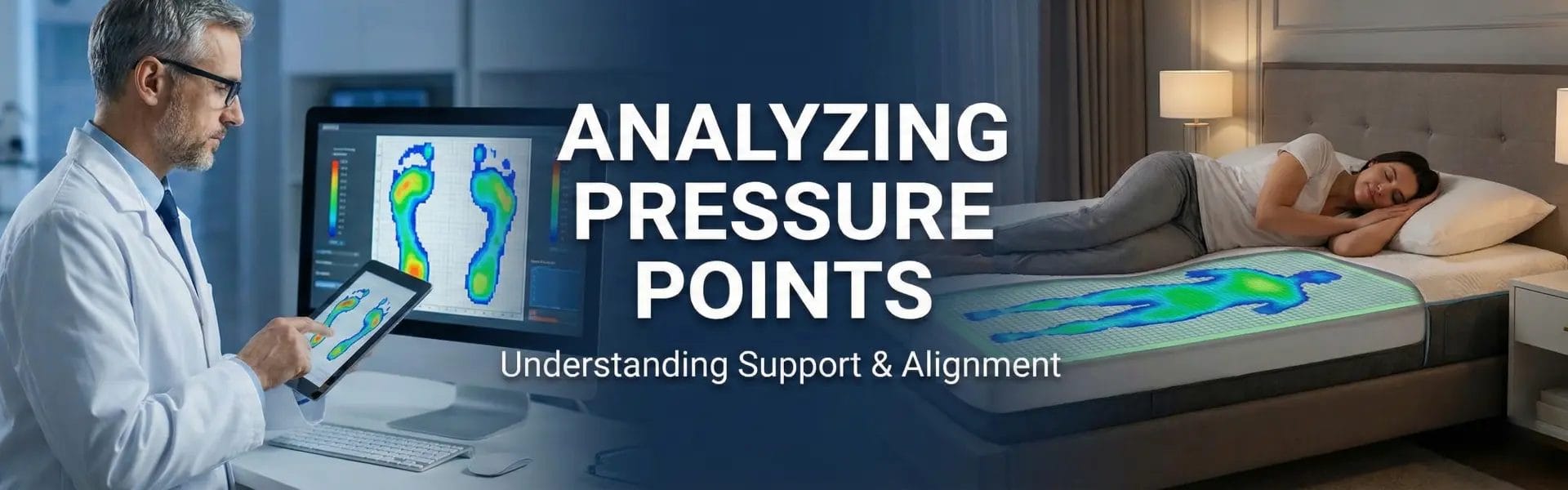
In a standard mattress, the resistance is uniform. But the human body is not a uniform block; it is an “S” curve.
-
Shoulders: Broad and heavy.
-
Waist: Narrow and light.
-
Hips: Heavy.
If the mattress is uniform:
-
On a Hard Bed: The shoulders and hips hit the hard surface. The waist bridges the gap, unsupported. Result: Muscle strain.
-
On a Cheap Soft Bed: The heavy hips sink too deep. The spine curves downward. Result: Disc compression.
The DERBAL Solution: The 5-Zone or 7-Zone System We engineer our mattresses with varying spring tensions.
-
Head/Shoulder Zone: Softer springs to allow the shoulder to sink in (vital for side sleepers).
-
Lumbar Zone: Firmer springs to push up and support the curve of the lower back.
-
Hip Zone: Balanced tension to support weight without bottoming out.
This is how we solve the back pain issue. We allow the “softness” for comfort, but provide the “resistance” exactly where anatomy dictates.
Part 4: Case Studies – Engineering Sleep for the World
As a one-stop project solution provider, DERBAL doesn’t just ship boxes. We analyze the guest demographic and engineer the product. Here are real-world examples.
Case Study 1: The “American Comfort” Retrofit
Client: Hilton Garden Inn Project (USA / Export)
-
The Challenge: The client required the brand standard “Plush” feel but needed to keep costs within a strict renovation budget. They were worried about importing from China due to the “hard bed” stigma.
-
The DERBAL Solution: We replicated the US specification using a 12-inch Hybrid Design.
-
Core: 7-Zone Pocket Spring system (2.2mm/2.0mm wire gauge).
-
Comfort: 2 inches of Gel-Infused Memory Foam (to prevent overheating) + 1 inch of High-Density Support Foam.
-
Edge Support: We encased the springs in a High-Density Foam Box. This allows guests to sit on the edge of the bed to put on shoes without sliding off—a crucial US preference.
-
-
The Result: The mattresses passed all CFR1633 fire tests and received a 9.8/10 guest satisfaction rating for sleep comfort in the first year.
Case Study 2: The International Business Hub
Client: Kempinski Hotel (China Branch)
-
The Challenge: A luxury property serving a mix of Chinese domestic travelers (who prefer hard beds) and European travelers (who prefer soft beds). A “one size fits all” mattress would alienate 50% of their guests.
-
The DERBAL Solution: The Dual-Sided Pillow Top Mattress.
-
We engineered a mattress with a detachable/flippable Topper.
-
Side A: Latex (Firmer, responsive) – Preferred by Asian guests.
-
Side B: Memory Foam (Softer, contouring) – Preferred by Western guests.
-
Implementation: Housekeeping could flip the topper based on the guest profile or request.
-
-
The Result: Complaints regarding bed hardness dropped to zero. The hotel was praised for its personalized service.
Case Study 3: The Tropical Resort
Client: Anantara Resort (Maldives)
-
The Challenge: High humidity and salt air. Standard mattresses were developing mold and sagging due to moisture absorption.
-
The DERBAL Solution: A Natural Latex Hotel Bed with breathable borders.
-
We utilized 100% natural latex (which is naturally mold-resistant).
-
We replaced the standard knitted fabric side panels with 3D Mesh Fabric. This allowed maximum airflow through the core of the mattress, preventing moisture buildup.
-
-
The Result: The lifespan of the mattresses was extended by 3 years compared to the previous supplier’s foam models.
Part 5: The Procurement Manager’s Checklist
If you are sourcing mattresses for your next project, do not just ask for “Queen Size.” Use this checklist to ensure you get the DERBAL quality standard.
-
Wire Gauge: Ask for the spring wire thickness.
-
Standard: 1.8mm – 2.0mm.
-
Heavy Duty: 2.2mm – 2.4mm (Ask for this if you want longevity).
-
-
Foam Density: This is where cheap factories cheat.
-
Avoid: 20kg/m³ density (It will collapse in 6 months).
-
Demand: Minimum 30kg/m³ for Support Foam and 50kg/m³ for Memory Foam.
-
-
Edge Support: Does the mattress have a “Foam Encasement” or just a metal wire border? Foam encasement increases the usable sleep surface by 20%.
-
Packaging:
-
Rolled/Compressed: Great for shipping costs (you can fit 300+ in a container), but limits the types of heavy border wires you can use.
-
Flat Packed: More expensive to ship, but allows for stronger edge support and thicker structures.
-
DERBAL Advice: For 5-star hotels, we often recommend Flat Packed or “Semi-Compressed” to maintain structural integrity.
-
Part 6: Maintenance – How to Make Them Last
Buying the right mattress is step one. Maintaining it is step two.
-
Rotation Schedule: Mattresses must be rotated (head to foot) every 3 months. This prevents permanent body indentations in the hip zone.
-
The Protector: Never use a mattress without a waterproof, breathable Mattress Protector. A single spilled glass of wine can ruin a $500 mattress. DERBAL supplies encasement protectors that also block bed bugs.
-
The “Sinking” Test: Every year, inspect the mattress. Place a straight edge (like a broom handle) across the bed. If there is a dip of more than 3cm when no one is lying on it, the comfort layer has failed, and it is time to replace it.
Conclusion: Don’t Let Your Guests Wake Up in Pain
The mattress is the silent engine of your hotel. When it works, no one mentions it. When it fails, everyone screams about it on TripAdvisor.
My personal journey from back pain to deep sleep taught me that quality isn’t about geography—it’s about specifications. It’s about Zoned Support, High-Density Materials, and Structural Integrity.
At DERBAL, we bridge the gap between Chinese manufacturing efficiency and Global comfort standards. We don’t force you to buy “what we have.” We engineer “what you need.”
Whether you need a rock-solid orthopedic bed for a domestic chain or a cloud-like pillow top for a US resort, we provide the one-stop solution from design to delivery.
Are your guests getting the best sleep of their lives? If you aren’t sure, it’s time to talk to us.
Contact DERBAL today at https://www.resortssupplies.com/ for a free consultation on your mattress specifications and project needs.
Frequently Asked Questions (FAQ)
Q1: How often should a hotel replace its mattresses?
-
Budget Hotels: 3-5 years.
-
Luxury Hotels: 5-7 years. However, with DERBAL’s high-density foam specs, we aim for a 7-8 year lifespan.
Q2: What is the best mattress for back pain sufferers?
-
We recommend a Medium-Firm (5-7 on the hardness scale) Hybrid Mattress. It must have a Pocket Spring core for support and a Latex transition layer for resilience.
Q3: Can DERBAL customize the mattress height?
-
Yes. Standard hotel heights range from 25cm (10 inches) to 35cm (14 inches). We can adjust the spring height and foam layers to match your headboard design perfectly.
Q4: Do you offer trial periods for bulk orders?
-
For large projects (100+ rooms), we strongly recommend producing a “Model Room” sample. We ship one mattress for your team to test, cut open, and verify before mass production begins.