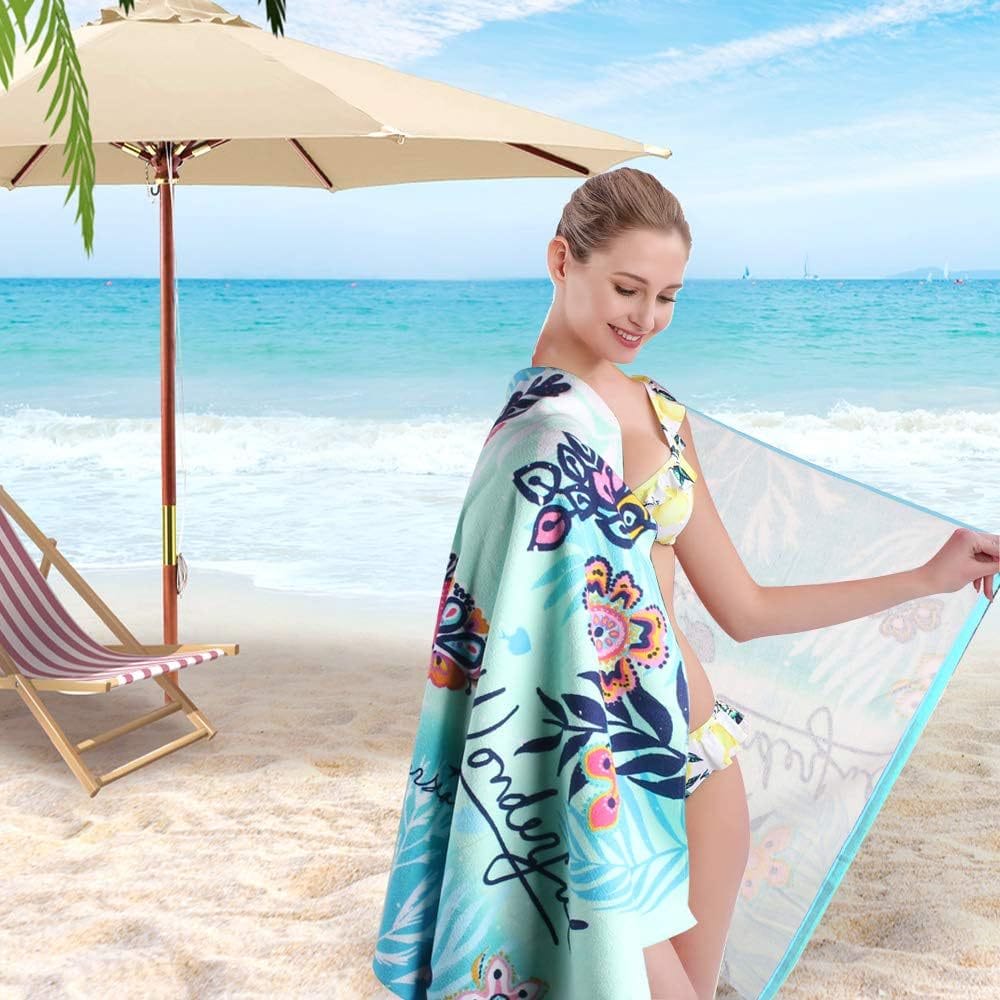
If you run FF&E specifications or procurement for island resorts, you already know towels take a daily beating. A true Hotel Beach Towel must survive salt spray, intense UV, chlorinated pools, sand abrasion, sunscreen oils, and nonstop commercial laundering—without bleeding dye, losing pile, or bursting seams. This guide distills what to specify, how to verify it, and where the trade‑offs sit so you can write defensible RFQs, compare suppliers on equal terms, and extend lifecycle cost‑effectively.

You’ll find practical acceptance criteria tied to recognizable standards (AATCC/ISO/ASTM), island‑specific laundering guidance, RFQ‑ready language blocks, a cost‑per‑use mini‑guide, and a procurement playbook fit for multi‑property rollouts. When we reference example product configurations from DERBAL, we do so neutrally and only to show how spec language translates into real‑world choices.
Key Takeaways
- Target a balanced GSM envelope for island climates: 450–600 GSM for most beach/pool programs; consider 380–450 GSM where dry room capacity is tight; reserve 600–720+ GSM for premium zones with robust drying.
- Prefer ring‑spun, combed cotton terry with 2‑ply loop pile for strength and softer hand; specify double‑needle lockstitch hems with polyester‑core or continuous‑filament polyester threads and bartacks at corners.
- Tie colorfastness to methods and ratings: washing (ISO 105‑C06/AATCC 61), chlorinated water (ISO 105‑E03), seawater (ISO 105‑E02), light/UV (ISO 105‑B02), and crocking (AATCC 8/15). Require third‑party lab reports dated within 12 months.
- Set dimensional stability (ISO 6330) and minimum tensile/tear strength (ASTM D5034/D2261) thresholds; define sampling and on‑delivery acceptance plans.
- Engineer island logistics: stagger shipments, hold buffer stock, and model cost‑per‑use rather than unit price alone for a truer total cost picture.
Why island resorts punish towels more than mainland properties
UV and heat are relentless. Intense sunlight accelerates dye fading and fiber embrittlement; UV‑sensitive shades suffer fastest. The industry relies on standardized lightfastness tests such as ISO 105‑B02 to compare dye system resilience under xenon‑arc exposure according to the method’s parameters, which helps align field expectations to lab results as long as laundering variables are also controlled. See ISO’s catalog entry for details in the method description in the official ISO 105‑B02 lightfastness method overview.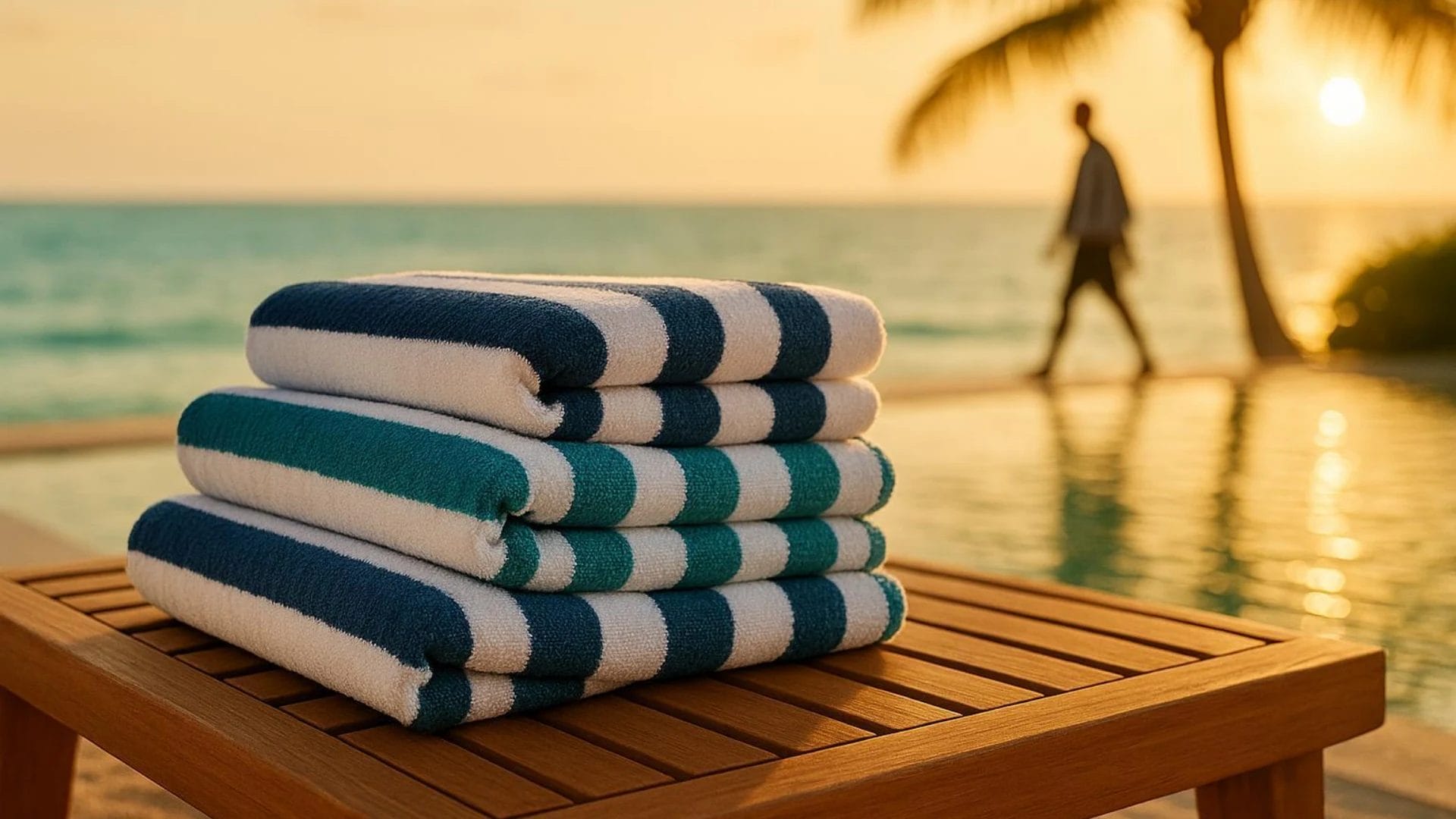
Salt and chlorine are a one‑two punch. Seawater salts and chlorinated pool water both impact colorfastness and fiber integrity. Chlorine, in particular, can attack certain dye classes; that’s why island programs often pair reactive dyes for most shades with vat dyes for darker or high‑exposure colorways when feasible. To anchor specs, refer to ISO’s dedicated method ISO 105‑E03 colorfastness to chlorinated water and the complementary ISO 105‑E02 seawater exposure method.
Humidity slows everything down. High ambient humidity can stretch dry times by 20–40% depending on airflow and finishing capacity. Heavier towels feel luxurious but can bottleneck laundry turns. Selecting the right GSM and loop density is as much an operations decision as it is a guest‑experience choice.
Sand and sunscreen create constant abrasion and oil load. Mechanical abrasion from sand and the presence of oils drive linting and pile loss. Construction details—yarn quality, twist level, and loop architecture—matter as much as base fiber.
Industrial laundering multiplies wear. Alkalinity, oxidizers, temperature, and mechanical action all influence textile degradation. Industry associations publish guidance to balance hygiene with longevity; see the TRSA resource center for textile care practices and ETSA’s overview of best practices in the ETSA resources on professional textile care.
Defining the performance envelope for a Hotel Beach Towel
This section frames decisions you can paste into your FF&E schedule or RFQ. Think of it as a control panel: GSM, yarn/pile, dye system, and hem construction each move lifecycle, guest feel, and laundry throughput.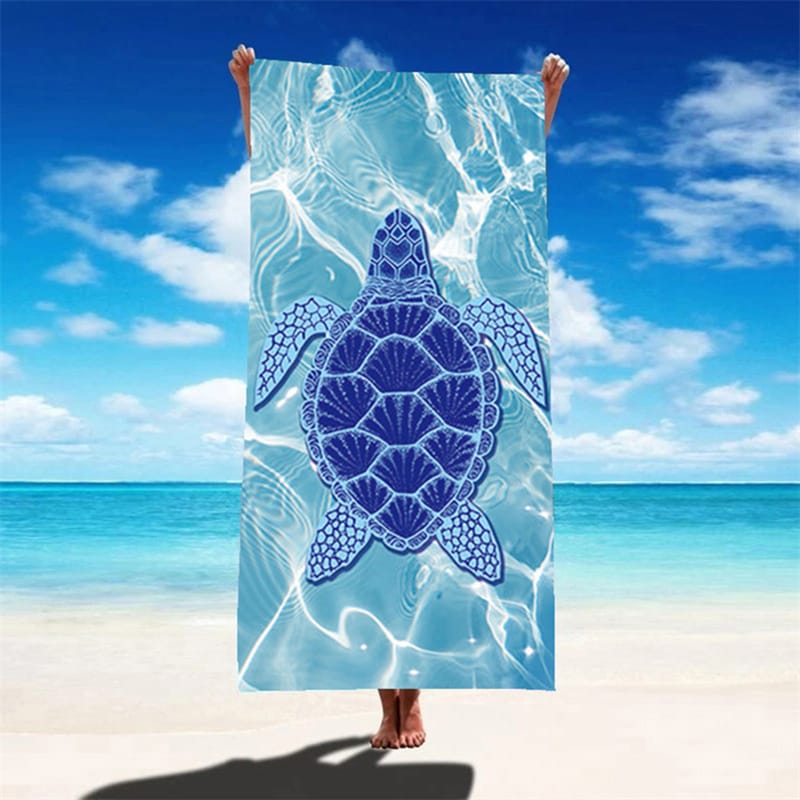
GSM ranges and trade‑offs
- 380–450 GSM: Lighter, faster drying, easier on constrained dry rooms; handfeel is thinner and can appear less premium.
- 450–600 GSM: The all‑rounder zone for most island beach/pool programs; good absorbency and durability with manageable dry times.
- 600–720+ GSM: Plush and photo‑ready; slower to dry in humid climates; reserve for VIP setups or where finishing equipment is strong.
Two operational tips:
- Specify GSM with a tolerance (±3–5%) and define how it is measured to avoid disputes; basis weight should be per ASTM D3776, the ASTM method for mass per unit area (GSM).
- Balance GSM with towel size; a 100 × 180 cm towel at 650 GSM may cross practical weight thresholds for staff handling when wet.
Yarn and pile construction
Fiber and yarn choice is the spine of durability. 100% ring‑spun, combed cotton typically offers better tensile strength and a softer hand than open‑end yarns; it also helps reduce linting. For pile, 2‑ply loop construction generally resists snagging better than single‑ply at the same GSM because each loop is anchored by two yarns. Twist level matters: lower twist can feel cloud‑soft but may shed more; a moderate twist balances touch and lifecycle.
Hems, threads, and reinforcements
Edge failures are a top driver of early retirement. Double‑needle lockstitch hems reduce edge failures during extraction; specify stitch density and thread type so factories don’t substitute. Polyester‑core spun or continuous‑filament polyester threads resist chemicals and heat better than cotton threads in industrial laundering. Add bartacks at corners to arrest seam pops.
Dye systems and finish
Reactive dyes deliver excellent overall color and softness across broad palettes; vat dyes excel in chlorine and UV resistance, particularly for deep/navy/black. Consider mixing systems by colorway based on exposure. Pre‑shrink and pre‑wash to stabilize dimensions; require shrinkage ceilings verified per ISO 6330, the ISO domestic washing/drying procedures.
Quick comparison matrix
| Spec dial | Guest feel | Durability under heavy laundering | Dry time in humid climate | Cost impact |
|---|---|---|---|---|
| 380–450 GSM | Light, less plush | Moderate | Fastest | Lower |
| 450–600 GSM | Substantial, balanced | High | Moderate | Medium |
| 600–720+ GSM | Plush, premium | High body durability; hems need reinforcement | Slowest | Higher |
| 1‑ply loops | Softer at weight | More snag‑prone | Slightly faster | Lower |
| 2‑ply loops | Fuller hand | Better snag resistance | Slightly slower | Medium |
| Reactive dye | Soft hand, broad palette | Good overall | N/A | Standard |
| Vat dye | Slightly firmer hand | Strong chlorine/UV resistance | N/A | Higher |
Testing that predicts field life: methods, gray scales, and lab pitfalls
Specs without test methods are opinions. Anchor your RFQ to recognized procedures, then define sampling and acceptance so everyone is playing the same game.
- Colorfastness to laundering (accelerated): AATCC 61 simulates cumulative wash effects using controlled conditions and multifiber adjacent fabrics. Ratings use the Gray Scale for Color Change and Staining (1–5, with 5 best). See the AATCC 61 method overview.
- Dimensional change after domestic laundering: AATCC 135 sets procedures for wash/dry and dimensional measurement; ISO 6330 is the international counterpart. See AATCC 135 for dimensional changes and ISO 6330 washing/drying procedures.
- Crocking (rubbing): AATCC 8 and AATCC 15 assess dry/wet color transfer; important for dark/reactive‑dyed towels exposed to oils and wet surfaces. See AATCC 8 colorfastness to crocking.
- Washing colorfastness (international): ISO 105‑C06 aligns to domestic/commercial laundering contexts; see ISO 105‑C06 washing colorfastness.
- Lightfastness (UV): ISO 105‑B02 evaluates fading under xenon‑arc exposure—critical for poolside branding; see ISO 105‑B02 lightfastness.
- Seawater and chlorinated water: Island programs should include both ISO 105‑E02 and ISO 105‑E03. See ISO 105‑E02 seawater and ISO 105‑E03 chlorinated water.
- GSM measurement: Protect basis weight specs with ASTM D3776 mass per unit area.
- Strength and tear: Use ASTM D5034 grab tensile and ASTM D2261 tongue tear.
How to read gray scales and avoid lab traps
- Gray scales: A rating of 5 means no change; 1 means severe change. Most island programs will accept ≥ 4 after defined exposures for washing/light and ≥ 3–4 for chlorinated water depending on depth of shade.
- Sample preparation: Require pre‑conditioning and clear identification of the exact dye recipe/shade card; subtle formulation shifts can swing results.
- Equivalency claims: “50 home wash equivalents” in AATCC 61 are not the same as 50 full commercial cycles; use results comparatively, not literally.
- Lab accreditation: Prefer labs with ISO/IEC 17025 accreditation and include the lab’s accreditation number in your documentation request.
- Repeatability: For critical shades (deep navy/black), request duplicate tests from retained samples to guard against single‑run anomalies.
Procurement playbook for island rollouts
MOQ and lead time deserve daylight. Confirm minimum order quantities by color/size and the true ex‑factory and transit windows, factoring in seasonal freight volatility to islands. If you’re targeting a grand opening, build a two‑week weather buffer into your maritime leg.
Phasing shipments reduces risk. For new openings or refurbishments, stagger deliveries (for example, a 60/40 split) so the second tranche backfills early wear and provides insurance against transit delays. Make sure the second tranche is dye‑matched to the first via a retained lab swatch.
Buffer stock is cheaper than reputational damage. Model expected monthly loss/replacement and hold 1–2 months of buffer on‑island if storage allows. Balance the carrying cost against the risk of stockouts in peak periods when towels walk faster.
Compare vendors on evidence, not adjectives. Use a compact matrix that forces apples‑to‑apples evaluation on construction, testing, and acceptance. Add lifecycle and logistics columns to catch hidden costs.
| Vendor | GSM (±%) | Yarn/pile | Dye system | Hem/thread | Key test results (methods) |
|---|---|---|---|---|---|
| A | 500 (±5) | 100% ring‑spun, 2‑ply loops | Reactive (navy), vat (black) | Double‑needle, poly‑core | AATCC 61 ≥4; ISO E03 ≥3–4; ISO B02 ≥4 |
| B | 580 (±3) | Ring‑spun, 1‑ply loops | Reactive all shades | Double‑needle, poly‑core | AATCC 61 ≥4; ISO B02 ≥4 |
| C | 460 (±5) | Open‑end, 1‑ply loops | Reactive all shades | Single‑needle, cotton thread | AATCC 61 ≥3–4; ISO E03 ≥3 |
Cost‑per‑use beats sticker price. Divide purchase price by verified average wash cycles‑to‑replacement (by construction) to see which proposal truly wins. If Vendor B costs 12% more but survives 30% longer in verified conditions, the math is clear.
Align laundry SLAs with your spec. If you outsource, ensure the launderer’s chemistry and parameters (pH, oxidizer levels, temperatures, extraction) are documented and compatible with your acceptance plan. Put test‑based penalties or rewash protocols in the SLA.
Cost‑per‑use mini‑guide: a quick model you can run
Here’s the deal: two towels can have the same unit price but wildly different lifecycles. Model total cost per guest use to avoid false savings.
Inputs to collect
- Purchase price per towel (USD)
- Verified average cycles‑to‑replacement under your laundering parameters
- Laundering cost per cycle (energy, water, chemicals, labor)
- Loss rate per month (missing/damaged)
- Caveats: Only use cycles verified via lab plus field checks; adjust for island energy costs and seasonality. If you can’t verify cycles, compare proposals on test ratings (methods + thresholds) and seam construction as proxies for life.
Practical example: six proposed DERBAL configurations mapped to this spec
The following are neutral, example configurations that reflect common island‑resort needs. They are provided as templates pending confirmation against DERBAL’s final SKU sheets and lab reports. They are not performance claims. Learn more about the company at DERBAL.
- DERBAL ST‑480 Island Turnover
- Use case: High‑turnover beach kiosks with constrained dry rooms.
- Spec: 90 × 170 cm; 480 GSM ±5%; 100% ring‑spun combed cotton; 1‑ply loop; reactive‑dyed brights; double‑needle hems; polyester‑core thread; corner bartacks.
- Target testing: AATCC 61/ISO 105‑C06 ≥ 4; ISO 105‑E03 ≥ 3–4; ISO 105‑B02 ≥ 4; AATCC 8 Dry ≥ 4.
- DERBAL ST‑520 Balanced Pool & Beach
- Use case: Main pool/beach towel for most island properties.
- Spec: 90 × 180 cm; 520 GSM ±5%; 100% ring‑spun combed; 2‑ply loop; reactive‑dyed mid‑tones; lockstitch hem; poly‑core thread; bartacks.
- Target testing: Same acceptance ranges as above; shrinkage ≤ 3% after ISO 6330.
- DERBAL ST‑560 Premium Feel, Managed Drying
- Use case: Premium daybeds/cabanas with adequate finishing capacity.
- Spec: 95 × 185 cm; 560 GSM ±5%; ring‑spun combed; 2‑ply loop; reactive dye for lights, vat dye for navy/black; reinforced hem.
- Target testing: As above with emphasis on ISO 105‑E03 for pool zones.
- DERBAL ST‑600 Coastal Luxe
- Use case: VIP setups and photo‑forward experiences.
- Spec: 100 × 200 cm; 600 GSM ±5%; ring‑spun combed; 2‑ply loop; vat‑dyed deep shades; double‑needle hem; continuous‑filament polyester thread.
- Target testing: ISO 105‑B02 ≥ 4 for outdoor exposure; confirm AATCC 61 ≥ 4 after defined cycles.
- DERBAL ST‑Stripe 520 Resort Identity
- Use case: Branded stripe palette maintaining color under pool exposure.
- Spec: 90 × 180 cm; 520 GSM ±5%; ring‑spun combed; 2‑ply loop; reactive/vat mix by stripe color; color‑matched poly‑core thread; bartacks.
- Target testing: Add AATCC 8/15 crocking focus for dark stripes.
- DERBAL ST‑Eco 500 Operations‑Friendly
- Use case: Lower dry‑time footprint with balanced hand.
- Spec: 88 × 175 cm; 500 GSM ±5%; ring‑spun combed; 1.5‑ply low‑snag loops; reactive dye; reinforced hems; poly‑core thread.
- Target testing: Emphasize shrinkage control and tensile/tear via ASTM D5034/D2261 to extend usable life at moderate GSM.
How to use these: Insert your chosen configuration into the RFQ block above, require method‑tied test reports dated within 12 months, and apply on‑delivery acceptance. If DERBAL or any vendor offers alternates, compare on the vendor matrix with like‑for‑like test evidence.
Field case frameworks (named properties noted; metrics anonymized pending permission)
Note on verification: The following frameworks are structured for audit‑readiness. Named properties are included per user direction but measurable outcomes remain anonymized until written permissions and corroborating documents (e.g., PO excerpts, lab/inspection summaries) are granted.
Case A — Reethi Faru Maldives
- Context: High‑occupancy island resort with significant pool/seawater exposure; on‑property laundry with limited dry room capacity during monsoon shoulder.
- Specification move: Shifted core pool/beach program to a 520–560 GSM, ring‑spun combed, 2‑ply loop construction; double‑needle hems, polyester‑core threads; reactive for mid‑tones, vat for navy.
- Acceptance discipline: Required third‑party testing to AATCC 61/ISO 105‑C06 (washing), ISO 105‑E03 (chlorinated water), ISO 105‑B02 (light), with shrinkage capped per ISO 6330; on‑delivery random carton inspection.
- Anonymized outcome: Over a tracked window (18–24 months), towels met internal appearance thresholds through a higher number of wash cycles versus prior spec, with reduced seam failures credited to hem/thread upgrades. Specific cycle counts redacted pending permission and documentation.
- Operational note: Drying bottlenecks were mitigated by retaining a 480 GSM kiosk towel for rainy weeks while keeping 520–560 GSM for standard service.
Case B — Stay Islands
- Context: Boutique island property with strong brand color requirements including deep navy and black for poolside identity; partial outsourcing of laundry.
- Specification move: Introduced vat‑dyed dark colorways for pool zones, reactive mid‑tones for beach; 500–520 GSM with double‑needle hems and bartacks; vetting laundry provider’s chlorine levels and rinse protocols.
- Acceptance discipline: Same method‑tied test plan as Case A; SLA addendum to align outsourced laundry chemistry and temperature with acceptance thresholds.
- Anonymized outcome: Fewer early color complaints on dark shades versus legacy items; verified shrinkage ≤ 3% after defined ISO 6330 procedure; exact colorfastness scores and cycle counts pending permission and lab documentation.
- Operational note: Maintained a small buffer of lighter GSM towels for periods of high humidity and limited dryer availability.
Care and laundering guidance tuned for island conditions
Good specs die quickly under harsh wash chemistry; great laundering stretches lifecycle without compromising hygiene. Think of it this way: care practices are part of the towel’s design.
Chemistry balance: Keep alkalinity and oxidizer levels within the launderer’s recommended bands for hospitality textiles; avoid unnecessary over‑chlorination that accelerates dye breakdown. Industry associations provide general guardrails; see the TRSA guidance library on laundering practices.
Temperature and mechanics: Use the lowest effective wash and drying temperatures that meet disinfection targets; avoid over‑extraction pressures that crush pile and stress hems.
Load management: Separate heavily sunscreen‑laden loads from lights; oils can migrate and cause uneven crocking perceptions.
Rinsing habits: Where operations allow, encourage a quick freshwater rinse after pool use to reduce chlorine load before collection.
Drying airflow: Prioritize airflow over extreme heat; in humid seasons, schedule more frequent, smaller loads or temporarily switch to lighter GSM items.
Inspection cadence: Implement weekly checks for seam integrity and pile loss; rotate out items that slip below guest‑visible thresholds before complaints surface.
Acceptance checklist you can run on delivery day
Bring a cart, a scale, and a plan.
Visual and construction
- Randomly select cartons per sampling plan; check hems for consistent double‑needle stitching and corner bartacks.
- Inspect loops for uniform height and density; note any snags or skipped stitches.
- Confirm thread is polyester‑core or continuous‑filament as specified (labeling + vendor declaration).
Dimensional and weight checks
- Measure length/width on a flat table; confirm within ±1.5% of finished size.
- GSM spot‑check: Cut a 100 cm² coupon from a defect sample (or sacrificial sample), weigh, and extrapolate per ASTM D3776. Record and average multiple spots.
Documentation and testing
- Verify third‑party lab reports (≤ 12 months old) for each shade group; confirm methods and gray‑scale ratings meet or exceed your RFQ thresholds.
- File lab accreditation details and sample IDs for audit.
Disposition
- If >10% of the sampled units fail a given criterion, trigger your rejection/credit clause. Quarantine any suspect cartons pending vendor guidance.
FAQ: quick answers for specifiers and buyers
- What GSM should I choose for a Hotel Beach Towel in the tropics?
- For most island resorts, 450–600 GSM balances absorbency, feel, and dry time. If dry room capacity is constrained or humidity is extreme, consider 380–450 GSM for faster turns.
- Ring‑spun vs open‑end—what matters in practice?
- Ring‑spun, combed cotton generally provides higher strength and a softer hand; it sheds less and holds up better to repeated washing than open‑end at the same GSM.
- How do I write a spec that vendors can’t “value engineer” without approval?
- Tie every performance promise to a method and an acceptance threshold (AATCC/ISO/ASTM). Require third‑party lab reports with sample IDs matching production lots and define on‑delivery inspection and failure thresholds.
- Can I use very dark brand colors by the pool?
- Yes, but consider vat dyes for deep/navy/black in pool zones and set minimum ISO 105‑E03 chlorinated water ratings. Expect some fading over life; engineer it within acceptable limits.
- What’s the best hem construction for durability?
- Double‑needle lockstitch hems with polyester‑core or continuous‑filament polyester thread plus bartacks at corners. Specify stitch density.
- Do bigger towels always last longer?
- Not necessarily. Size impacts handling and dry time. Durability comes more from yarn quality, loop construction, hem/thread choices, and laundering discipline than sheer dimensions.
Next steps
- Paste the RFQ block into your next tender, set the acceptance thresholds, and attach your sampling plan.
- Build a vendor matrix using the columns above so you can compare proposals on like‑for‑like evidence rather than adjectives.
- If you need help mapping an island‑ready spec to available configurations, you can reference the neutral templates above and contact DERBAL for technical sheets or sampling—evidence should lead every decision.