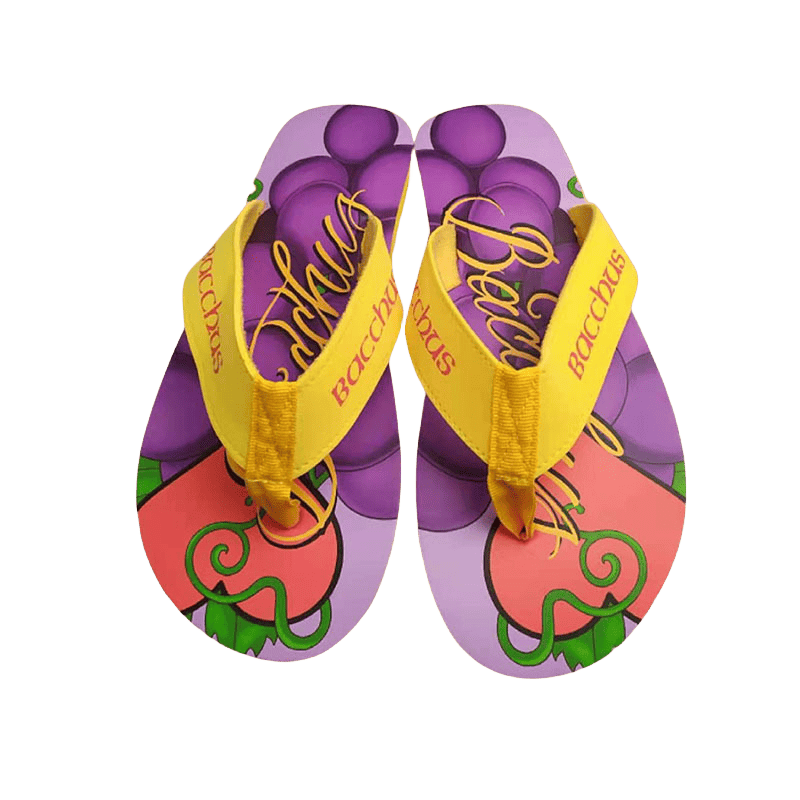
Beach slippers look simple. But the right choice influences guest safety around wet decks, the look and feel of your brand, housekeeping workflow, and even ship‑window timing for pre‑opens. If you manage procurement for a resort—or you’re running OS&E/FF&E on a renovation—you’re making a decision that touches safety, sustainability, and total cost per occupied room.
This guide is written from a procurement and project perspective. We’ll lead with customization at scale—because that’s what guests notice first—and connect it to the logistics and standards you need to deliver reliably.

Key takeaways
- Treat Beach Slippers as a branded safety amenity: pick compounds and tread that perform on your wet substrates and pair them with consistent logo/color execution.
- Make customization decisions early—logo method, PMS colors, packaging, and size runs drive MOQs, unit cost, and lead time.
- Validate slip resistance with lab data where available (e.g., ASTM F2913/SATRA TM144) and always run on‑property wet‑deck trials before rollout.
- For 4‑ and 5‑star properties, plan provisioning levels in line with classification norms; slippers are commonly “on demand” at 4‑star and “in‑room” at 5‑star in many European markets, per the Hotelstars Union 2025–2030 criteria.
- Consolidate OS&E shipments and align with FF&E milestones. Build buffers for ocean routes—especially feeders into island destinations—to protect opening dates.
- Document sustainability choices clearly: which components are OEKO‑TEX or GRS‑verified, and which packaging elements are FSC‑certified.
A quick decision framework for hotel Beach Slippers
Before diving into specs, clarify the context. Think of it this way: match the setting and service model to the SKU family, then layer branding and logistics on top. If your primary zone is a slick porcelain pool deck with constant spray, your first filter is wet‑traction. If you’re moving guests along long timber boardwalks, comfort and wear rise to the top. Eco‑positioned boutiques may prioritize material storytelling and packaging disclosures.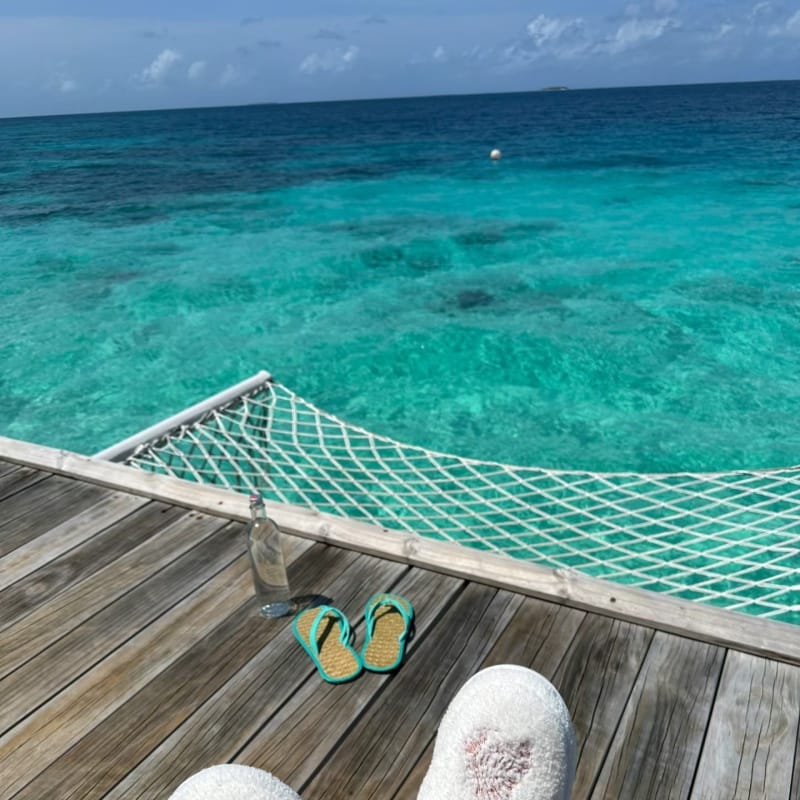
SKU families at a glance (examples are illustrative):
| Setting | Primary SKU | Why it fits | Notes |
|---|---|---|---|
| Pool/wet deck | EVA beach slippers | Lightweight comfort; good wet contact; fast dry | Verify wet traction via ASTM F2913/SATRA TM144 where available; test on your tiles |
| Beach/villa paths | Rubber flip flops | Balanced durability and grip; resilient on boardwalks | Check tread siping and strap comfort for longer walks |
| Family/all‑inclusive | PVC slides | Durable, simple to sanitize; stable strap | Confirm comfort vs hardness; consider size breadth |
| Eco‑program suites | Cork‑sole eco slippers | Natural cushioning; sustainability story | Align claims with GRS or component disclosures |
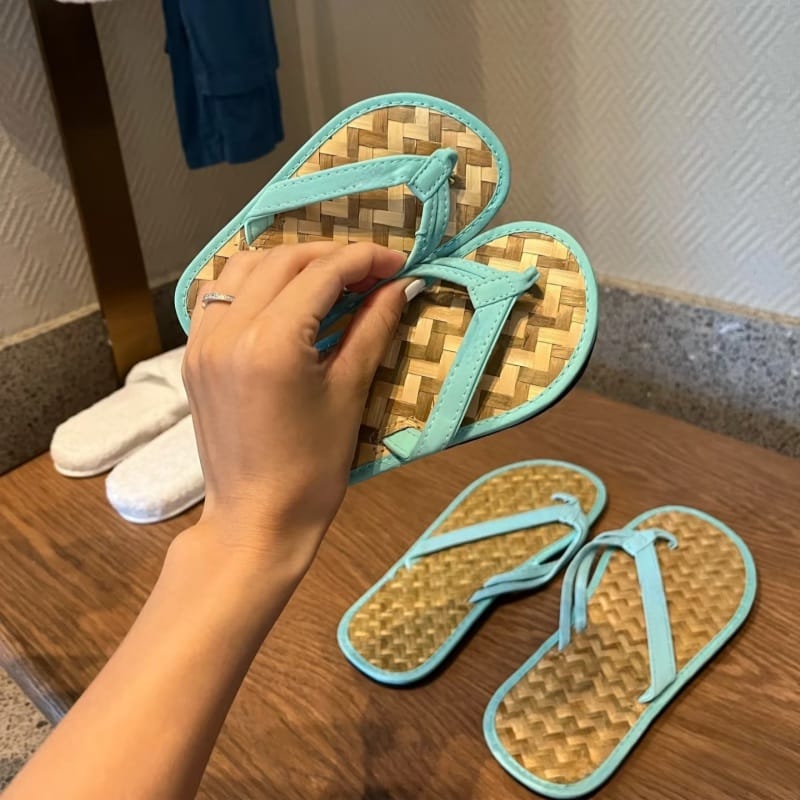
| Boutique outdoor | Natural straw slippers | Breathable, tactile upper | Pair with EVA non‑slip outsole; avoid prolonged soaking |
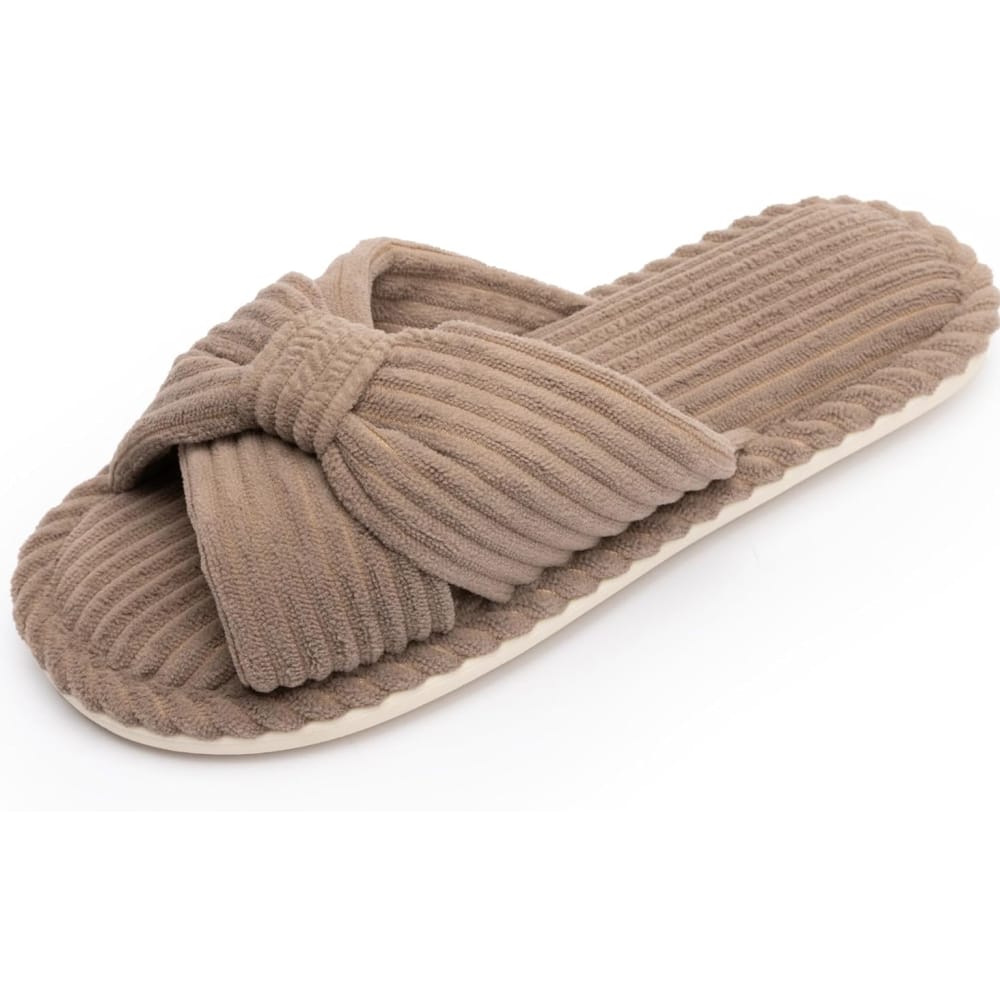
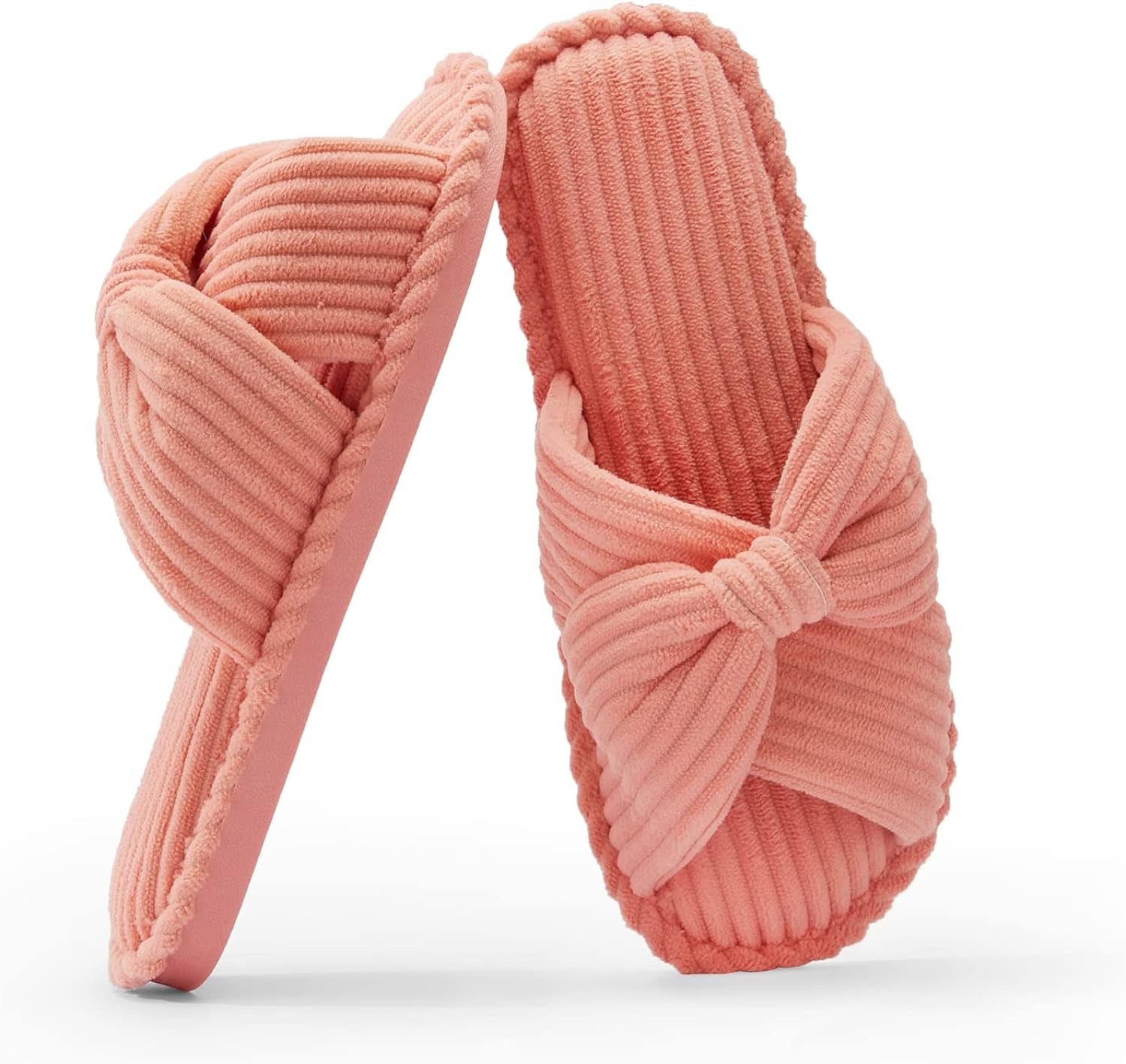
| Spa/villa indoor | Waffle or velvet slippers | Brandable textiles; plush feel | Not for wet decks; use indoors or dry terraces |
Why material and construction matter
Material choice drives comfort, traction, durability, and cost. Here’s the practical lens many buyers use.
- EVA (ethylene‑vinyl acetate): Soft, lightweight, conforming feel that can improve contact on smooth wet surfaces. It’s comfortable for quick walks around pools, though softer grades can wear faster. Tread design matters as much as compound.
- Rubber (natural/synthetic): Generally tougher and more wear‑resistant. With fine siping and a suitable compound, rubber can deliver consistent wet traction and longevity for villa paths and sandy boardwalks.
- PVC/TPE slides: Harder feel but strong wear properties. Many hotels use PVC slides for easy sanitization and durability; confirm that hardness doesn’t create foot fatigue on long walks.
- Textiles/uppers: Cotton, microfiber, waffle, or woven straw change the touch and breathability. For beach use, prefer fast‑dry or wipeable surfaces; reserve plush fabrics for indoor/spa contexts.

What does the evidence say? A manufacturer explainer notes EVA often provides higher wet‑surface grip due to softness and conformity, while PVC can excel through aggressive tread geometry and wear resistance; both require real‑world validation on your surfaces. See the comparison in the manufacturer explainer on slip properties between EVA and PVC in the footwear context in the MapperShoe EVA vs PVC discussion (industry explainer, not peer‑reviewed).
When it comes to amenity standards, regional classification frameworks can shape expectations. For European properties, the Hotelstars Union clarifies that slippers are typically “on demand” at 4‑star and “in‑room” at 5‑star, which helps set provisioning levels and storage planning. Reference: Hotelstars Union 2025–2030 criteria.
Slip resistance and guest safety around wet areas
Lab methods like ASTM F2913 and SATRA TM144 measure dynamic coefficient of friction using whole‑shoe testers across dry and wet conditions. They create comparable numbers, but results depend on surfaces, contaminants, and compounds—so treat them as inputs, not universal guarantees.
- For context on how buyers use these methods, see SATRA’s overviews of whole‑shoe slip testing and updates to U.S. standards: SATRA’s STM 603 testing explainer and SATRA’s bulletin on ASTM F2913‑24 updates.
- In practice, many teams pair lab data with on‑property wet‑deck trials. Run trials on your actual pool tiles, stone, or textured concrete after typical cleaning, and collect observations or simple COF proxies if your safety team uses them. A design article discussing wet‑area slip considerations and DCOF expectations offers useful framing for aquatic spaces: AquaTile’s guidance on wet‑deck slip safety.
Pragmatic buyer checklist:
- Request any available whole‑shoe slip test reports (ASTM F2913 or SATRA TM144) from candidates.
- Inspect tread geometry (fine siping, water channels) and outsole thickness.
- Pilot test 2–3 shortlisted SKUs on representative wet surfaces during normal operations.
- Capture housekeeping feedback: how quickly they dry, how easily they clean, and how they hold up for multi‑guest reuse if relevant.
The Beach Slippers SKU taxonomy buyers actually use
Below are category profiles with where they fit, pros/cons, branding options, and practical selection tips. We include internal links to example product pages for deeper spec context.
1) EVA beach slippers
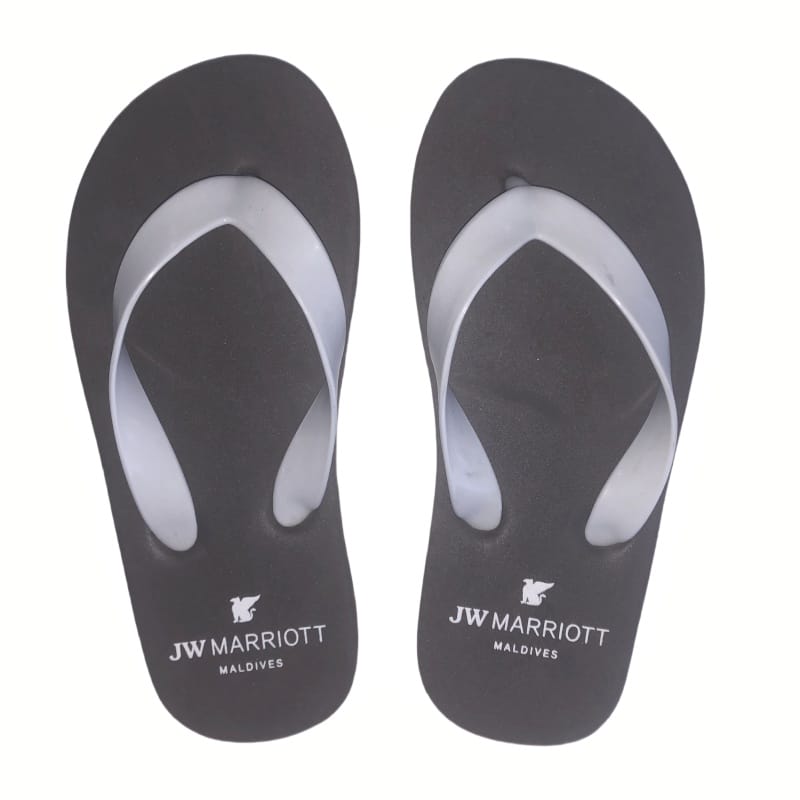
Best for: Pool decks and fast‑turn beach amenities where comfort and water contact are key. refer EVA Slippers
- Properties: Lightweight; soft underfoot; conforms to smooth wet tiles. Pair with fine siping or patterned tread to disperse water.
- Branding: Emboss/deboss on footbeds; strap printing in PMS‑matched colors.
- Tips: Specify EVA density/durometer if available; a mid‑density often balances comfort with wear.
- Explore examples for context: Hotel Beach Slippers overview.
2) Rubber flip flops
Best for: Villas and boardwalks; daily wear to and from pools or beaches.
- Properties: Durable; holds up on sand and timber; good with fine siping and quality compound.
- Branding: Strap embossing or two‑color strap prints.
- Tips: Check strap comfort and toe‑post finishing to avoid abrasion.
- See premium builds: Luxury flip flops positioned for islands.
3) PVC slides
Best for: Family resorts and high‑turn environments; easy wipe‑down.
- Properties: Harder feel; stable strap; strong wear. Wet traction depends on tread pattern; validate on your surfaces.
- Branding: Large strap print area; durable pad printing or digital print with protective coating.
- Tips: Confirm comfort for longer walks; consider a slightly contoured footbed.
4) Eco cork‑sole slippers
Best for: Eco suites and programs where natural materials support the brand story.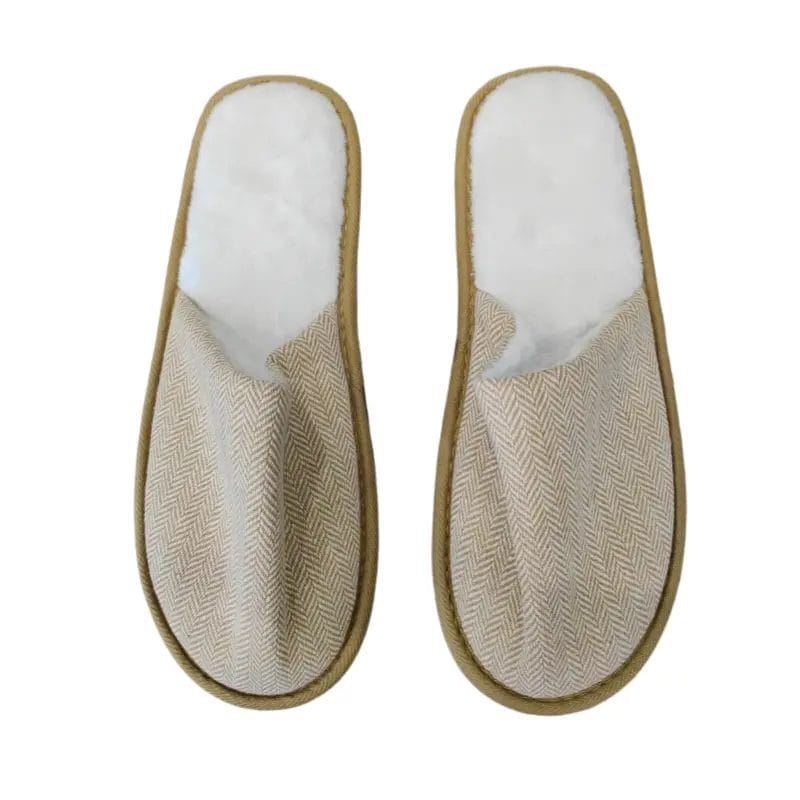
- Properties: Cork cushioning with textile uppers (often cotton‑linen); comfortable and breathable.
- Branding: Subtle woven labels or heel prints; eco‑packaging aligns well.
- Tips: Clarify what is certified—e.g., recycled content via GRS for textiles or FSC for packaging components.
- Explore an example: Eco slippers with cork soles.
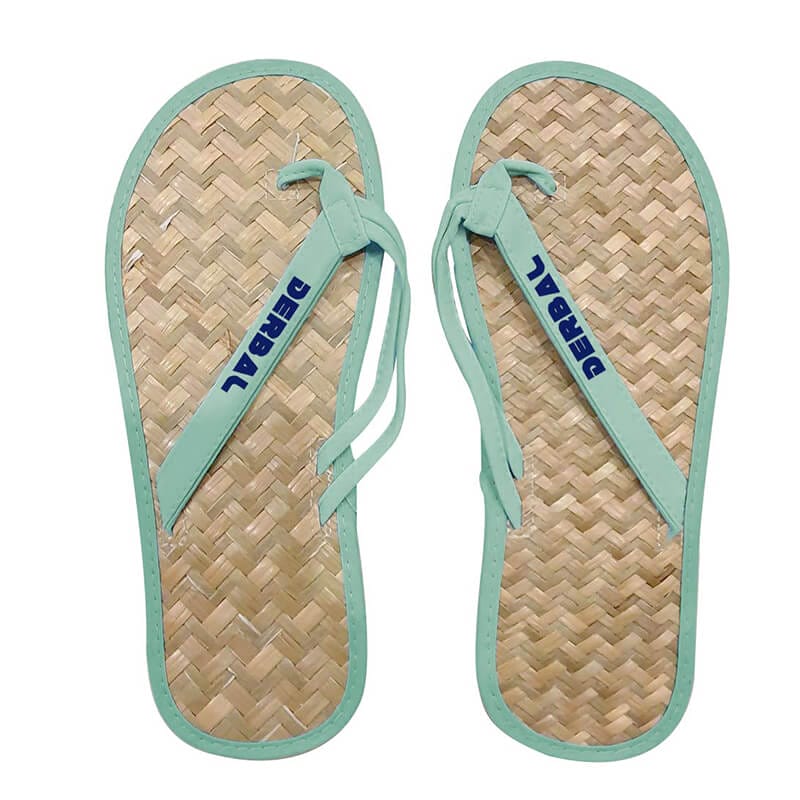
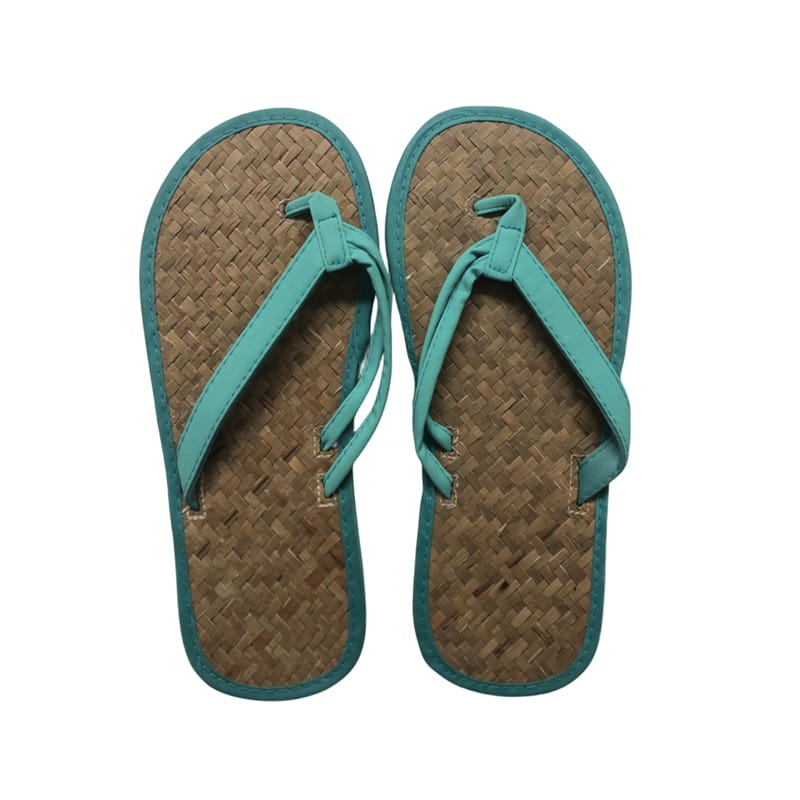
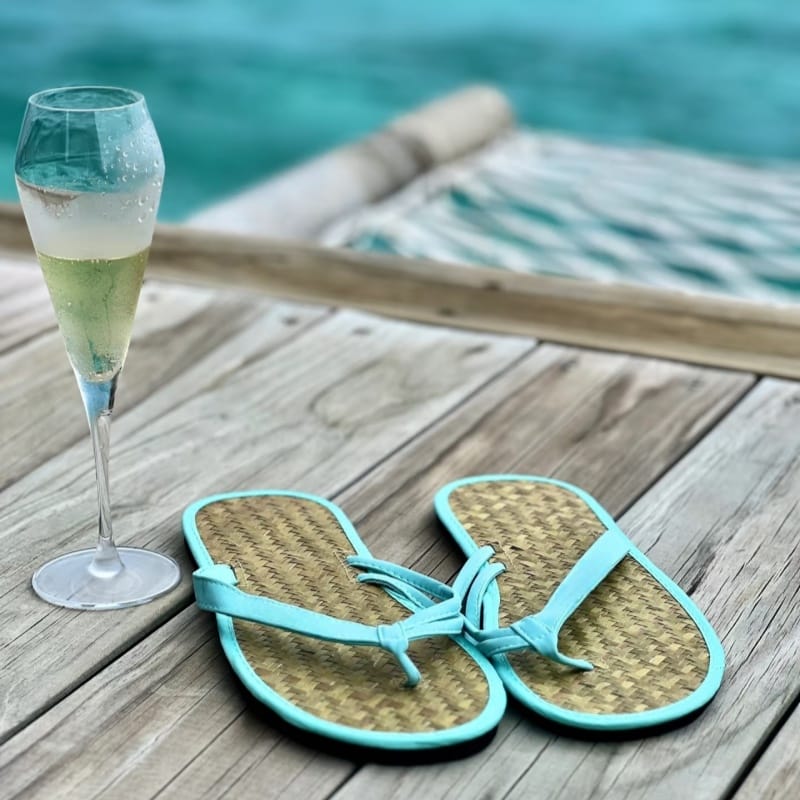
5) Natural straw outdoor slippers
Best for: Boutique beach paths and terraces where breathability and texture matter.
- Properties: Woven straw uppers; tactile feel; pair with EVA non‑slip outsoles.
- Branding: Woven tags or subtle prints.
- Tips: Not ideal for prolonged soaking; use for dry walks to loungers and terraces.
- See an example: Natural straw eco outdoor slippers.
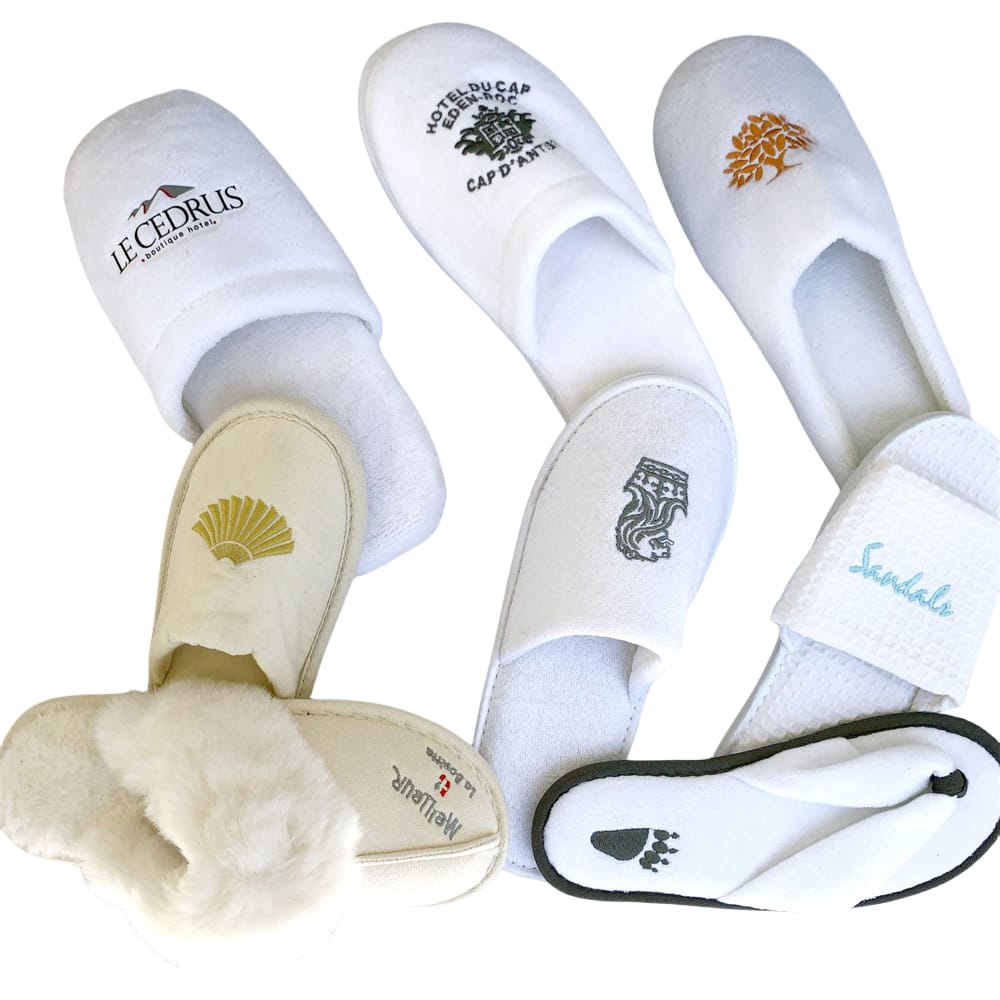
6) Waffle spa slippers (indoor/spa crossover)
Best for: Indoor spa areas, suites, and turndown; complements beach SKUs for a full amenity set.
- Properties: Soft textile uppers (waffle/terry/velour) with EVA or foam soles; not for wet decks.
- Branding: Embroidery or print; color piping options.
- Tips: Keep these to dry zones; confirm laundering or sanitation instructions if reusable.
- Explore options: Waffle spa slippers and Microfiber slippers.
7) Velvet or premium fabric slippers
Best for: Premium villas and suites; indoor use and photo‑worthy turndown moments.
- Properties: Plush handfeel; brand colorways; EVA or foam midsoles.
- Branding: Embossed heel badge or embroidery.
- Tips: Reserve for indoor or dry terrace use; ensure guest‑size coverage.
- Example page: Velvet hotel slippers.
Customization and branding at scale (the lead differentiator)
Customization is where Beach Slippers stop being commodities and start carrying your brand. Decisions here determine MOQs, tooling, lead times, and budget. What impression do you want a guest to have the moment they slip these on by the pool—the quiet assurance of a debossed crest, or a playful pop of color that matches the parasols?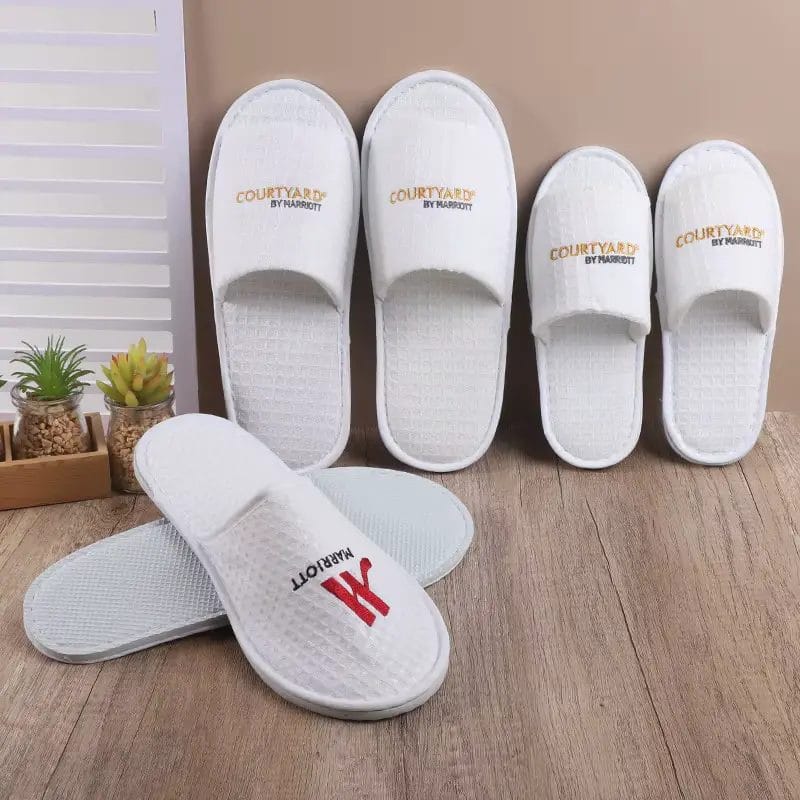
What to define early:
- Logo method: Emboss/deboss on footbeds (durable and subtle) vs. strap printing (high visibility). Confirm artwork sizes and acceptable variance.
- PMS color matching: For straps, footbeds, and prints. Note that color deltas can occur between materials; agree on tolerances.
- Packaging: From simple pair wraps to FSC‑certified boxes or reusable bags. In humid/tropical regions, moisture‑barrier poly and desiccants reduce mold risk.
- Size runs: Regionally appropriate men/women/children ranges; some resorts prefer unified unisex runs (e.g., S‑M‑L‑XL) to streamline logistics.
Artwork and sampling workflow that procurement teams trust:
- RFQ stage: Provide vector artwork, exact Pantone codes, logo placements, and size matrices. Request photos of prior similar executions.
- Pre‑production sample: Approve color, placement, and finish; check comfort and traction on site.
- First‑article photo sign‑off: Factory photos of initial bulk pairs before full run.
- Production QC: Spot checks on color, logo adhesion/relief depth, and size labeling.
Procurement playbook: from RFQ to room opening
This section translates real‑world cost and time drivers into a plan you can run.
Spec fields that make RFQs apples‑to‑apples
Provide complete specifications so vendors can quote accurately and you can compare responses fairly.
- Materials: Outsole compound (EVA/rubber/PVC/TPE), density/durometer if available; outsole thickness; tread description.
- Uppers/straps: Material, color, stitching details.
- Branding: Method (emboss/deboss/print), placement, artwork dimensions.
- Colors: PMS codes; number of colorways; acceptable variance.
- Sizes: Regional runs (EU/US/UK) or unisex S‑XL; children’s sizes if needed.
- Packaging: Unit wrap/box; moisture‑barrier and desiccants for tropics; FSC option.
- Documentation: Any available slip‑test reports (ASTM F2913/SATRA TM144), OEKO‑TEX scope certificates, GRS declarations for recycled components, FSC COC for packaging.
- Commercials: MOQ; tiered pricing by volume; sample and bulk lead times; INCOTERM and port; defect tolerance and rework policy; carton dimensions/weight; pallet plan.
Indicative MOQs, lead times, and pricing bands
- MOQs: Basic textiles hundreds of pairs; customized EVA/PVC slides often 1,000–5,000+ depending on branding and molds.
- Lead times: Samples typically 7–10 days after artwork; bulk 25–45 days after approvals and deposit (capacity and customization can push this).
- Pricing: Directional bulk ranges often ~$0.79–$4 for EVA/rubber basics; eco/premium builds $4–$7+; complex branding can be higher. Treat as planning context; secure live quotes for accuracy.
Lead‑time planning by destination (buffers included)
| Lane | Ocean transit reference | Practical buffer | Booking guidance |
|---|---|---|---|
| China → SE Asia hubs (e.g., Thailand) | ~6–12 days on intra‑Asia loops | +7–14 days | Book 3–4 weeks ahead of cargo ready date |
| China → Colombo (Sri Lanka) | ~32–40 days via Asia–Med loops (via‑Cape patterns) | +14–21 days | Book 6–8 weeks ahead; watch peak seasons |
| China → Malé (Maldives) | Via Colombo + feeder +2–5 days | +14–21 days | Same as above; confirm feeder schedules |
Carrier schedules shift; verify with your forwarder. See carrier docs and market updates for planning context, e.g., MSC’s via‑Cape network and Maersk APAC market updates.
Consolidated shipping and OS&E/FF&E coordination
- Carton labeling: Include SKU, size, color, destination location, and project phase; barcode/QRs ease receiving.
- Moisture control: Moisture‑barrier poly, desiccant packs, sealed pallets; store off the floor.
- Ship‑window alignment: Tie arrivals to pre‑open/renovation milestones; reserve delivery slots.
A neutral example of process coordination: Some procurement teams work with suppliers like DERBAL to synchronize pre‑production samples, size‑run confirmations, and carton labeling schemas with OS&E consolidation windows. The point isn’t the vendor name—it’s the discipline of approvals and logistics so beach slippers land in rooms on time.
Sustainability and hygiene documentation buyers can trust
Sustainability: Be precise about what’s certified and what isn’t.
- OEKO‑TEX STANDARD 100: Applies to textiles (uppers/linings). Request scope certificates for the components you’re buying; don’t imply whole‑product coverage unless applicable. See OEKO‑TEX STANDARD 100 overview.
- GRS (Global Recycled Standard): Relevant for recycled EVA or textile components. Ask for chain‑of‑custody evidence when “recycled content” is claimed. See Textile Exchange’s program FAQs for how brands substantiate recycled claims: Textile Exchange guidance.
- FSC: For paper/wood‑based packaging elements; verify chain‑of‑custody. See FSC trademark and COC guidance.
Hygiene and reuse protocols: Align with general public‑health principles for non‑porous items around aquatic venues.
Provide clear, property‑specific SOPs. Clean to remove soils (detergent + warm water), then disinfect with an appropriate, registered product; respect label dwell times; and allow full air‑drying before redistribution. Store cleaned slippers in dry, ventilated areas away from wet decks. Public‑health resources for aquatic venues offer context your safety team can adapt, such as the CDC Model Aquatic Health Code annex materials.
Case notes and project vignettes (anonymized)
Until partner permissions and auditable metrics are available, keep examples neutral and process‑focused. The following scenarios reflect typical resort programs.
Tropical pre‑opening, 200 keys, island destination
- Context: Pre‑open OS&E kit with villa pathways on boardwalks and sand; high humidity and salt air.
- SKU mix: EVA beach slippers for pool/wet decks; rubber flip flops for pathways; waffle spa slippers for suites.
- Branding: Embossed heel logo on EVA; two‑color strap print on rubber; embroidered logo on waffle.
- Logistics: Book 6–8 weeks ahead; aim for Colombo transshipment + feeder; add 14–21‑day buffer. Moisture‑barrier poly + desiccants; clear carton labeling by villa wing.
Large renovation rollout, 500 keys, regional hub property
- Context: Phased floor closures; OS&E replenishment alongside FF&E swaps.
- SKU mix: PVC slides for durability in family zones; EVA pool slippers; velvet indoor slippers for premium suites.
- Branding: PMS‑matched straps; protective coating over prints.
- Logistics: Consolidate SKUs with other OS&E to a single cross‑dock; reserved delivery windows; first‑article sign‑off photos to keep production on schedule.
High‑turnover all‑inclusive, 350 keys, coastal mainland
- Context: Heavy daily use; frequent sanitation; need rapid replenishment.
- SKU mix: PVC slides and rubber flip flops; waffle slippers limited to spa.
- Branding: Simple, high‑contrast prints for visibility.
- Logistics: Shorter, more frequent replenishment cycles; vendor holds safety stock after initial bulk run per agreed SLA.
Common procurement questions, answered
Do we need lab slip‑test reports? They help in early screening, but on‑site wet‑deck trials on your actual surfaces make the final call. Many teams find the combination of a credible lab report plus a short in‑property pilot the most reliable path.
What size runs work best? Unisex S‑XL simplifies pick/pack and storage. For family segments, add children’s sizes and increase the M/L allocations to match guest demographics.
How do we prevent mold in storage? Use moisture‑barrier poly and desiccants, palletize and elevate cartons, and maintain good airflow. Rotate stock first‑in, first‑out, especially in tropical climates.
What’s the fastest lever to cut unit cost? Limit colorways and reduce logo complexity. Then look at volume tiers and align with dependable ship windows so you’re not paying for airfreight.
Next steps and resources
If you’re building a spec, start with the RFQ template above and the SKU taxonomy. For deeper context and examples of materials and branding options, you can review product pages such as Beach Slippers Flip Flops (rubber/EVA wholesale) and Custom Hotel Slippers for beach use on resort‑focused supplier sites. When you’re ready to compare samples or align ship windows with OS&E consolidation, a supplier like DERBAL can support artwork matching, pre‑production sampling, and coordinated shipping within your FF&E/OS&E timeline.