Noise complaints, damaged doorframes, and staff fatigue are the hidden operational costs of cheap trolleys.
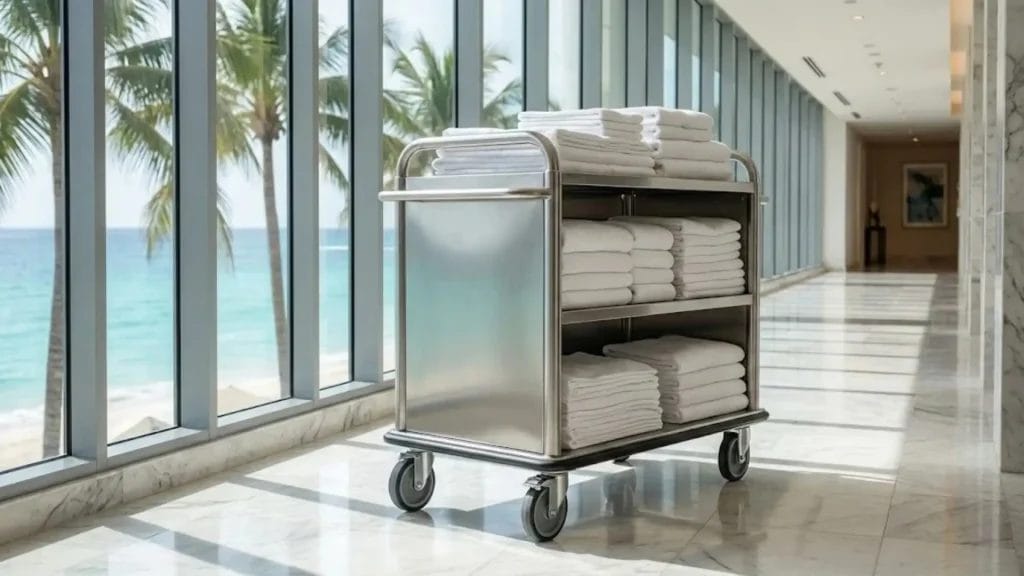
You know the sound: a rattling cart on polished marble at 6 a.m. Guests glance up. Housekeeping slows down to fight a sticky wheel at the lobby threshold. A five-minute delay becomes a fifteen-minute backlog. One small hardware choice—a wheel, a bearing, a bumper—sets the tone for the entire shift.
This guide shows hotel and resort leaders across Asia, the Middle East, and Africa how to spec a heavy duty laundry trolley (also known as a commercial linen cart or bulk truck) that runs quiet on stone floors, protects finishes, reduces strain on staff, and pays for itself through fewer incidents and faster cycles. We’ll keep it vendor-agnostic, bring in standards where they’re useful, and add an on-property case study so you can estimate your own ROI.
Key Takeaways
-
The 80/20 Rule: Caster assemblies (diameter, tread, bearings) and frame material decisions drive most outcomes—noise, rollability, floor protection, and lifespan.
-
For Marble/Granite: Specify non-marking PU or TPR treads, sealed precision bearings, and 125–150 mm wheels; combine two fixed + two swivel with total locks.
-
Coastal Protection: Coastal and high-humidity properties should prioritize 316 stainless steel or add coatings and strict maintenance if using 304/aluminum.
-
Ergonomics Matter: Keep handles near elbow height and push/pull forces within practical guidance values to reduce fatigue and risk.
-
Modular Accessories: Dividers, covers, bumpers, and liners cut sorting time, reduce scuffs, and protect guest experience—small additions with outsized impact.
What “Heavy Duty” Really Means for Hotel Laundry Trolleys
In hospitality, “heavy duty” is not a marketing slogan; it’s a set of choices you can test on-property. A true heavy duty laundry trolley should keep its geometry under load, resist corrosion in humid back-of-house areas, roll quietly across polished stone, and survive daily sanitizing routines.
- Start with the Frame Thick-gauge stainless tubing with reinforced corner welds prevents racking when you push off from a standstill. Check weld beads where vertical members meet base frames; those joints carry the highest torsional loads when turning with a full linen stack. A rigid frame keeps casters aligned, so wheels roll instead of scraping.
- Audit Liners and Tub Interfaces If you use soft bags, attachment points should be grommeted metal or molded-in slots that don’t tear under repetitive loading. For rigid tubs, the interface to the frame needs mechanical retention—bolts or clamps—so the tub can’t shift and overload one side.
- The “Push Test” Finally, audit the claim to “heavy duty” with acceptance tests: load the trolley to your typical peak, then push it through your most challenging route—lobby stone, elevator thresholds, service corridor tiles. Listen for noise, feel the starting resistance, and watch for sway. A quality laundry trolley should feel boring: stable, quiet, predictable.
Materials That Survive Humidity, Salt, and Sanitizers
Environmental realities: From the Maldives to Marrakesh Every region adds its twist. Coastal resorts in the Maldives or Phuket battle salt and humidity that eat 304 stainless for breakfast. Desert campuses in Saudi Arabia or Egypt deal with fine sand that destroys unsealed bearings.
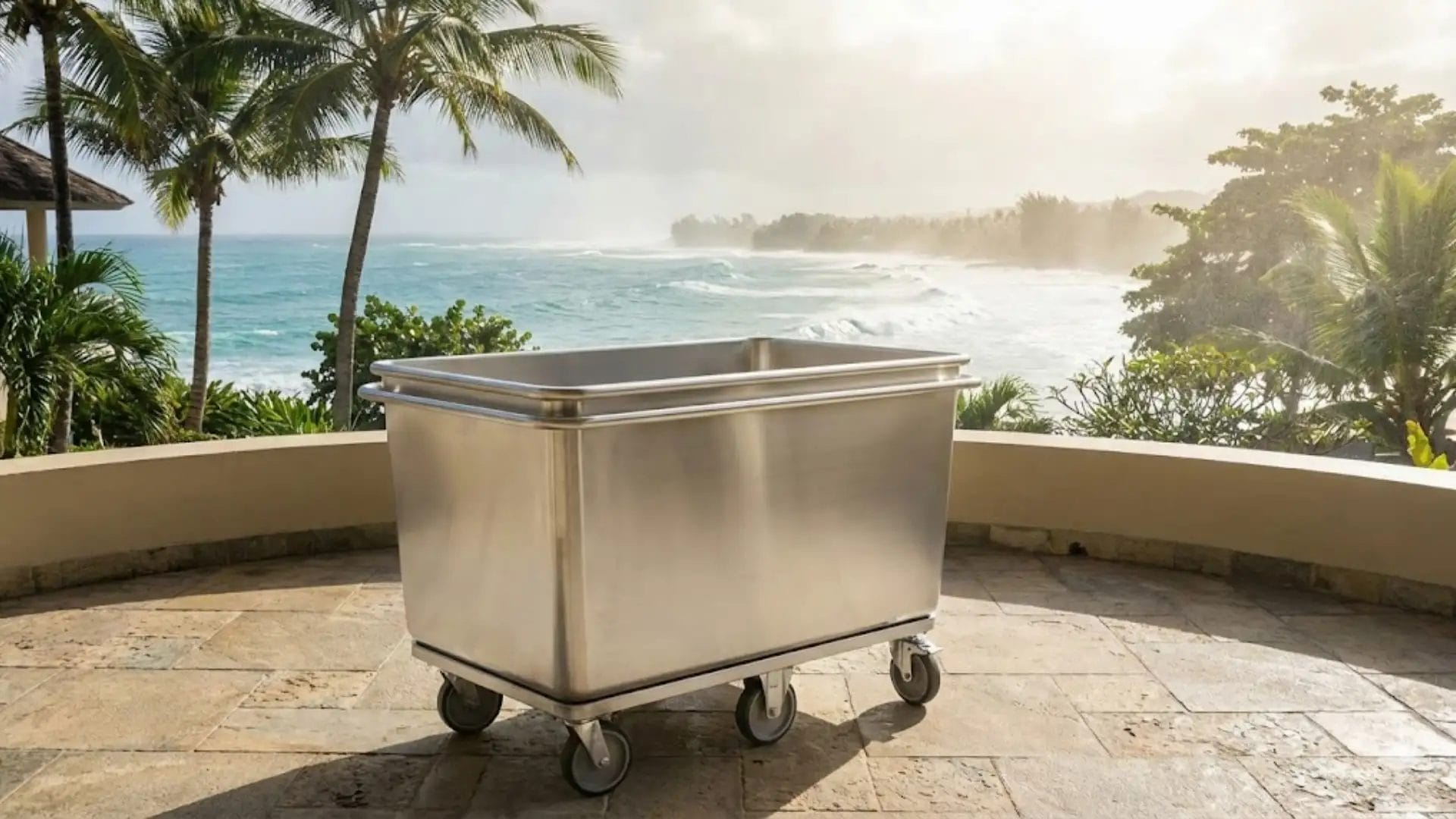
Properties near the coast or in humid climates deal with a quiet destroyer: chloride-laden moisture. Type 316 stainless steel includes molybdenum and offers markedly better resistance to chloride pitting and crevice attack than 304. That’s why materials bodies recommend 316 for coastal exposure; 304 can pit without vigilant upkeep.
(Reference: See the Stainless Steel Industry of North America and International Molybdenum Association’s guidance in the presentation Selecting Stainless Steel for Optimum Performance, which explains why 316 resists chloride attack better than 304.)
Aluminum is lighter and corrosion-resistant in many contexts thanks to its oxide layer, but pay attention to galvanic pairs—mixing aluminum with stainless fasteners without isolation can invite corrosion in humid, salty environments. Heavy-duty polymers don’t rust, simplify cleaning, and resist chemicals, though they can degrade under UV or deep impacts if not designed properly.
Whatever you choose, the maintenance plan matters as much as the material. For coastal properties, add a weekly freshwater rinse to remove salt residue from frames and casters. A solid frame with neglected hardware will not feel “heavy duty” for long.
The Caster Decision That Decides 80% of Outcomes
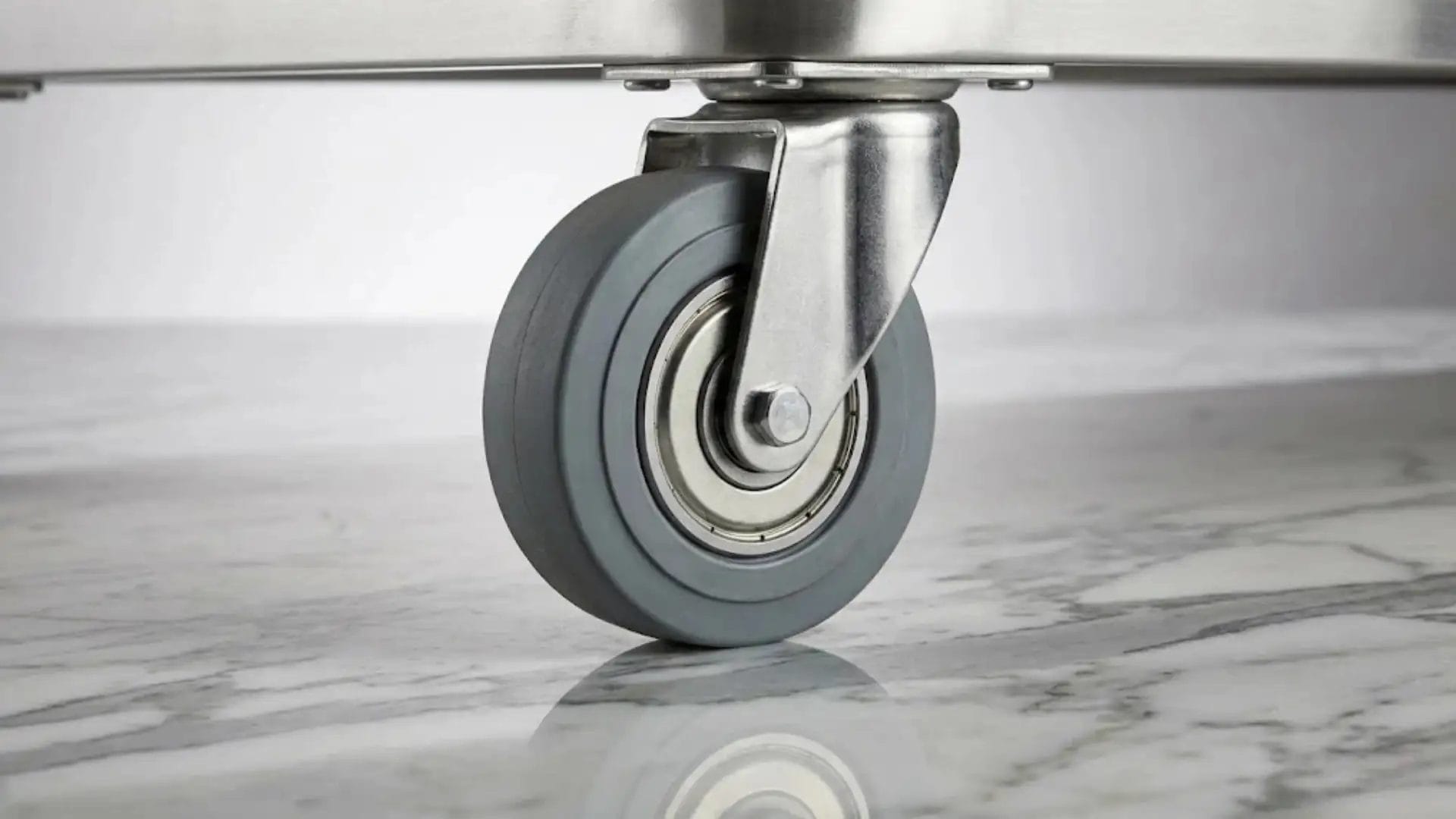
Ask housekeeping what makes a hotel linen cart feel heavy. Nine times out of ten, they’ll point to the wheels. Casters determine starting resistance, turning effort, noise, and floor protection. Get this wrong, and everything else becomes damage control.
-
Diameter and Geometry: Wheel diameters from 100–200 mm (4–8 inches) are typical. For hotel laundry trolleys on marble or granite, 125–150 mm (5–6 inches) is a reliable sweet spot: larger wheels reduce rolling resistance, bridge small gaps smoothly, and lower contact pressure on stone surfaces. They also roll over door thresholds without the jarring “thunk” that wakes a lobby.
-
Tread Compounds: Choose non-marking polyurethane (PU) or thermoplastic rubber (TPR) treads for polished floors. PU offers excellent durability and low rolling resistance. Softer TPR can further dampen noise on hard surfaces, though it may wear faster under high loads.
-
Bearings: Sealed precision ball bearings reduce both start-up and sustained push forces and keep grit out—crucial in sandy or dusty regions.
-
Locks and Layout: A common configuration uses two fixed casters on one end and two swivel casters (with total locks) on the other. This setup stabilizes the path down long hallways while allowing maneuverability around tight corners.
| Component | Specification Requirement |
| Frame | 316 stainless steel frame preferred for coastal/humid sites; alternatives (304 SS or aluminum) require protective finishes and documented cleaning protocol. Reinforced corner welds at high-stress joints. |
| Casters | Four total; two fixed + two swivel with total locks. Wheel diameter 125–150 mm; tread compound non-marking PU or TPR; sealed precision ball bearings; corrosion-resistant hardware. Vendor to declare compliance with applicable ISO/EN castor load and durability tests (e.g., ISO static/dynamic protocols, ISO 22882 or EN/DIN equivalents). |
| Ergonomics | Handle height near elbow height (approx. 90–110 cm). Provide measured cart weight (empty) and maximum recommended load; demonstrate acceptable starting and sustained push forces on representative floors. |
| Accessories | Removable linen dividers; soft/zippered cover for guest-facing corridors; perimeter bumpers; washable liners with secure attachment points; spare kit: two wheels, fasteners, bumper segments. |
| Hygiene & Maintenance | Non-porous, easy-clean surfaces; weekly freshwater rinse for coastal sites; monthly inspection of casters and fasteners. Provide cleaning and lubrication SOP. |
| Acceptance Tests | Rollability and noise on representative marble/granite; threshold traversal; brake hold on elevator and mild slope; turning circle in corridor without wall contact. |
Ergonomics and Safety Your Team Can Feel
Good ergonomics keep people safe and productive. Two principles do most of the work: handle height near elbow height, and push/pull forces kept within realistic guidance values.
Handle Height Placing handles around elbow height lets staff keep their arms close to their torso and minimizes shoulder strain. Many trolley designs fix this around 90–110 cm for average adults. This keeps posture neutral when starting, turning, and stopping—especially important with heavier loads.
Push/Pull Forces For procurement, a practical reference is the Canadian Centre for Occupational Health and Safety’s guidance: initial (start) forces ideally below about 320 N for males and 220 N for females. Use these as orientation values and test on your actual floors.
Capacity, Organization, and Modular Accessories
Capacity is obvious: the trolley must handle peak linen volumes. The less obvious gains come from how you organize those linens.
-
Dividers and Covers: Removable dividers prevent mixing housekeeping categories—towels, sheets, duvets. A soft or zippered cover hides clutter in guest-facing corridors and blocks dust in outdoor breezeways.
-
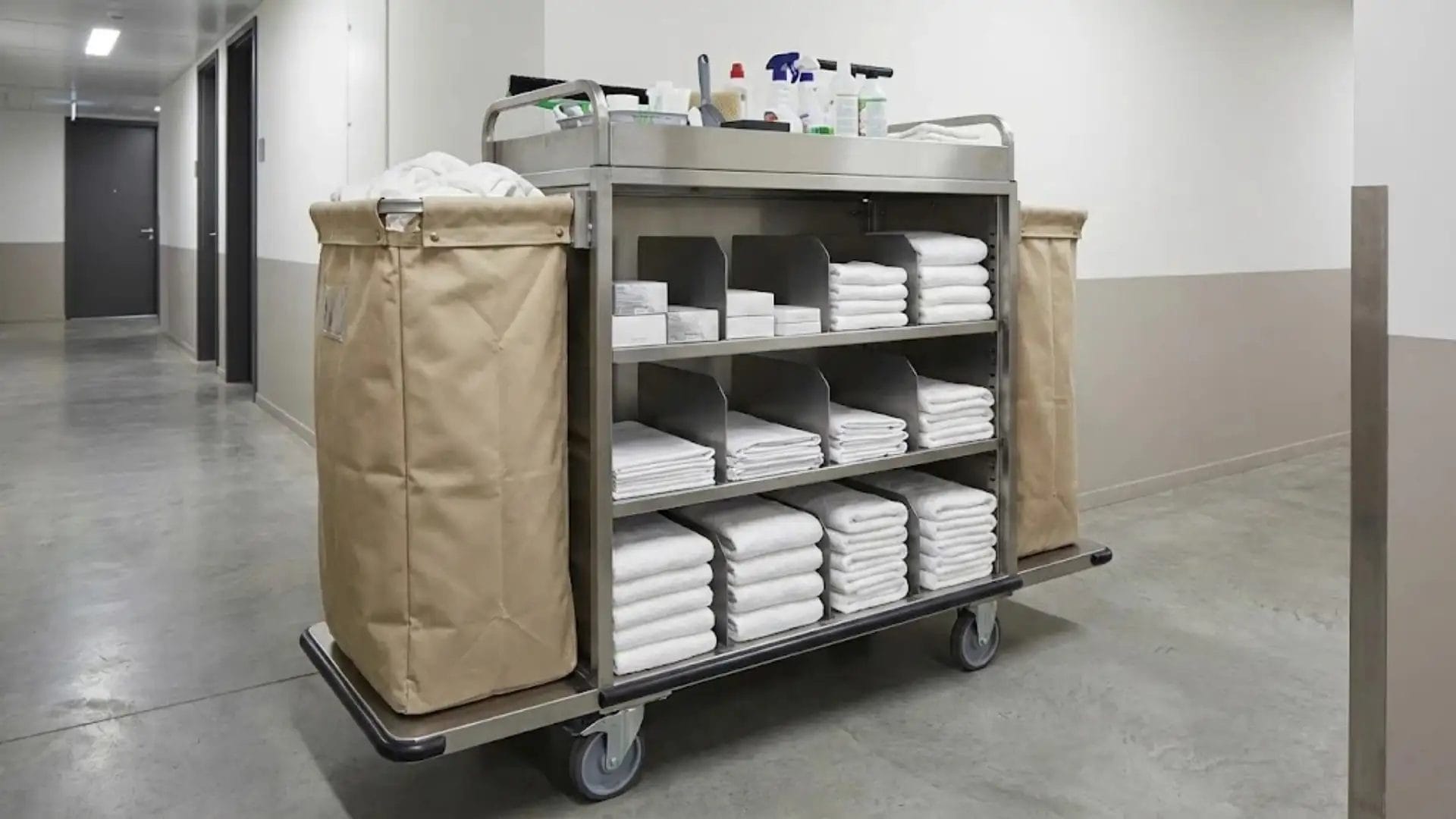
Bumpers and Liners: Soft perimeter bumpers save door frames and stone edges from scuffs. Washable liners reduce cross-contamination. If you need examples of durable liners, review the canvas laundry bag for hotels and hotel cotton laundry bag options on our site, which illustrate attachment points appropriate for housekeeping trolleys.
ROI Modeling: How the Trolley Pays for Itself
Hotel teams often feel the cost of a poor trolley, but finance needs numbers. Here’s a transparent way to model ROI using conservative assumptions.
- Labor Time Savings Oversized, low-noise casters with sealed bearings reduce rolling resistance. If that trims 5–10% from each route’s travel time, and your team completes 30 routes per day, you’ve freed 1.5–3 routes’ worth of time. That time can be reallocated to room readiness.
- Breakage and Incident Reduction Bumpers and stable frames reduce scuff incidents in corridors. If you record 20 minor scuffs per month and a post-upgrade program reduces that by 25%, you cut rework time for engineering while protecting your finishes.
- Replacement Cycles Non-marking PU or TPR with sealed bearings typically outlast hard resin alternatives because grit and moisture are common. Extending wheel replacement intervals by 20–40% accumulates significant savings across a fleet of heavy duty laundry trolleys.
Composite Case Study: 5-Star Beach Resort, Middle East
Property Profile: A 380-key beachfront resort with marble lobby and guest corridors, long outdoor breezeways exposed to salt air.
The Intervention: The resort replaced eight aging carts with heavy duty laundry trolleys spec’d as follows: 316 stainless frame, 150 mm non-marking PU wheels with sealed precision bearings, and soft perimeter bumpers.
Six-Week Outcomes:
-
Average route time dropped from 26 to 23.5 minutes (−9.6%).
-
Minor scuff incidents fell from 18/month to 12/month (−33%).
-
Guest noise complaints referencing carts dropped to 1 per month.
Using standard labor rates, the time savings alone offset roughly 55% of the upgrade cost within the first year.
Practical Example: Configuring for Marble Floors & Humid Air
Disclosure: DERBAL is our product. Here’s how we typically configure a heavy duty laundry trolley for a luxury property with polished stone floors and salt exposure:
We specify 150 mm non-marking PU wheels with sealed precision bearings on a corrosion-resistant assembly, two fixed plus two swivel with total locks, and soft perimeter bumpers to reduce contact noise. For organization, we add removable linen dividers and a soft zippered cover. In coastal areas, the frame is configured in 316 stainless steel, paired with a spares kit (two wheels, fasteners, bumper segments) to keep downtime near zero.
If you’re evaluating broader housekeeping categories, our housekeeping solutions overview offers a useful starting point for scoping adjacent carts and modules.
Frequently Asked Questions:
What wheel size should we pick for marble floors?
For most hotel laundry trolleys on marble or granite, 125–150 mm (5–6 inches) hits the balance of low rolling resistance, obstacle handling, and quiet operation.
Which tread is best—PU or TPR?
If you prioritize longevity and low rolling resistance, non-marking PU is a strong default. If your property is extremely noise-sensitive, a softer TPR can dampen sound further; just budget for slightly faster wear under heavy loads.
How do we keep noise low after six months?
Sealed bearings, regular rinse-and-dry routines in humid or dusty environments, and intact perimeter bumpers are the trifecta. If noise creeps up, clean treads and check swivel raceways for grit.
Ready to upgrade your fleet?
Contact DERBAL today to spec the ultimate heavy duty laundry trolley for your resort. Don’t let a rattling cart define your guest experience.