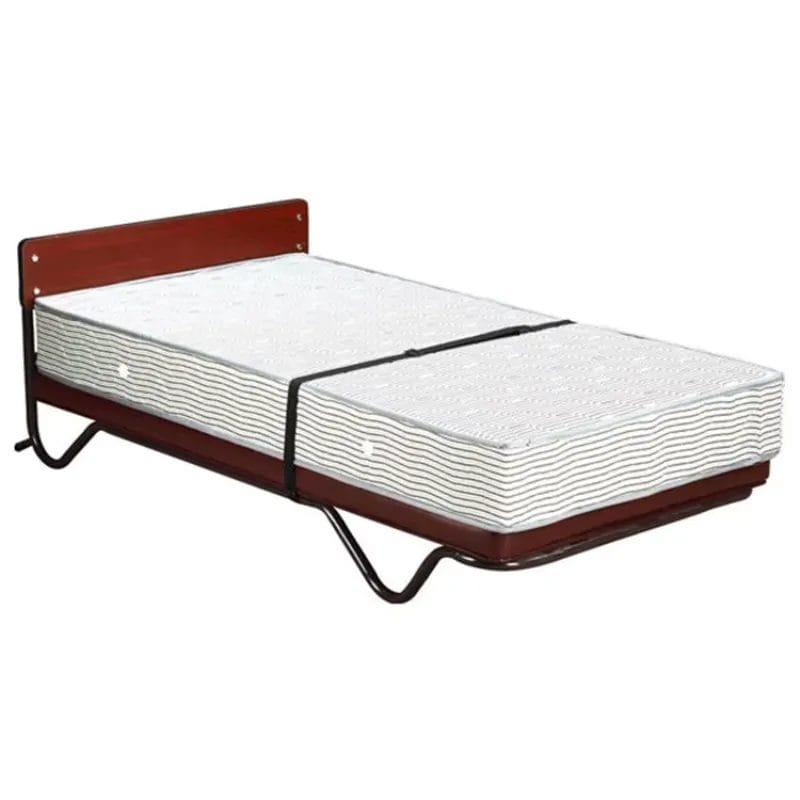
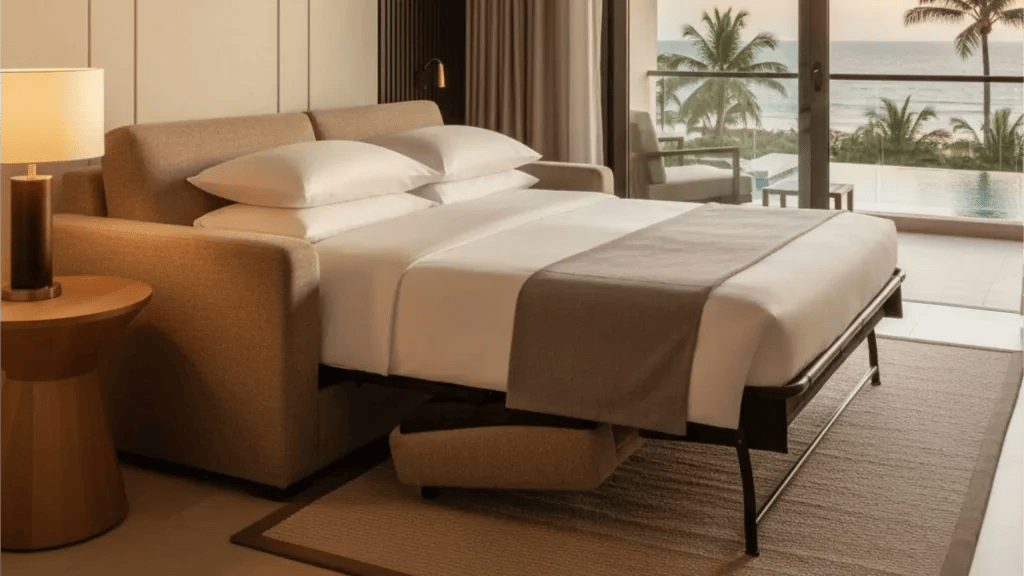
Commercial hotel sofa beds are not just sofas with a folding mattress. In hospitality, “commercial grade” means flame-resilient upholstery systems, heavy-duty mechanisms engineered for daily cycles, frames that pass contract seating durability tests, and finishes that survive housekeeping. Done right, a hospitality sleeper sofa can convert a standard room into a flexible family-ready layout—supporting segment mix and, by extension, RevPAR—without adding inventory or knocking down walls.
In this guide, we write from a supplier/distributor and solution expert perspective. Our goal is simple: help you specify the right model, mechanism, and materials so you don’t waste money and you stay compliant across regions.
Key takeaways
- Comfort first: Pair a compatible mechanism with a 4–5 in (≈10–12 cm) high-density foam or memory-foam mattress to close the “comfort gap.” Avoid over-thick residential mattresses that won’t fold correctly.
- Verify space: Plan with closed width and open depth. Queen sleepers commonly need 80–90 in (203–229 cm) of open depth; always check the model’s spec sheet.
- Choose the right mechanism: Pull-out (bi-fold) often wins on comfort with engineered foam packs; flip-over (tri-fold) is fast to set up and footprint-efficient.
- Build for durability: Look for ANSI/BIFMA lounge/public seating compliance, steel frames, and fabrics ≥30,000 Martindale with stain-resist treatments.
- Stay compliant by region: US projects often reference TB117-2013 and NFPA 260/261; some occupancies may require ASTM E1537 full-item tests. UK/Middle East frequently request BS 5852 (Crib 5) and BS 7176 classes; EU leans on EN 1021-1/2 composites.
- Make maintenance easy: Removable/washable covers and replaceable mattresses reduce lifecycle cost. Plan biannual mechanism inspections and light lubrication.
- Project logistics: Target project MOQs (e.g., 10+ units), align lead times, and collect fire and durability documentation in your RFQ.
What Makes “Commercial Hotel Sofa Beds” Different?
Commercial grade means the product is engineered for contract use, not residential. In practice, that includes:
- Fire performance tested to the market’s standard. In the US, material selection often references TB117-2013 and component/composite tests per NFPA 260 and NFPA 261; certain occupancies reference full furniture fire tests such as ASTM E1537 for heat release in room tests (see the method at the official standard page in ASTM E1537-22 and the NFPA listings for NFPA 260 (2024) and NFPA 261 (2023)). In the UK and Middle East, hospitality specs often call for BS 5852 Crib 5 or hazard classifications under BS 7176; in the EU, seating composites are typically assessed to EN 1021-1/2.
- Structural durability validated against contract benchmarks. For public and lounge seating, the reference is ANSI/BIFMA X5.4 (2020 revision expanded the scope), with heavy-duty categories covered by X5.41 for large occupants; see BIFMA’s update note in “BIFMA Revises Standard For Seating In Public Spaces”.
- Heavy-duty mechanisms and frames. Steel frames and reinforced decks are preferred over light residential wood constructions for daily/weekly conversion cycles.
- Performance upholstery. Fabric with ≥30,000 Martindale cycles, stain-resistant finishing, and where required, FR back-coating or barrier components.
- Maintainable design. Removable/washable covers and replaceable mattresses simplify housekeeping and keep rooms in rotation.
Regulatory note: Always verify local code requirements and hotel brand standards. UK hospitality also relies on practical guidance like VisitBritain’s overview of furniture fire safety for businesses; see the official summary in VisitBritain’s Pink Book guidance (2023).
The Comfort Gap—and How to Close It
If you’ve ever heard a guest say, “Why are hotel sofa beds uncomfortable?” you’re not alone. Historically, many sleepers used thin spring packs that compressed under adult weight and telegraphed bars or joints. The quickest path to comfortable hotel sofa beds today is pairing the right mechanism with a modern foam mattress.
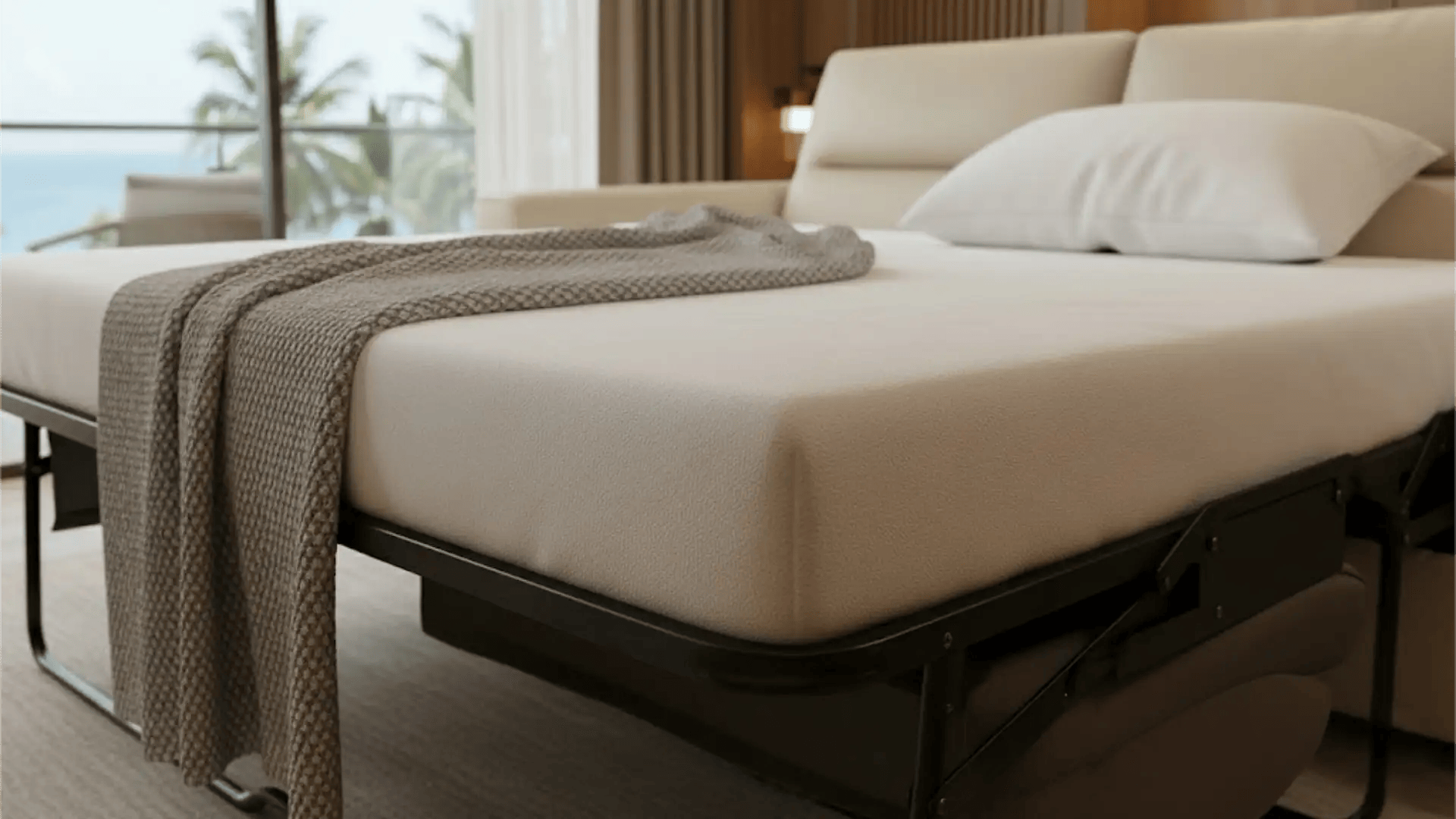
Here’s the deal: most commercial mechanisms are designed to fold a specific thickness profile. For many hospitality sleeper sofas, a 4–5 in (≈10–12 cm) high-density foam or memory-foam mattress provides a supportive, even surface without binding the mechanism. Overly thick residential mattresses often refuse to fold properly, stressing hinges and shortening the product’s life.
- Pull-out (bi-fold) sleepers typically require thinner foam profiles to fold cleanly. Comfort improves dramatically when you move from old spring packs to high-density foam engineered for sleeper use.
- Flip-over (tri-fold) systems create the sleep surface from seat/back cushions. They can accept slightly thicker foam builds, but you still need to confirm compatibility. Some designs feature platform decks that eliminate the feel of crossbars.
For procurement, “source comfortable hotel sofa beds” by making mattress/mechanism compatibility a line item in your RFQ, including allowable thickness and foam density. Ask vendors to document maximum mattress thickness and the exact foam construction they supply for the mechanism.
Hotel Sofa Bed Dimensions
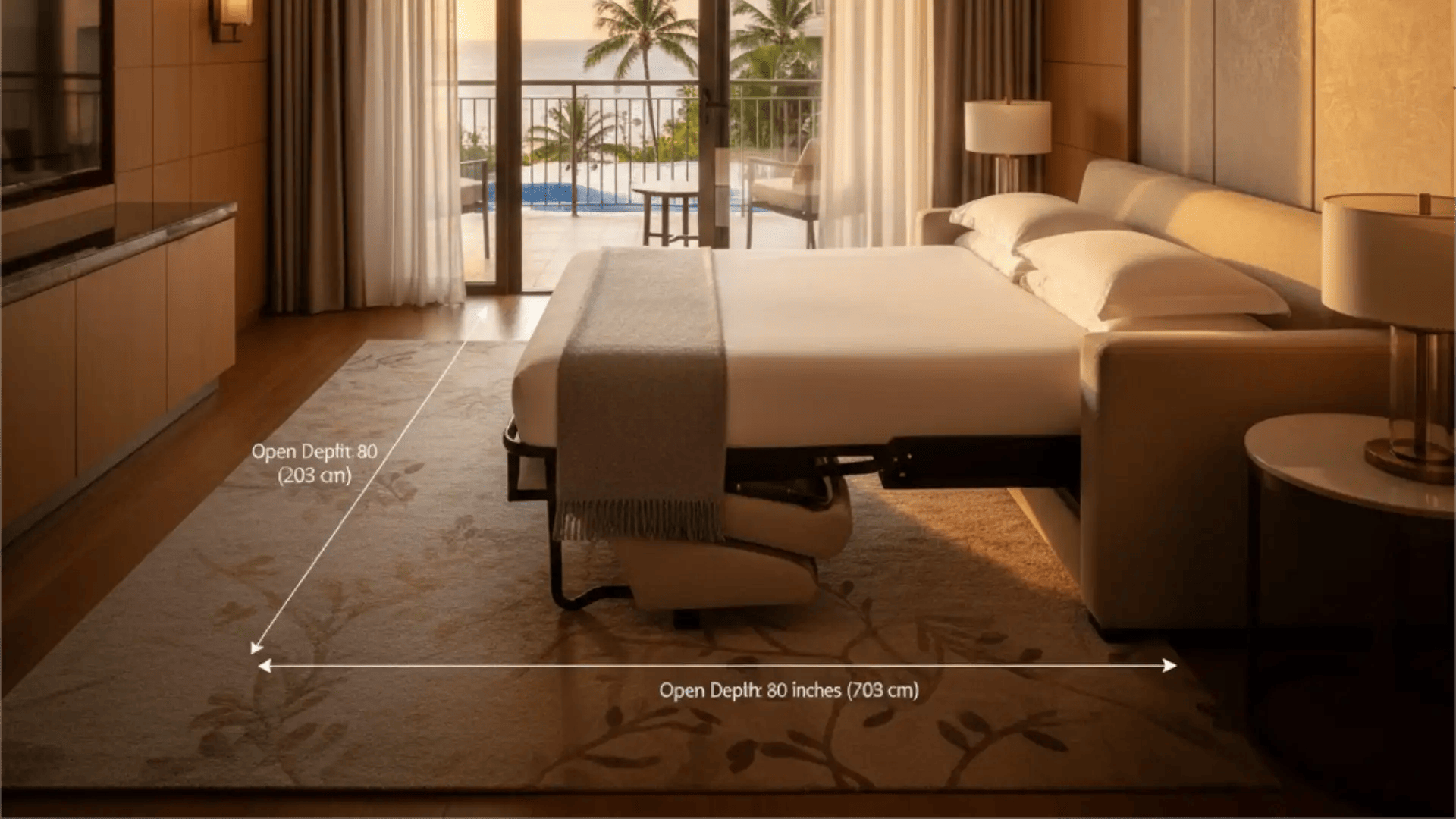
Space planning is where projects either fly or get bogged down. The key variables are closed width (how much wall the sofa occupies) and open depth (how far the bed extends into the room). Clearance in front of the bed for safe egress and access to storage/media units is just as important.
Below are typical ranges used by contract suppliers. Because models vary, treat these as planning guides and verify each shortlisted model’s spec sheet. We include “sofa bed queen size dimensions” because queen is the most requested in full-service and upscale select-service projects; make sure your layout accommodates queen size dimensions and any door swing or circulation paths.
| Size class | Closed width (in / cm) | Open depth (in / cm) | Mattress width × length (in / cm) |
|---|---|---|---|
| Single/Chair | 28–40 / 71–102 | 70–78 / 178–198 | 30–39 × 72–78 / 76–99 × 183–198 |
| Full/Double | 48–66 / 122–168 | 75–84 / 190–213 | 48–54 × 72–80 / 122–137 × 183–203 |
| Queen | 68–86 / 173–218 | 80–90 / 203–229 | 60 × 75–80 / 152 × 191–203 |
Example spec patterns from established sleeper lines show open depths in the 80–90 in range for queen, with true 80 in sleep lengths and 5 in engineered mattresses. Always check the exact model drawing before finalizing floor plans.
Practical space-planning tips
- Maintain at least 24–30 in (61–76 cm) of clearance at the foot when open so guests can reach storage or balconies without climbing over bedding.
- Confirm power/USB placement; guests often charge devices on the side table adjacent to the sleeper, which must remain accessible when open.
- Note door swings and ADA routes; open depth must not block required egress paths.
Mechanism Types: Pull-Out (Bi-Fold) vs Flip-Over (Tri-Fold)
Both mechanism families can work well in hotels when specified correctly. The trade-offs are practical:
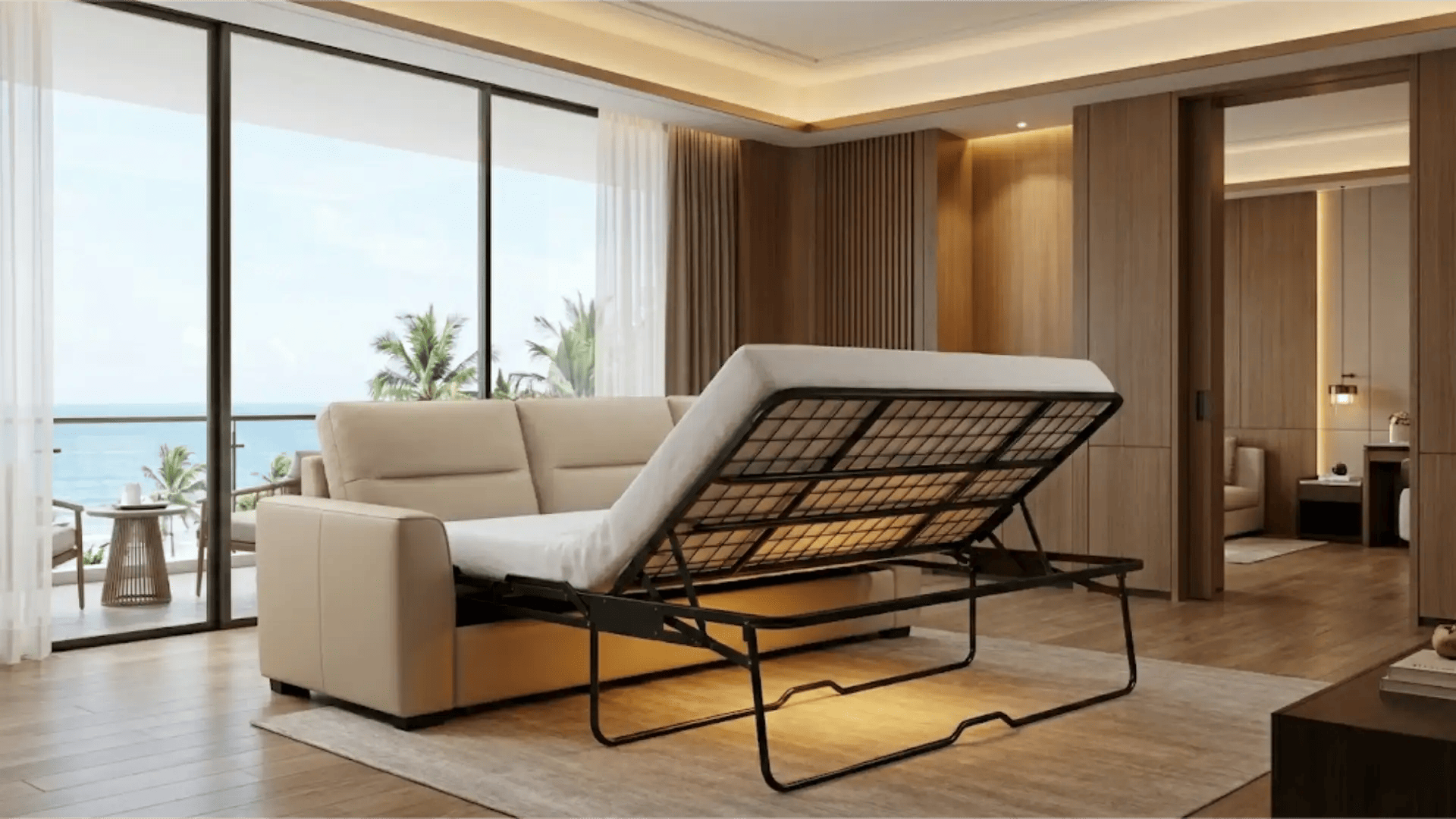
- Pull-out (bi-fold): Traditional design with a stowed mattress that unfolds. Pros: familiar for housekeeping, can deliver excellent comfort with engineered foam packs, and offers “true” sleep lengths in many models. Considerations: requires more open depth; mattress thickness is limited by fold geometry.
- Flip-over (tri-fold/convertible): Seat and back flip into a flat sleep deck. Pros: quick setup and often a more compact footprint with some zero-clearance backs. Considerations: support depends on the platform design; confirm that the foam/cushion build is engineered for nightly use, not just occasional.
Commercial vs residential frames is not a small distinction. Hotels need heavy-duty sleeper sofa frames, typically steel with reinforced cross-members, to withstand frequent conversion and multi-guest loads. Where properties serve large-occupant cohorts, consider mechanisms and frames designed to meet large-occupant categories, aligning to BIFMA X5.41 test expectations.
Durability & Maintenance for Hospitality Sleeper Sofas
On durability, treat hospitality sleepers as public and lounge seating first, and beds second. That means:
- Reference ANSI/BIFMA X5.4 for safety, durability, and structural adequacy, and consider X5.41 where large-occupant performance is required. BIFMA’s 2020 communication outlines the expanded scope for public spaces.
- Specify upholstery with ≥30,000 Martindale cycles as a baseline (40–60k where traffic is heavy), with stain-resistant finishing and, if needed, moisture barriers per brand standards.
- Require removable/washable covers or at minimum zippered cushion cases sized for housekeeping machines. Ensure the mattress is replaceable without disassembling the frame.
Simple maintenance practices extend life and guest satisfaction:
- Inspect mechanisms biannually for loose fasteners, uneven decks, or squeaks. Tighten hardware proactively.
- Apply a light silicone-based lubricant to pivot points per mechanism OEM instructions. Avoid petroleum-based products that attract dust.
- Rotate or replace sleeper mattresses on a planned cycle. Maintain spare covers and at least a small buffer of replacement mattresses in storage for quick swaps.
Procurement Standards, Documentation, and Project Logistics
Multi-region hotel portfolios need flexibility. When you issue RFQs, specify the standard you need by jurisdiction and ask for matching documentation:
- United States: Material/component smolder standards (TB117-2013) and component/composite cigarette/smolder tests (NFPA 260/261). For certain occupancies and jurisdictions, full furniture room-corner fire testing may be required; the current industry method is ASTM E1537-22. Confirm with local code officials and chain standards.
- United Kingdom / Middle East: Composite testing to BS 5852 (Crib 5). Many hospitality settings also classify performance per BS 7176 hazard categories; practical compliance guidance is summarized in VisitBritain’s fire safety page.
- European Union: Composite testing to EN 1021-1/2. Note that some countries retain additional national requirements; align with your local consultants.
Suggested RFQ documentation checklist:
- Fire compliance: Relevant composite and/or component test reports matching the delivered construction (cover, barrier, foam) and jurisdiction.
- Durability: ANSI/BIFMA X5.4 test summary (and X5.41 if seeking large-occupant capability).
- Fabric performance: Martindale/Wyzenbeek abrasion results, stain-resistance datasheet, any moisture barrier specs.
- Drawings: Closed width, open depth, and clearance diagrams; maximum mattress thickness allowed by the mechanism.
- Serviceability: Confirmation of removable covers and replaceable mattress access.
On logistics, position orders as project packages, not retail transactions: project-friendly MOQs (e.g., 10+ units), consolidated delivery windows, and spare parts kits. Lead times for custom fabrics or region-specific FR constructions typically span 8–12 weeks; build in approvals time for mock-ups and test reports.
Choosing the Right Model by Room Type
Start with the room’s function and footprint, then work backward:
- Select-service king rooms: A full/double sleeper often preserves circulation while providing child-friendly capacity. Confirm open depth versus media unit and balcony access.
- Family suites and long-stay: A queen sleeper supports adults and teens; double-check the “queen size dimensions” footprint and egress when the bed is open.
- Compact urban rooms: Sleeper chairs provide overflow without blocking door swings; prioritize zero-clearance backs and smaller open depths.
Think of it this way: the decision hinges on five numbers—closed width, open depth, mattress size, allowed thickness, and clearance. Match those to your brand’s comfort target and your jurisdiction’s fire documentation rules, and most of the risk disappears.
About our perspective
Disclosure: DERBAL is a vertical hotel supply specialist operating as a supplier/distributor and solution consultant. We support multi-region compliance (US, UK/Middle East, EU) and help project teams select mechanisms, materials, and documentation that meet brand standards without overspecifying.
Conclusion and next steps
The right commercial hotel sofa bed combines compliant materials, a compatible mechanism, and a serviceable design. Focus on comfort (4–5 in high-density foam or memory-foam mattresses that your mechanism supports), verify hotel sofa bed dimensions at both closed and open states, and anchor durability to ANSI/BIFMA with fabrics that resist abrasion and stains. Align fire documentation to each jurisdiction and insist on removable covers and replaceable mattresses to control lifecycle costs.
If you’re planning a renovation or a new build and want a layout-ready recommendation, consult a specialist for a custom floor plan assessment—including open-depth clearances, mechanism choice, and the exact compliance package your market requires.
FAQ
Q1: What is the difference between residential and Commercial Hotel Sofa Beds?
A: The main difference lies in durability and safety. Commercial hotel sofa beds are engineered with heavy-duty metal mechanisms and reinforced frames to withstand daily use and frequent opening/closing cycles. Unlike residential models, they must also meet strict fire safety standards (such as TB117-2013 in the US or BS 5852 Crib 5 in the UK) and use fabrics with high abrasion resistance (30,000+ Martindale cycles).
Q2: Why are hotel sofa beds often considered uncomfortable, and how do you fix this?
A: Discomfort usually comes from thin mattresses and support bars digging into the guest’s back. To solve this, we specify our commercial hotel sofa beds with high-density memory foam mattresses (4–5 inches thick) that provide superior support. We also use advanced bi-fold or tri-fold mechanisms that eliminate the “bar-in-the-back” feeling, ensuring your guests get a sleep experience comparable to a standard hotel bed.
Q3: What is the typical lifespan of a commercial grade sleeper sofa?
A: With proper maintenance, a high-quality commercial hotel sofa bed should last 5 to 7 years in a high-traffic hospitality environment. Key factors affecting lifespan include the mechanism’s quality (steel vs. alloy), the fabric’s durability, and whether the mattress is rotated regularly. At DERBAL, we offer models with replaceable mattresses and removable covers to extend the product’s service life significantly.
Q4: How much space do I need for a Queen size hotel sofa bed?
A: Space planning is critical. A standard Queen size commercial hotel sofa bed typically requires an open depth of 85–90 inches (approx. 215–230 cm) from the back of the sofa to the foot of the bed. You must also leave at least 24 inches of clearance around the bed for guests to walk safely. Always check the specific “open depth” dimension on the spec sheet before finalizing your room layout.
Q5: Can I customize the fabric to match my hotel’s interior design?
A: Yes. As a vertical supply expert, DERBAL allows full customization. You can choose from a wide range of commercial-grade fabrics that are fire-retardant, stain-resistant, and color-matched to your specific room decor. Whether you need a modern velvet finish or a durable woven texture, we ensure the material meets commercial hotel sofa bed standards for both aesthetics and performance.